

Companies turn to games
Businesses use cost-effective measures to train employees
Geek Boy at Finlay Financial wants to attend the Star Trek convention. Should you take him, or should you take a Finlay Financial executive to your company’s visitor’s center?
The characters and institutions are fictitious, but Louisville, Colo.-based Storage Technology salespeople make serious decisions while playing a computer game designed to help individuals increase sales. While playing, they interview simulated clients, respond to customer concerns, and hopefully close a sale.
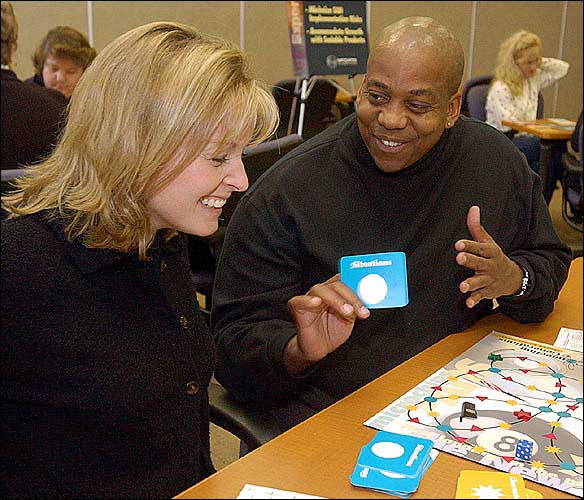
Robyn Longfellow starts laughing as Adolph Holston tries to coax the right answer out of her during a round of Connecting Generations, a board game designed to improve understanding between co-workers. The McData employees were in a training session where the game was used as a training tool.
At the end, players know whether they got the sale and the dollar amount. Their managers know, too.
Across the country, businesses are using games to train work forces. Wendy’s restaurant uses a special board game to improve communication between managers and employees. In Broomfield, McData Corp. recently played the same game to help baby boomers people born between 1940 and 1960 and their Generation X co-workers understand each other.
Game developers say games are a great way to train employees, especially in the downturned economy. They say the method is cheaper than traditional classroom-style training because the games cost a flat fee the more employees trained, the more cost efficient and playing games doesn’t require employee travel.
They also say playing games encourages employees to talk to each other, unlike traditional training sessions where a presenter does most of the talking. And games are fun.
And consider this: By the time young people enter the work force they have spent more than 10,000 hours on video games, which is more than three times the time the most voracious readers have spent reading books, according to “Digital Game-Based Learning” by Marc Prensky. There’s nothing new about using games to teach adults, said Anders Gronstedt, president of The Gronstedt Group, the Superior- and Stockholm, Sweden-based company that developed the digital sales game for StorageTek.
Pilots use flights simulators to learn to fly. Military trainees fight battles in simulators.
“The model built on ‘I’m going to talk and you’re going to listen is highly ineffective,’ said Gronstedt, a former journalism professor at University of Colorado at Boulder.
Connecting Generations is not your usual board game. Peace necklaces, black and white televisions, rubix cubes and cell phones cover the board. Players pick events, characteristics and situation cards and work together to identify the age group that fits the description. The ultimate goal to understand other employees’ behaviors, honor generational differences and work more effectively together.
The game is based on the theory we’re shaped by our times, headlines, heroes and music, and was developed from Sandy Mazarakis’ partner, Claire Raines’ research. Raines lectures about bridging generational differences in the workplace and wrote three books on the subject.
“This is not about playing games,” said Joanne Cohen, McData’s director of learning services. “The game was the vehicle to get together and communicate with each other. This game shows how people work and live differently and that is very powerful.”
Storage Technology Corp. commissioned The Gronstedt Group to develop a series of interactive digital training programs for its worldwide sales force. The Gronstedt Group makes “second generation e-learning tools,” which are more interactive than traditional e-learning slide shows, said Gronstedt. The games, played on a computer, contain flash animation (still photographs linked together) and voices of professional actors.
The Gronstedt Group’s digital games can be dubbed in any language and sent across the globe via the Internet. For fun, the e-learning company often uses well-known company figures for the actors; for example, Geek Boy is really Randy Chalfant, Storage Tek’s director of corporate strategy.
The company is doing well in the recession, said Sam Smith, The Gronstedt Group’s communications director.
“It’s a very compelling return on investment proposition for sales forces trying to make their targets,” Smith said. “Instead of flying in a 1,000-person sales force and putting them in a nice hotel, you can accomplish the same learning goals with this kind of simulation.”
The Gronstedt Group’s custom games cost between $100,000 and $500,000, depending on the length, the company said. Corporate spending on e-learning is expected to more than quadruple by 2005 to $18 billion, according to International Data Corporation.
The Gronstedt Group was founded in the mid 1990s, but last year moved from marketing consulting to e-learning. It had $800,000 revenues this year and Gronstedt predicts $1.6 million for 2002. Its global client list includes Astra, Electrolux, Emerson, Ericsson, Telia, and Volvo.
Connecting Generations says it also is doing well in the slow economy. Since September 2000, it has sold about 400 games to about 50 corporations, Mazarakis said. The board game costs $400.
“If they use that game one time per month over one year’s times it’s less than $10 per person,” Mazarakis said. “You can spend anywhere from $200 to $500 a day (for traditional training) per person. So it is cost effective.”
Cohen said McData plans to purchase the game and make it available to all 900 employees.
“The game pays for itself,” Cohen said. “The economy has been up and down. We want to optimize our resources. It’s a very cost-effective way for people to get to know themselves and each other better.”