Partial knee replacement gets runner back on track
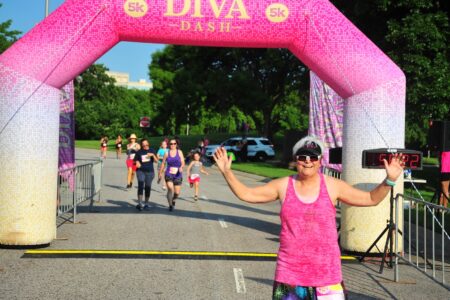
photo by: Contributed
Paula Daoust, 68, is an avid runner and has been able to get back to doing what she loves after having a partial knee replacement surgery.
At age 68, Paula Daoust is an avid runner. She’s run 150 half marathons — a distance of 13.1 miles each — including one in every state. So, when she started having debilitating knee pain, Daoust did everything she could to avoid having to hang up her running shoes for good.
“I couldn’t go for a walk or go shopping for more than 10 minutes without having to sit down due to the pain,” she said. “To be able to run, I’d have to tape my knee, but I’d end up in a lot of pain afterward. The idea of not being able to run was too depressing, so I kept trying a variety of things.”
Daoust coped with the pain for nearly five years until a friend suggested seeing an orthopedic physician. Hoping that she would be able to continue to run, she turned to LMH Health OrthoKansas for help.
Diagnosing the pain
Daoust saw Dr. James Huston, an orthopedic surgeon who specializes in knee and hip replacement. Daoust had had an arthroscopic surgery years before, and a knee replacement wasn’t an idea she wanted to entertain, so she started by using anti-inflammatory medicines and multiple types of injections to relieve her pain.
When it didn’t improve following those interventions, she met with Huston again to discuss the pain she felt on the inside of her knee. Huston suggested a different treatment — a partial knee replacement.
“X-rays showed that Paula had bone-on-bone arthritis on the inner (medial) aspect of her knee, with well-maintained joint spaces in the rest of the knee,” Huston said. Because the arthritis was isolated, Daoust was an excellent candidate for a partial knee replacement, where a section of bone from one part of the knee joint is removed and replaced with an implant.
“When there’s arthritis and/or pain in other areas of the knee, a total knee replacement is typically a better surgical option,” Huston said. “A partial replacement is less invasive, typically has a quicker recovery period and feels more like a natural knee because all of the knee ligaments are preserved.”
Robotic replacement
In June 2021, Huston performed Daoust’s partial knee replacement using the MAKO robotic arm, an instrument used to perform partial and total knee replacements, as well as total hip replacements. LMH Health has two of the MAKO robots, one at the Main Campus and the other at the West Campus. The robots, which were funded in part by donations to the LMH Health Foundation, have been proven to facilitate a shorter hospital stay and can result in less pain and a quicker return to function.
“The MAKO system can be more precise than traditional surgical techniques,” Huston said. “The system allows us to create a personalized plan for each patient. The arm allows us to place the joint more precisely and cause less damage to soft tissues and surrounding structures, which can lead to less pain, less need for pain medication and quicker recovery times.”
Huston said that there would be some short-term pain following Daoust’s knee replacement, but that it would become less severe as time went on. And Daoust said getting up from a seated position was painful for three or four days after surgery, but the pain disappeared pretty quickly. She ditched her pain medication within three days, opting instead for Tylenol, a cold therapy machine and relaxation exercises for the muscles in her legs.
“I used the walker for one day, progressed to crutches and then a cane. Within two weeks, I was walking on my own and driving a car,” she said.
After a six-week course of physical therapy, Daoust said the pain had gone away, although she sometimes feels a bit of pressure in her knee. She’s started getting back to her old form, running a race with her husband every weekend and competing in at least 10 half marathons since her surgery. She’s also beginning to reduce the time she needs to run those 13.1 miles, recently clocking in at three hours and eight minutes — about half an hour shy of her pre-surgical times.
“I’m so excited to be able to do what I love without the pain,” Daoust said.
— Autumn Bishop is the marketing manager and content strategist at LMH Health, which is a major sponsor of the Journal-World’s Health section.
Health

Event connects families with early childhood resources
Nonprofit plans a full slate of events for Sexual Assault Awareness Month, including trivia, art auction, vigil for survivors

Public invited to free event focusing on birth outcomes in Douglas County
IT’S NOT JUST VACCINES: Parents are refusing other routine preventive care for newborns

Ion robotic bronchoscopy transforms lung cancer detection