Town Talk
City receives four proposals for citywide, curbside recycling program; officials hope to keep monthly costs below $5
Lawrence city officials haven’t forgotten about the idea of a curbside recycling program. A state law still is in place that stops the city from starting a new program prior to June 2014, but city officials have been spending a lot of time on the idea recently.
Sources tell me that a committee of city officials and a couple of members of the city’s Solid Waste Task Force spent seven hours last week listening to proposals from four companies or entities wanting to be involved in a proposed curbside recycling program in Lawrence.
City Manager David Corliss told me he was “cautiously optimistic” the proposals would produce a workable program for the city.
Corliss didn’t get into details, but another source told me that — at first glance — it appears the companies are putting together proposals that would offer weekly curbside recycling services at or below the $5 per month price point that some city officials have indicated would be acceptable.
But the details on this one will be important. For example, I haven’t heard whether the proposals included fuel escalator clauses, which would allow the monthly price to vary, depending on the price of diesel fuel.
“We want to make sure we completely understand all of the proposals before we make any recommendations,” Corliss said. “Each proposal has some interesting aspects.”
According to my source, the four entities that have submitted proposals are: Deffenbaugh Industries out of Kansas City; Waste Management, which is a major player in the Topeka market; Hamm Companies, which is the city’s current landfill provider; and a proposal put together by Lawrence’s own sanitation division.
Deffenbaugh and Waste Management are prepared to both collect and process the recycled materials. Hamm has proposed that the city would collect materials, but Hamm would build a new processing facility to handle the Lawrence materials. The city proposal calls for city crews to collect the materials, which then would be processed at a privately owned facility. Corliss confirmed the city is not proposing to build its own processing facility, which easily can be a multimillion-dollar project.
Under all of the proposals, the city would be responsible for handling the billing for the new service. The monthly amount would be added onto trash bills of city residents and businesses. As it is currently structured, every household would be required to pay for the service, whether they want it or not. City officials previously have said that is the way to ensure the service is delivered in the most efficient manner, and it helps the city boost its recycling rate, which has been a goal of all this.
City commissioners at their meeting on Tuesday will be taking a procedural step that keeps this process moving along. Commissioners are being asked to formally adopt a curbside recycling plan. But the plan is written in a pretty general way that doesn’t tie the city’s hands too much. Importantly, it also allows the city to back out of the idea, if it finds the project will cost too much.
Among details the plan does spell out are:
• Residents will be provided a special cart to set out recyclable materials. Residents won’t be required to do any sorting of materials. The plan doesn’t specify whether haulers have to accept glass. In the past, the city has said working glass into the program may be difficult.
• Where it is not feasible to provide a cart to a resident, such as people who live in apartment complexes, those residents will have access to “recycling stations,” which are cluster of recycling carts or Dumpsters.
• The city will consider plans that provide either weekly collection of recycling or every-other-week collection.
• A program should be designed with the goal of increasing the citywide recycling rate to 50 percent by 2020. The city has been changing how it figures its recycling rate, but previously the rate has been in the 30 percent range.
• A plan should be developed to minimize “displacement and economic impact to current recycling collectors.” There are about a half-dozen small, private companies that provide the service in Lawrence. The plan says the city will evaluate proposals, in part, on how well the city’s chosen provider works with those existing companies.
This is where the plan may get trickier than that pyramid of beer cans you have built in your garage waiting for the city to start a curbside program.
Jim Tuchscherer, owner of Home Recycling, said neither Deffenbaugh or Waste Management has contacted him about how his 13-year-old business might be incorporated into a citywide system.
The city of Lawrence has contacted Tuchscherer about its idea, but Tuchscherer hasn’t liked what he’s heard. Tuchscherer said the city is proposing that the recycling companies be allowed to keep their current customers but not be allowed to add new ones.
“I’ve told the city that I’m not opposed to increasing recycling, but I am opposed to the city voting to put me out of business,” Tuchscherer said.
Tuchscherer said he thinks the fair thing for the city to do would be to buy out his business and the other small recycling companies that operate in the city. I haven’t heard any serious talk of that happening, however, at City Hall.
Tuchscherer said he doesn't think the city will find a way to successfully incorporate the small companies into a citywide plan.
“I don’t think there is a workable option,” Tuchscherer said. “I’m sure Waste Management and Deffenbaugh have figured that out too.”
Assuming commissioners pass the plan at Tuesday’s meeting, the next big action step is expected in January, when commissioners will be presented summaries of the proposals presented by the four entities.
Commissioners meet at 6:35 p.m. Tuesday at City Hall.
Lawrence sales tax totals growing at fastest rate since 1998
I’m surfing my AOL account to try to figure out what has gotten Lawrence consumers so motivated these days. I figure it must be those new Discman portable CD players or maybe the Digimon craze.
What’s that, you say? We’re not in the 1990s anymore? My wife will tell you I have a wardrobe that says otherwise, but a new set of numbers makes it easy to get confused.
New retail sales numbers from Lawrence City Hall, show that sales tax numbers are growing at their fastest pace since 1998.
Through November, Lawrence consumers have tallied $1.25 billion worth of sales in 2012. That’s up from $1.17 billion compared to the same period a year ago. The 6.3 percent growth rate is the best since the carefree days of 1998, when we were preoccupied by a stain on a White House intern’s dress, and two home run sluggers who were proving how healthy eating and a few over-the-counter vitamin supplements could make you a new man. (That was the takeaway from the Mark McGwire/Sammy Sosa era, wasn’t it?)
If the growth rate holds up through the end of the year, it will mark the second straight year sales tax numbers have grown significantly. It also will help erase the memories of 2009 and 2010 when consumers ran scared and sales tax numbers posted actual declines for two years in a row. Lawrence City Hall is now on pace to collect $ 2 million more in sales tax revenues than it budgeted.
Here’s a look at how Lawrence’s sales taxes have grown or shrunk over the years:
2011: up 4.5 percent. 2010: down 1.68 percent. 2009: down 2.53 percent. 2008: up 3.57 percent. 2007: up 1.58 percent. 2006: up 3.54 percent. 2005: up 3.52 percent. 2004: up 4.81 percent. 2003: up 1.15 percent. 2002: up 0.46 percent. 2001: up 3.79 percent. 2000: up 1.71 percent. 1999: up 5.17 percent. 1998: up 8.58 percent. 1997: up 6.48 percent 1996: down 0.71 percent
While the growth rate is near an all-time high, folks shouldn’t misinterpret that to mean Lawrence really has gotten its mojo from the 1990s back. Here’s an interesting figure. In that record year of 1998, Lawrence consumers spent $967.4 million. If you adjust that number for inflation, it comes out to $1.37 billion in 2012 dollars. Lawrence this year is on pace to spend a little more than $1.26 billion for the year. Ah, the good old days when home equity still worked like an ATM.
But today’s numbers do show that Lawrence consumers almost have returned to their spending levels prior to the financial crash that happened in late 2008. Here’s a look at actual consumer spending figures for the past five years, with the number in parenthesis showing 2012 inflation-adjusted dollars.
2012 - $1.25 billion. 2011 - $1.17 billion ($1.20). 2010 - $1.12 billion ($1.19). 2009 - $1.14 billion ($1.23). 2008 - $1.17 billion ($1.26).
The November sales tax report also gives us our first glimpse at how holiday sales are shaping up. Due to a delay in reporting times, the November report doesn’t actually represent sales made in November. Instead, it shows sales from mid-September to mid-October, which is holiday shopping season for those organized people who make you want to throw up.
Sales in the November 2012 period were up 8.9 percent from the same period a year ago. If that trend continues, retailers will be happy, and those of us unwrapping holiday gifts may be happy too. Maybe I’ll finally get that Macarena mix tape. Oops, sorry, wrong year again.
Genesis takes over operations of Lawrence Athletic Club; $4 million remodel on tap
Well, the tea leaves ended up being right on this one: As folks have speculated for more than a week, Genesis Health Club has taken over the operations of the Lawrence Athletic Club.
Employees of LAC, 3201 Mesa Way, were informed of the change earlier today. I haven’t yet heard back from a Genesis representative, but the phones out at LAC are now being answered as Genesis Health Club.
A worker at the front desk said a Genesis official would give me a call soon, and I will report back on what I find.
Until then, details are a little scarce on what, if any, changes are in store. Genesis already operates a health club at 2329 Iowa St. in south Lawrence.
I think lots of folks are assuming that Genesis will operate two locations in town but we’ll try to confirm that, as well as what happens to the memberships that LAC members have paid for.
No word yet on what longtime LAC owner Rick Sells' future may have in store. Based on old stories we’ve done on him, I think he has been in the athletic club business for about 30 years.
UPDATE: I've now gotten in touch with Rodney Steven II, owner of the Genesis chain of health clubs, and he confirmed that the change over did indeed occur at noon today.
Steven said part of the agreement was for Genesis to honor all existing LAC memberships. He's on site at the club today handing out new membership cards. Hours of the facility also won't change.
But what will change is that members should expect a major remodeling of the facility, which was bought — not leased — by Genesis. Steven said he hopes to start construction soon on a project that will change the exterior of the building and really be a complete remodel of the interior space. He said that will include new weight and cardio rooms and equipment, new locker rooms and new furnishings.
"We usually spend millions of dollars outfitting and remodeling a club," Steven said.
Steven said he hasn't been able to do that at the Genesis location at 2339 Iowa St. because he has been unsuccessful in purchasing the real estate of that location. Steven said the south Iowa Street location will remain open for the foreseeable future, and he said the company's long-term plan is to operate two locations in Lawrence. But Steven made it clear he likes owning rather than leasing, so he stopped short of saying whether the company will remain at the South Iowa location for the long-term.
Steven said he hopes to have the remodeling work at the former LAC spot completed by September or October. He said the club will remain open during construction, which will be done in phases to minimize disruptions to members.
Sporting goods store coming to 23rd Street and other retail rumblings
There’s a trade in the works that sounds mighty familiar from my youth: Trading books for bats and balls.
I have received confirmation that University Book Shop, 1116 W. 23rd St., is on the way out, and Jock’s Nitch sporting goods is on the way in.
Scott Ozier, a store manager for Jock’s Nitch, told me the company will be vacating its space at 916 Massachusetts St. in order to offer a more full-line sporting goods store in the much larger space on 23rd Street.
“This will allow us to carry a lot more sporting goods,” said Ryan Boler, another manager at the company, which has eight stores in eastern and central Kansas and another five in Missouri and Oklahoma. “There is a need for it in Lawrence. There are not a lot of options in Lawrence right now, and we think the location on 23rd Street will make it easier for people to get to.”
The Jock’s Nitch store at 837 Massachusetts St. will remain open. That store serves as the company’s KU fan shop store, focusing on apparel and other team merchandise rather than sporting goods.
The new store on 23rd Street will be more than twice as large as the company’s store on Massachusetts Street.
Ozier said the new store can handle a larger line of products in all categories, but he said the soccer section is expected to expand significantly, and more football gear is expected during season as well. In addition, the company will start running a team center out of the store, selling custom apparel to youth and high school teams.
Ozier said he hopes the store can be open by April 1. The company’s store at 916 Massachusetts has been closed all week, but reopened today to begin a moving liquidation sale. The store is marking down items 25 percent to 75 percent in an effort to reduce the amount of merchandise that the company will have to move. Ozier said the store will be open through the holidays, but likely would close in early 2013, and then reopen a few months later on 23rd Street.
No word yet on when the last day for the University Book Shop will be. It does not come as a surprise that UBS is leaving the location. We reported earlier this year that the building was on the market. Plus, the owners of UBS also own Jayhawk Bookstore, which has a prime textbook selling location right on the edge of the KU campus.
• I know talk of a sporting goods store will cause people to wonder about whether one of the big box retailers, like a Dick’s Sporting Goods Store, is eyeing Lawrence.
That rumor certainly has been around for awhile, but so far it has remained just that — a rumor. The former Sears building at 27th and Iowa has been a rumor hub for such developments. Dick’s has been mentioned as a possible tenant for that location, but my understanding is that the long-term future of the Sears building is uncertain because Sears’ parent company and the Los Angeles real estate company that owns the building haven’t yet agreed how to dispose of the remaining time left on the building’s lease.
The latest rumor I’ve heard — and I haven’t yet confirmed it — is that a local car dealership plans to move into a portion of the building while it does major work on one of its dealership buildings. I’ll check on that and see if there is any truth there.
As for big box stores, though, I’m pretty certain Lawrence is getting some serious looks from a few. I don’t know all the names yet, but Menards sure seems to be mentioned a lot these days. We had reported there may be some interest in converting the former Gaslight Mobile Home Village into retail space, now that a deal for an apartment complex has fallen through at that location. But I’m pretty certain there are other locations Menards and other big box stores are looking at.
Certainly, there is the retail area the Schawda’s are trying to develop at Sixth and the South Lawrence Trafficway, which they hope will get a boost from the proposed KU/city sports park. But I’m going to be keeping a close eye on the South Iowa Street corridor. I think there is a lot of momentum building in the southern Lawrence area.
Do you think it is coincidence that it is building about the same time folks think the South Lawrence Trafficway will be completed?
I’ll let you know when I hear more solid details.
Potential shake-up in leadership of Lawrence Association of Neighborhoods in the works
If you are a follower of the political process in Lawrence, tonight might end up being an interesting evening.
It sounds like a shake-up is in the works at the Lawrence Association of Neighborhoods. The group has its meeting where it elects its officers at 7 tonight in the ground floor meeting room of the Hobbs Taylor Lofts Building at Eighth and New Hampshire streets.
It looks likely that longtime LAN chair Gwen Klingenberg is facing a major challenge to keep her leadership position with the organization. Sources tell me a strong push is being made to install Laura Routh, a longtime City Hall observer and frequent critic of the police department, to the top spot.
In fact, the effort may be so strong that Klingenberg may not even seek another term. One source told me that she essentially had resigned her seat leading up to tonight’s vote, but I haven’t been able to confirm that with Klingenberg.
Routh, however, did confirm to me that she is seeking the position.
Some of you may be wondering why you care at this point. That’s understandable. LAN doesn’t always garner a lot of attention, but it has been one of the major political players at Lawrence City Hall in the past. As the largest neighborhood organization in the city, it has an ability to muster forces for or against any number of projects.
Within the last decade LAN has held considerable sway with the commission at various times. How much sway it holds today is debatable, and that may be what this change in leadership is partially about.
A member who called me up about this potential change, said there is a split in the organization currently. One group, it appears, is seeking more aggressive advocacy from LAN, while another group is concerned that if such aggressiveness is perceived as being confrontational with City Hall that it will make it more difficult for LAN to get things done.
Routh stopped short of saying that her platform as president would involve amping up the aggressiveness of the organization. But anyone who has watched City Hall much recognizes that Routh is not hesitant to challenge commissioners and call them out on issues.
“I’m a pretty known quantity,” Routh told me. “I’m a pretty direct person. I think people know that about me. But my intention is to serve as the membership desires."
LAN runs a pretty open ship. Its meetings are open to anyone interested in Lawrence neighborhoods, but only members of the organization can vote.
Large apartment complex surrounded by new nine-hole golf course proposed for northwest Lawrence
Watch out Tiger Woods. It looks like I may soon start getting paid to golf, too.
Plans have been filed at Lawrence City Hall to revive a unique apartment proposal that would include building a new nine-hole golf course in northwest Lawrence. (More on how that benefits my pocketbook in a moment.)
In fact, the plans have expanded since they first were filed back in late 2007.
Fayetteville, Ark.-based Lindsey Management has filed a proposal to build a 630-unit apartment complex that will front a new privately owned nine hole golf course at 251 Queens Road.
If you are having a hard time picturing that location, it is just a bit east of another little project that has been in the news — the proposed Kansas University/city of Lawrence sports park and recreation center.
The project would be on about 81 acres on the north side of Sixth Street, basically stretching from Queens Road toward George Williams Way. The project would run behind, or north of, the recently constructed Hunter’s Ridge Apartment Complex and St. Margaret’s Episcopal Church.
The company bought the land several years ago after it filed its original plan in 2007. But back then, the project was slated to be a 480-unit apartment complex.
The development, though, will still have room for a nine-hole golf course, and that is what really makes this apartment proposal unique. Lindsey operates apartment complexes across the Midwest and the southern U.S. that are connected to golf courses. According to the company’s Web site, in some communities residents' monthly rent provides them unlimited access to the golf course. In other communities, residents of the apartment complex get highly discounted green fees.
I’ve got a call into Lindsey officials for more details about their Lawrence plans, but haven’t yet heard back.
Some of you may be familiar with the company’s golf course and apartment projects. The company operates the Derby Golf & Country Club and the apartments around it, and also the Shawnee Golf & Country Club and those apartments.
The company also operates golf/apartment complexes in Columbia, Mo., and Springfield, Mo., in addition to projects in Tennessee, Oklahoma, Nebraska, Mississippi, Arkansas and Alabama.
As for the Lawrence golf course, the plans filed at City Hall indicate it will be more than your typical, short executive golf course but probably will play a little shorter than, say, Eagle Bend.
I suspect all of this is subject to change, but here’s what I garnered about the course from the plans on file at City Hall: Hole No. 1, 333 yards; No. 2, 254 yards, plays partially over about a half-acre lake; No. 3, 100 yards; No. 4, 250 yards, plays over a portion of what looks to be an approximately 3-acre lake; No. 5, 487 yards, plays over a portion of the same lake; No. 6, 112 yards, plays through a narrow alley of trees; No. 7, 487 yards; No. 8, 123 yards; and No. 9, 333 yards.
In addition, the project will include a two-story clubhouse and a large natural area. The plans show 13 acres in the center of the property will be designated as a “tree preservation area.”
Based on the company’s Web site, it looks like in other communities the golf courses do sell some limited memberships to folks who don’t live at the apartment complex. Opening the course to public play was part of the plans in 2007. Either way, it will be new competition for the city’s existing five golf courses — two at Alvamar, Lawrence Country Club, the executive Orchards Course and the city-owned Eagle Bend.
It will be interesting to hear what has caused Lindsey officials to restart the project that was previously put on hold due to economic conditions. Just a month ago, developers of another large apartment complex proposed for the Gaslight Village Mobile Home Park in south Lawrence, pulled the plug. They said they didn’t see the demand in Lawrence, although that project was exclusively targeted to students.
This project may be more of a mix of students and retirees. From the plans, about two-thirds of the apartments will be one-bedroom units while the remainder will be two-bedroom units.
Perhaps the recreation center and sports park is spurring some new interest, or it might be the company has been encouraged by the other development happening nearby.
As I mentioned, this project will be next door to the recently completed Hunter’s Ridge Apartment Complex, which has about 500 living units. In addition, we’ve reported on two apartment projects that are either under way or have filed plans for the area north of Sixth and Wakarusa. Plus, plans have been filed for a new residential development near the southeast corner of Sixth Street and the South Lawrence Trafficway. In addition to about 30 single-family homes, it includes about 50 duplexes and 85 new apartments.
So the Sixth Street corridor is showing signs of growth. But, at the moment, apartments rather than single-family homes are dominating the action.
As for how this latest golf project will help my pocketbook, that’s easy. With all those apartments so close to a golf course, it seems a given that my friends at Kennedy Glass or some other window repair shop will pay to send me and my buddy out on the course, armed with our reliable hook and slice.
I’ll be playing through from your living room in no time.
Compton-led banking company purchases Missouri-based bank
Almost anybody who follows the Lawrence business scene can tell you that local entrepreneur Doug Compton has a growing enterprise.
That never will be more evident than next year when groups led by Compton begin work on a pair of multistory buildings at Ninth and New Hampshire streets.
But what may not be as evident to the general public is that Compton also has a growing banking enterprise. A new deal has recently put that on display.
De Soto-based Great American Bank on Nov. 30 finalized its purchase of Lone Summit Bank of Lake Lotawana, Mo., which now will become a branch of Great American Bank. That’s significant in Lawrence because Great American Bank is owned by First Financial Bancshares Inc., a Lawrence-based bank holding company that is led by Compton.
First Financial Bancshares also is the holding company that owns Lawrence Bank and its two locations in the city. But it has been Great American Bank that really has been the aggressively expanding enterprise at First Financial. In 2009, Great American Bank purchased First Bank of Kansas City at 39th and Main from the FDIC.
Travis Hicks, Great American’s president and CEO, said in a statement that the bank’s growth strategy is likely to continue as the “bank will continue to look for opportunities to expand throughout the market.”
Also expect some activity from Lawrence Bank in the near future. The company will be getting a brand new facility as part of Compton’s plans to build a multistory apartment and office building at the northeast corner of Ninth and New Hampshire. Lawrence Bank currently has offices in the former Black Hills Energy building that is on the site and will be demolished as part of the project. Plans for the new building show a bank and drive-thru lane occupying a good part of the first floor of the new building.
According to a September filing with the FDIC, First Financial Bancshares had about $128.2 million in assets. With this latest deal, the total is expected to grow to about $155 million in assets.
According to records with the FDIC, the company has grown its assets by about 30 percent since late 2008. The latest FDIC report shows the bank holding company had net operating income of about $1.3 million, up from about $565,000 in 2008.
Compton, according to the most recent annual report from the Kansas Secretary of State’s office, serves as president of the bank holding company. Other directors of the company include Lawrence residents Jeff Hatfield, Les Dreiling and Hicks.
New breakfast spot, The Roost, slated to open in former Milton’s location
Milton’s may not be coming back to downtown Lawrence, but a full-fledged breakfast restaurant is slated for its spot at 920 Massachusetts St.
And it will have a strong Milton’s connection.
Manda Jolly, a former general manager for Milton’s, has inked a deal to open The Roost in early 2013.
Jolly said the restaurant and its menu won’t be a replica of Milton’s — which closed last month — but it will be a place to get a traditional breakfast, and some of the menu items will be very recognizable to fans of Milton’s.
“I understand that there were things that people grew to love and need from there,” said Jolly.
(I’m working to get her to write my doctor a note to prove to him that I indeed do need sausage gravy.)
Jolly said The Roost will focus on breakfast, lunch, pastries and something she calls “inspired cocktails.” (That sounds a bit redundant to me. Almost every cocktail I’ve had has inspired me to have another.)
Jolly is opening the restaurant with three other partners — she is not yet releasing those names — but she said one of the partners has opened and managed several bars in Lawrence. She said The Roost will be more committed to having cocktails and spirits be a part of the restaurant than Milton’s was, which had a liquor license on and off during its existence. But at the moment, Jolly said the restaurant won’t have regular evening hours. (Don’t fret, I’ve heard cocktails at lunch can be very inspiring and darn right transformational at breakfast.) Instead, The Roost will be available for rent for evening events, and Jolly said the restaurant also will host a few special evenings per year.
The former Milton’s space will get a major makeover to accommodate The Roost. Jolly said the name for the restaurant comes from her family’s farm just outside of Speed, Kan., which is near Phillipsburg, which is near Stockton, which is near . . . (In Western Kansas, we could play this game all day, but it always ends the same. It is east of Denver.) The family farm’s name is The Roost, and Jolly said the restaurant space is going to take on a little bit more of that type of feel with some old barn wood incorporated into the design and more natural elements such as exposing some stone walls.
When all of it comes together, is still a bit uncertain. Jolly at this point is only committing to “early 2013” as an opening date.
“I don’t want to give up on January yet, but it won’t be early January,” Jolly said.
Jolly started at Milton’s as a hostess on the day the restaurant opened in 1997. Jolly worked there pretty much for the next 11 years, rising to the rank of general manager. When she left the restaurant four years ago, she tried to buy Milton’s then, but the deal never quite happened. The idea, though, never did fully leave her.
“I love mornings,” Jolly said. “I’m used to that. Milton’s served as a major hub of the community for a long time. It always has been the best job I ever had.”
City ends negotiations to purchase Abe & Jake’s building next to City Hall
Well, it looks like dreams of Lawrence perhaps having the most picturesque Planning and Development Services offices in the country have been dashed.
There had been quite a bit of speculation in certain real estate circles that the city of Lawrence was close to buying the Abe & Jake’s Landing building that is immediately east of City Hall.
The city was interested in the building as a home for a combined office for its Planning and Development Services Department. Currently, the building permit and code enforcement portion of that department is in the former Riverfront Mall, while the planning portion of the department is in City Hall. The city has long wanted a combined office so it can have a “one-stop shop” for builders and developers doing business with the city.
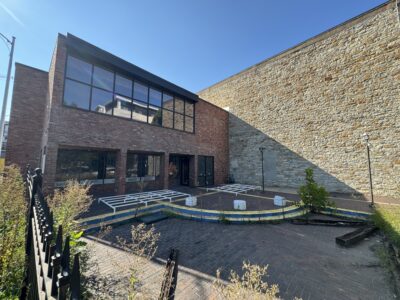
And what a stop that would have been. If you have forgotten, the Abe & Jake’s building is one of the more unique in the city. The old 19th Century industry building sits along the south bank of the Kansas River and has huge windows overlooking the Kaw.
But it appears the deal is not to be. Mayor Bob Schumm confirmed to me that the city had been working for about four months on a potential purchase. But after architects brought back estimates on what it would cost to renovate the 24,000-square-foot building — which has about 50-foot-high ceilings in most places — the city recently backed away from the deal.
Schumm said he doesn’t see much chance the city will pursue the building in the future, and he said the city currently is not looking at any other locations for a joint Planning and Development Services office.
The deal would have come with an interesting twist: The city would have been buying a building it already owns. The building and property came under the ownership of the city when it purchased land in the area for City Hall. But the city in the 1990s granted Lawrence businessman Mike Elwell a low-cost, long-term lease on the building, in exchange for him making about $2 million worth of improvements to what had become an eyesore of a building.
Elwell’s lease on the building runs into 2087. The city really would have been purchasing that lease.
Elwell has made no secret that he wants to sell his rights to the building. We reported in January 2011 that the building — which basically has been an event venue and nightclub since Elwell finished the building in 2002 — was on the market for $1.3 million.
At the time, Elwell said he was receiving some interest from hotels and others who wanted to use the building as a small-scale convention center and events venue. But he said the slow economy was holding back those sort of deals. It will be interesting to see what eventually lands at Abe & Jake’s.
The fact the city was contemplating a deal for the property also brings up an interesting point. According to my sources, the city believed it could purchase and perhaps renovate the building without having to raise any taxes.
If so, this is just another reminder of how unique of a financial position the city is in. It has access to cheap money through the bond market that is lending money at historically low rates, and the city’s bond and interest fund has very sizable reserves at the moment.
Let’s do a little back-of-the-napkin math on all the projects the city has or plans to do without raising taxes: $25 million for a recreation center; about $7 million in infrastructure for the future business park at the former Farmland Industries site; let’s estimate $3 million for the Planning and Development Services offices; and then there is the approximately $300,000 per year the city says it has to cover the expected operational shortfall of the proposed recreation center. That $300,000 per year probably could finance about a $4 million bond.
That’s just off the top of my head, and the amount comes to $39 million the city can put toward a project or projects without having to raise taxes. I wonder how many folks realize how unique of a time period Lawrence city government finds itself in these days.
More on that another day.
Lawrence mayor to pay up on bet after KU loses football game to West Virginia
City Hall on a Tuesday night is sometimes a good place to see an odd sight.
That may be the case tonight. When Lawrence city commissioners meet for their regular weekly meeting, Mayor Bob Schumm is scheduled to be wearing odd attire.
Schumm will be decked out in team gear from West Virginia University. The folks at city hall in Morgantown, W.Va. — home of West Virginia University — proposed a wager with Schumm. If KU won last Saturday’s football game between the two universities, Morgantown mayor would wear KU gear to his council meeting. If West Virginia won the game, Schumm would wear Mountaineer gear.
The folks at Morgantown offered a similar wager to all the other Big 12 communities. I suspect it was just their way of saying hello to their new conference neighbors and perhaps generating a little interest among conference residents about Morgantown. On that note, I wonder how many KU fans made the trip to Morgantown last weekend, and what they thought of the place. If you went, let me know your thoughts below.
In case you missed it, KU fell just a bit short on Saturday, losing 59-10. Schumm told me he has a yellow West Virginia shirt that he’ll be sporting at the meeting.
“I told them I would wear it, but I never said for how long,” Schumm said.
Schumm ought to just take his lumps and feel lucky. I’m surprised that blowout loss didn’t trigger some clause in the wager that required Schumm to wear the entire Mountaineer mascot uniform.
Though that may not have been all bad. I think the Mountaineer mascot comes with a musket and moonshine. (West Virginia officials may dispute the moonshine part of this, but anybody who has seen their atmosphere at a football game would confirm moonshine has to be involved.) I don’t know how much the musket would add, but I’m pretty sure the moonshine would improve most City Commission meetings.
Oklahoma City tornado sparks discussion of building code standards at Lawrence City Hall
It didn’t take long for the tales of tragedy in Moore, Okla., to cause at least one city leader to begin asking questions of whether Lawrence is adequately prepared for a similar natural disaster.
City Commissioner Jeremy Farmer raised questions at last night’s City Commission meeting about whether Lawrence’s building codes for public buildings, like schools, are adequate when it comes to providing shelter from tornadoes.
“I think it would behoove us to look at ways to make our school buildings safer,” Farmer said. “If we don’t, shame on us.”
Farmer's comments Tuesday night came after he first broached the subject on his Facebook page earlier in the day. From his page: “I understand that natural disasters happen. I understand that we have better things in place to enhance warnings. But if we parade children into a hallway and tell them to cover their necks with their hands, and an EF-5 comes rolling through town, it won't matter. It’s time we stop making excuses for lives being taken because we were too irresponsible to think outside of a box, or too cheap to make sure this NEVER happens again.
“Reinforced tunnels, underground schools. Something. Smarter people than me are thinking about this. We have to figure something out. Innocent lives being taken because we didn't act when we possessed the innovation to stop it is unacceptable to me.”
Commissioners asked Planning Director Scott McCullough to produce a report summarizing what Lawrence’s building codes require in the way of storm shelters in public buildings and whether there are feasible additions that could be made to the code.
I would look for that report in the next few weeks.
As for what is really possible, I don’t know. Lawrence Public Schools spokeswoman Julie Boyle told me Lawrence public schools don’t have FEMA designated safe rooms, but obviously they do have plans to locate students and staff to interior portions of the buildings, which are better designed to withstand severe weather.
We’ll see how much, if any, serious discussion the idea of stricter building standards gets at City Hall.
Tuesday’s discussion arose after Mayor Mike Dever asked whether the city was planning to send any personnel to the Oklahoma City area to assist with the devastation following this week’s tornado.
City Manager David Corliss said the city hadn’t yet been asked for any assistance, but he plans to spread an offer of assistance to public administration officials he knows in the Oklahoma City area.
“I certainly will make it clear that we are available to do that,” Corliss said.
Wicked Broadband project seeks $500,000 city grant; downtown hotel project seeks adjustment to incentives package; historical society seeks $20k for new exhibit
Reading the agenda for Tuesday night’s Lawrence City Commission meeting is kind of like reading my household’s credit card bill: There are plenty of questions, and all the answers seem to have dollar signs.
There are three outside organizations requesting financial assistance from the city, with two of them each asking for a half-million dollars.
We’ll try to fill in more details later, but here’s a look at the basics of the requests:
• Lawrence-based Wicked Broadband announced last month that it will start a pilot project to bring super fast 1-Gigabit Internet service to a neighborhood later this year.
A kick-off event for the project spelled out a lot of details about how the company, which previously did business as Lawrence Freenet, could bring the same type of high-speed Internet service to Lawrence that Google Fiber is bringing to Kansas City. At that event, the idea of financial incentives from the city wasn’t envisioned. Well, it is now.
The company has filed an application for a $500,000 economic development grant from the city, plus is asking to receive up to a $20,000 a year rebate in franchise fees it pays to the city. It also wants to have the right to enter into $10 per year leases to use a portion of new fiber optic cables that the city plans to install throughout the community in future years.
Joshua Montgomery, co-owner of Wicked Broadband, said there are several factors that have caused him to rethink the need for city incentives for the project. But perhaps the largest is that he’s been contacted by several significant New York-based capital investment companies that are interested in investing in a locally owned, high-speed Internet service. Those investors have made it clear that the city of Lawrence needs to do something to show that it is committed to the idea of bringing a high-speed network to the city.
“If the city says that it is behind it 100 percent, that opens the door for the next $30 million in private funding that will be needed to spread this service to the rest of the community,” Montgomery said.
Montgomery said the $500,000, one-time grant would allow the service territory for the pilot project to grow to 1,000 households, up from 500. The neighborhood or neighborhoods haven’t been selected yet. Wicked is taking pre-registrations for the service on its website. The neighborhood with the highest percentage of residents pre-registered will serve as the pilot project. An announcement is expected June 15.
Montgomery said he and his business partner and wife, Lawrence school board member Kris Adair, are putting up $500,000 in private money for the pilot project.
City commissioners on Tuesday aren’t being asked to approve the request. Instead, Tuesday’s vote is just to direct city staff to begin analyzing it.
Wicked Broadband’s service will be a direct competitor to existing Internet providers, such as Knology and AT&T, which generally do not receive such city subsidies. So, it will be interesting to hear what those companies have to say as the process unfolds.
As for Montgomery, he said he’ll argue that the city won’t be making an investment in a private company as much as it will be making an investment in a new infrastructure system that will be critical to future commerce. “It is an economic enabler,” Montgomery said.
•••
The second request comes from a group led by Lawrence businessman Doug Compton, which is seeking to build a new hotel at the southeast corner of Ninth and New Hampshire.
It is a bit more complicated to understand, and I’ll try to get a better handle on the numbers before Tuesday’s meeting. But the request seeks to raise the amount of Tax Increment Finance dollars the hotel is eligible to receive to $4 million, up from $3.5 million.
Unlike the Wicked Broadband request, this doesn’t involve the city writing a $500,000 check to the development. Instead, a TIF allows the project to get a rebate on a certain percentage of the property taxes it pays. It is kind of like a tax abatement, except the money has to be used to pay for infrastructure type of expenses. In this case, that includes a private parking garage for the hotel.
What makes it a bit complicated is that the developers also have proposed a multistory apartment/office project for the northeast corner of the intersection. It also uses Tax Increment Financing. It looks like a likely option is to increase the amount of TIF money available for the southeast corner hotel project by reducing the amount of projected TIF revenues available to the northeast corner apartment project.
If that is ultimately what happens, then the overall amount of incentive basically would be a wash. We’ll have to see how those details work out.
The more interesting part is what developers have said about the hotel project. It has had its necessary building approvals for months, but hasn’t yet started construction. A letter to the city now makes it clear that there are financial questions the investors are trying to answer.
Bill Fleming, an attorney for the development group, told the city in a letter that “the hotel investors are keenly interested in the ‘cost per key,’ which is the average cost for each hotel room.”
If the additional $500,000 in TIF money is not available to the hotel project, then that will raise the average cost per room the investors must pay.
“The investors may conclude the project is not feasible at that cost per key, and the project in that case will not proceed,” Fleming wrote.
That would be a major turn of events for the project, which faced stiff opposition from the adjacent East Lawrence neighborhood, and had to fight hard to win city approval.
•••
Maybe the folks at the Douglas County Historical Society are more than just masters of history. Perhaps they also are masters of timing. After those two big-ticket items, they are asking for a mere $20,000 in city funding. The money will be used to help fund a permanent exhibit on the second floor of the Watkins Museum commemorating the 150th anniversary of Quantrill’s raid on Lawrence.
The new exhibit is set to open on Aug. 17, and will “explore Douglas County’s history, issues that shaped the development of the community, and events that made it a focus of national attention.”
Ultimately, the exhibit will be expanded to the third floor of the museum. The bulk of the nearly $257,000 in exhibit costs has come from private individuals, businesses and grants.
City staff members are recommending approval of the $20,000 in funding. The money would come from the city’s guest tax fund, which receives its revenue from the guest tax charged at hotel and motel rooms.
Commissioners meet at 6:35 p.m. Tuesday.
Lawrence hosts mayor of Greek sister city this week
There was a bit of pomp and circumstance in the air at City Hall on Tuesday. An official delegation from Lawrence’s sister city of Iniades, Greece, was on hand.
Well, sort of. The delegation actually consisted of the mayor of Messolonghi, Greece. But here’s a good opportunity to learn a little something about our newest sister city. Iniades — it also can be spelled Oiniades — isn’t a city in and of itself like Lawrence. It used to be, but at some point in the not-too-distant past it was merged with two other municipalities to create what is officially known as the Sacred City of Messolonghi. (Lawrence residents, start thinking of how we can expand our name to something neat like that. Perhaps the Basketball Kingdom of Lawrence.)
The whole city covers an area of about 674 square kilometers, according to a brochure that Mayor Panagiotis A. Katsoulis graciously gave me. (That’s approximately the size of Texas, or perhaps it is about 420 square miles. I’m American. I’m not good with kilometers.) Either way, for comparison’s sake, Douglas County is about 470 square miles.
The Messolonghi area — which is about a four-hour bus trip from Athens — has about 35,000 people, and has an economy that is still largely based on agriculture.
“They grow a cornucopia of agricultural products there,” said Jon Josserand, a member of Lawrence’s Sister Cities Advisory Board. “Wheat, beef, grapes, olives, vegetables, citrus.”
The potential agricultural connection is one area the sister cities program may expand upon. Mayor Katsoulis made a point during his remarks to city commissioners that he would like to establish more exchange programs with Lawrence.
The idea of Greek agricultural leaders coming to Kansas to learn more about agricultural techniques is one that is likely to be explored in the future, Josserand said. Lawrence also is interested in creating a student exchange program, much like Lawrence has with its other sister cities of Eutin, Germany, and Hiratsuka, Japan.
It will be interesting to see if this sister cities relationship takes on more of a business-oriented slant. The economy of Greece is certainly looking for help where it can find it, and who knows what potential opportunities there may be for a Lawrence firm to benefit from a relationship with a Greek community.
Creating relationships is what the sister cities program is all about. The city formalized its first sister city relationship with Eutin, Germany, in 1989, then Hiratsuka, Japan, in 1990. Iniades was added in 2009, in large part because of the decades-long relationship KU’s theater department has had with the community. Since about 1990, KU has operated a summer study abroad program that uses Iniades’ outdoor theater, which dates back to 4 B.C.
This week’s trip was the first for Mayor Katsoulis to Lawrence. Through his interpreter, Katsoulis said he was impressed with the community and its people.
“It is a very different society than ours with a different lifestyle and organization,” Katsoulis said. “It is very quiet and in harmony with nature, and filled with people who respect the laws in everyday life.”
Katsoulis arrived in Lawrence on Friday, and will be in the city for about a week.
As planners debate Menards project, new study finds retail vacancy rate at 7.2 percent citywide
Let the number games begin. As we’ve previously reported, the Lawrence-Douglas County Planning Commission is set to debate a proposal by Menards to locate a new store adjacent to Home Depot near 31st and Iowa streets.
As we’ve also reported, one of the factors that planners are supposed to take into consideration when considering such large retail projects is the city’s retail vacancy rate.
But at the time Menards filed its plans with City Hall, the last time the city had conducted a retail vacancy rate study was in 2010.
Well, there are now new numbers. The city recently has completed its most recent Retail Market Report, which looks at vacancy rates as they were in December 2012. Here’s a look at some of the findings:
• Citywide, the retail vacancy rate was 7.2 percent, down from the 7.3 percent found in the city’s 2010 report and up from the 6.9 percent found in the 2006 report. In other words, there hasn’t been much change in the overall number.
• Downtown had a vacancy rate of 9.4 percent, up from 9.1 percent in 2010; South Iowa had a vacancy rate of 7.8 percent, up from 2.7 percent; East 23rd had a vacancy rate of 10.4 percent, down from 13.6 percent; West 23rd Street had a vacancy rate of 6.1 percent, down from 6.7 percent.
• The 19th and Haskell area had the highest vacancy rate in the city at 30.2 percent. North Lawrence was second at 16.4 percent, although the numbers indicate a turnaround is happening in the area. In 2010, it had a vacancy rate of 27.5 percent.
• Turnarounds happened in a couple of other areas too. The Bob Billings Parkway and Wakarusa area has a vacancy rate of 7.8 percent, down from 26.4 percent in 2010.
• The report also provides information about the type of retail uses in downtown. The report found 116 merchant-based retail businesses in downtown, which is down from 126 in 2006. Restaurant and beverage oriented uses grew to 83, up from 68 establishments, during the same time period.
The report is an interesting one for people who watch Lawrence’s commercial real estate market. Perhaps the most interesting part about it, though, is how different it is from a private report that was put together during roughly the same time period.
The Lawrence office of Colliers International released a report in January that measured vacancy rates for late 2012. It found an overall retail vacancy rate of 5.4 percent, compared to 7.2 percent in the city’s report.
In downtown, Colliers found a vacancy rate of 4.4 percent compared to 9.4 percent in the city report.
The differences, I believe, come down to the methodology of the two reports. I don’t know all the differences but I think a lot of it comes from how the two studies define retail space. For example, the city study counts some industrially zoned space as potential retail space because the city’s development code would allow for retail to be located in the space. Also, there are places like the former Riverfront Mall building. Whether that space is counted as retail space, which is what it was built for, or office space, which is how it is pretty much being marketed now, makes a difference in the vacancy rate calculations.
Vacancy rates: They’re like my kids saying they’ve “cleaned” their rooms. It is a subject where interpretations and definitions matter.
As far as the Menards project goes, we’ll see how much weight planners, and ultimately city commissioners, give to the vacancy rate subject.
The city’s comprehensive plan, Horizon 2020, says large retail projects shouldn’t be approved, if there is evidence the project will push the city’s overall retail vacancy rate above 8 percent.
If the 190,000 square foot Menards store and the 65,000 square feet of outlying parcels — restaurants and other smaller retailers surrounding the store — were built and then were entirely vacant, the city’s vacancy rate would rise to 9.7 percent. It would be odd, however, for Menards to build a store and then not occupy it, but technically that is the assumption city planners are supposed to make under the rules of Horizon 2020.
Several planning commissioners the last time they considered this issue, however, indicated concern with making that type of assumption. The city also is in the process of rewriting that portion of Horizon 2020, but those changes haven’t yet been made. So, it is possible that planners may discard the idea that they should assume the new Menards building will be vacant after it is built.
Staff members put together another calculation that shows what would happen if the Menards building is occupied but all of the 65,000 square feet of surrounding retail is vacant. The result would be the citywide vacancy rate would rise to 7.7 percent, which is still below the 8 percent threshold that Horizon 2020 says is critical.
So, we’ll see what comes of all this. I’m not sure how much this retail market study is going to play into the Menards decision, but this report likely will play into future debates about whether Lawrence has too much or too little retail space for a community its size.
The Menards discussion will take place at 6:30 tonight at City Hall.
City estimates it may cost hundreds of thousands of dollars per year to keep concealed weapons out of city buildings
It appears the city soon will have to buy hundreds thousands of dollars worth of security measures. Either that, or the city will have to learn to live with a new state law that would allow concealed-carry permit holders to bring firearms into City Hall and other city buildings.
City commissioners at their Tuesday evening meeting will consider formally asking the Kansas Attorney General for an exemption from the new state law until Jan. 1, 2014. The state law — approved by the legislature and signed by the governor this session — essentially contains an automatic one-year exemption period for local governments. The city also may be able to get three additional one-year exemptions, although that is less certain.
The law no longer allows city or county buildings to be posted with the "no gun" signs that make it illegal for anyone, including concealed-carry permit holders, to bring a concealed weapon into the buildings. Under the new law, governments can only post those signs if the buildings have adequate security measures, such as metal detectors and security officers.
Lawrence city officials have begun calculating the cost to purchase and staff such metal detectors. A memo from City Attorney Toni Wheeler estimates it will cost about $5,000 for each metal detector, plus at least $42,000 a year for a single police officer to staff the metal detector—and the Lawrence Police Department, Wheeler wrote, believes two officers may be necessary for each detector. That would place the annual operating costs for the program at more than $84,000 for each building with a detector. And the cost may be even greater, because the personnel numbers represent starting salaries and don’t factor in benefit costs or other costs to equip a police officer.
Wheeler says at least three city buildings — City Hall, Lawrence Municipal Court and the public access area of the Police Department’s Investigations and Training Center — all warrant consideration for security systems. Beyond those three, city commissioners also would have to decide whether recreation centers and other city offices need the security measures.
New security costs for the city are expected to be addressed in the City Manager’s recommended 2014 budget, which is scheduled to be released in July. The costs could add up. If the city decided to include recreation centers in the program, there would be a total of nine buildings to equip and staff. At a minimum of $42,000 per building, that's almost $400,000 a year, plus the cost of the metal detectors. At $84,000 per building — which would be the case if two officers are required — it would be more than $750,000 a year.
But say you wanted to have security measures in place for every city-owned building that currently prohibits concealed firearms. The city currently has 47 buildings listed in its administrative policy, which means it would cost $3.9 million to provide a two-member security detail at every location. That, of course, is not going to happen. It probably would be a bit odd to have a metal detector at the city’s Landscape Shop or the Wastewater Treatment Plant, for example. Those places probably will become buildings where concealed-carry permit holders can have a weapon.
It will be interesting to see how city commissioners react to the new legislation. The previous City Commission sent a letter to the legislature objecting to the bill while it was under consideration. Whether the city’s objections rise to the level of spending more than a half-million dollars on security each year, I don’t know. The city already spends some money on security: a police officer attends each Lawrence City Commission meeting, and a bailiff is employed by the Lawrence Municipal Court.
If the city gets serious about installing metal detectors, there will be quite a few items to discuss. It probably would require the public entrances at City Hall to be changed significantly, since there are three ways for the public to enter City Hall. The city also could have a discussion about whether security officers — rather than fully sworn police officers — would be appropriate to staff the metal detectors. That may reduce the personnel cost for a security program.
And then there are city buildings such as the Lawrence Public Library and the Lawrence Arts Center that attract large crowds on a regular basis. How would they be secured and staffed?
Of course, the city always could have the discussion of whether any harm would come from allowing licensed individuals to carry a weapon in city buildings. According to the Kansas Attorney General’s office, it already is legal for concealed-carry permit holders to carry a weapon on various pieces of city property. Every city-owned park, for example, is a place where concealed-carry permit holders are entitled to have a weapon. “Parks, parking lots and other open public property" are no longer able to be restricted through signs, according to the Attorney General’s Web site. That didn’t always use to be the case, but the law was changed, I believe, during the 2010 legislative session.
City commissioners won’t be the only ones that get to have this fun. Douglas County also will have to go through the same exercise with its buildings, although it already has a metal detector for the Judicial and Law Enforcement Center. Public schools won’t have to install metal detectors under the new law. School officials can continue to post the "no gun" signs on school buildings, which will make it illegal for concealed-carry permit holders to bring a weapon into the building.
Knology changes its name to WOW!; lifts usage caps on Internet service
The changes keep on coming in the Lawrence Internet market.
The largest Internet service provider in Lawrence has just announced that it is removing all of its usage caps from its Internet service packages, as the company changes its name from Knology to WOW! That means customers no longer will be charged for going over their usage limits, according to a press release by the company.
Englewood, Colo.-based WOW purchased Knology back in July, but it had not converted Knology over to the WOW brand until today. Signs for the company around town are being changed today, according to WOW.
But the changes related to Internet usage caps are likely to garner more attention from hard-core Internet users. The caps had generated concern among many users because customers’ standard monthly rates could rise depending on how much Internet usage they had in a particular month.
The change in the cap policy comes at a time when both private and public officials have been talking about shaking up the city’s Internet service provider market.
A city-hired consultant recently completed a report that found that current broadband offerings in Lawrence generally are “costlier, slower and more limited than in other comparable communities.” City officials had the report commissioned because they have been interested in possibly allowing private companies to have access to a growing ring of fiber optic cable owned by the city.
On the private front, Lawrence-based Wicked Broadband — formerly known as Lawrence Freenet — has made a proposal to the city to further tap into that ring of fiber. (Ring of Fiber: Johnny Cash used to sing that song in his old age.)
At their meeting tonight, city commissioners will receive a request from Wicked for low-cost fiber leases with the city, and a one-time $500,000 grant to help the company build new broadband infrastructure in the city. The request is part of a pilot project Wicked is launching to bring to one Lawrence neighborhood the same type of superfast Internet service that Google Fiber is bringing to Kansas City. If successful, Wicked Broadband wants to extend the high-speed broadband project to all of the city.
So, we’ll see what cards the folks at WOW start playing in what appears to be an increasingly competitive game in Lawrence. Consumers, I suspect, will be keeping an eye on whether the competition starts having an impact on rates.
Lawrence ranked second-worst-performing small metro area, according to new national economic index
Call it a rankings rut, and this one is pretty deep for the city of Lawrence.
A new national study has ranked Lawrence as the second-worst-performing small metropolitan area in the nation, based on a variety of economic measures. The Milken Institute ranked Lawrence 178 out of 179 metro areas in its most recent Best Performing Cities index. A web site for The Atlantic this week had an article analyzing the results.
This latest report adds onto the negative news released earlier this month by the U.S. Bureau of Economic Analysis about Lawrence’s gross domestic product. It ranked 339th out of 366 metro areas, and was shrinking.
The Milken report uses some of the same types of economic numbers to create its index. But it places a particular emphasis on an area in which Lawrence is supposed to be positioned to excel: high-tech, knowledge-based jobs.
Simply put, the report found we aren’t excelling in that area. In fact, Lawrence didn’t excel in any area.
Over the course of the past year, Lawrence’s ranking in the report fell 79 spots, from No. 99 in the 2011 report to No. 178 in the most recent index. Only three other cities — Ithaca, N.Y., Great Falls, Mont., and Hot Springs, Ark. — had sharper declines than Lawrence’s.
The report takes a look at nine different categories, and Lawrence didn’t crack the top 100 in any of them. Here’s a look:
• Five-year job growth: No. 107
• One-year job growth: No. 172
• Five-year wage growth: No. 101
• One-year wage growth: No. 158
• One-year job growth percentage: No. 156
• Five-year high-tech GDP growth: No. 170
• One-year high-tech GDP growth: No. 151
• High-tech GDP as part of overall GDP: No. 164
• Concentration of high-tech companies: No. 148
I know how you all like comparisons, so I have gathered the rankings for several regional communities. I would ask for a drumroll, but the drama already has been sucked from this. Since Lawrence is second to last — last place was Carson City, Nev. — I’m guessing you’ve already deduced that every city in the region ranked ahead of us.
On a positive note, Manhattan, which has been on a roll in these type of rankings, wasn’t included in this index, likely because its population wasn’t quite large enough to qualify. But fear not, here is something for you to gnash your teeth over: Columbia, Mo., ranked No. 10 on the small cities list. Here’s a look at others:
• Iowa City, Iowa: No. 16
• St. Joseph, Mo.: No. 29
• Waco, Texas: No. 31
• Joplin, Mo.: No. 44
• Ames, Iowa: No. 61
• Topeka: No. 144
Several of the cities Lawrence often compares itself to, or at least watches, were included in the list of 200 large cities. Here’s how some of those cities fared in the rankings:
• Fort Collins, Colo.: No. 12
• Boulder, Colo.: No. 15
• Lubbock, Texas: No. 20
• Oklahoma City: No. 32
• Madison, Wis.: No. 71
• Lincoln, Neb.: No. 81
• Kansas City: No. 104
• Tulsa, Okla.: No. 118
• Springfield, Mo.: No. 144
• Wichita: No. 146
Take these rankings for whatever you think they’re worth. These indexes all have their own biases about what they think are the most important economic indicators. This one seems to be heavily focused on wages and high-tech business indicators. For what it is worth, those are two areas I hear local leaders emphasize a lot as well.
Another factor to remember is that this index — like all of them — is based on data that sometimes has some age to it. Most of the job growth numbers date back to 2011, and some of the wage numbers date back to 2010. It was no secret that Lawrence struggled during those periods. It also is worth remembering that Lawrence basically has entirely revamped its economic development team since that point.
Plus, some recent indicators have been more positive. Retail sales tax collections in 2012 had their best growth since the mid-1990s, there’s been a significant decline in Massachusetts Street vacancies, Hallmark Cards is in the process of shifting about 200 workers to its Lawrence plant, and even home sales and building permits have showed signs of a rebound.
Yes, I’m trying to put a little cheer in your Kool-Aid. But only for a moment. I’ll leave you with a finding from the report that ought to leave Lawrence leaders scratching their heads. The authors of the report noted that there were two types of communities most likely to do well in this year’s index: communities benefiting from the country’s new natural gas and oil exploration; and communities with “high concentrations of public-sector employees, especially in prominent universities.”
That second one sure sounds like us. But maybe our definition of prominent is a bit different from others. The top ranked small city, for the second year in a row, was Logan, Utah, home to Utah State University. Prominent? I don’t know. But I’m pretty sure our basketball team can beat theirs.
City recreation leaders not in favor of lighted tennis court plan near Lawrence High
All we need now is John McEnroe, or absent that, somebody in white 1980s-style tennis shorts with an excitable personality.
Yes, we’re talking about the looming tennis court debate that will be coming to Lawrence City Hall. As we reported last week, city commissioners have decided to reopen the issue of whether eight tennis courts near Lawrence High School should be lighted.
At the time, however, we didn’t have a date for when the commissioners were to have a public hearing on the issue. Well, the commission now has a tentative hearing date of June 4, at its 6:35 p.m. meeting at City Hall.
There’s been one other development in the matter: The city’s Parks and Recreation Advisory Board brought up the issue of lighted tennis courts for the site, and it is clear recreation officials aren’t on board with the idea, largely because of concerns about cost.
In case you have forgotten, members of the Lawrence Tennis Association believe lights should be added to the courts to make up for lighted courts that were lost when LHS renovated its campus. Neighbors in the area have opposed the lighting plan, expressing concern that it will be just one more example of LHS facilities creating a neighborhood conflict. They think the light will spill onto their properties.
City officials already have agreed to build eight outdoor lighted tennis courts as part of the city’s recreation center in northwest Lawrence. Several city officials thought that put an end to the issue, but members of the tennis association said they still see value in having lighted courts in the LHS area.
But at a recent meeting, the top officials at the city’s Parks and Recreation Department said they couldn’t support the idea of lighting the LHS courts and building the eight lighted courts at the recreation center. Cost was one reason they cited. They now estimate the cost of installing lights at the courts — which are on the property of the former Centennial Elementary school — at about $240,000, if done in a way to minimize light spillage. When the project was first proposed a couple of years ago, the department was planning on spending about $100,000 to light the courts.
Plus, the city would have to enter into a maintenance agreement with the school district to help make any future repairs on the courts. Parks and Recreation officials aren’t sure they want to do that, because two of the courts already are showing signs of needing significant repair. Currently, all maintenance is the responsibility of the school district. (In case you are wondering why it wouldn’t be the school district’s responsibility to add lights to courts it owns, the answer is because the district says it doesn’t really need the lights for its high school programs. The lights mainly would accommodate city residents that use the courts.)
Members of the tennis association are passionate about the issue and well-organized. They also note that the needs in the area are changing because KU will be losing most of its public courts on campus when the new School of Business building is constructed.
So, we’ll see how the debate goes. Let the volleying begin.
Planning Commission to debate Menards project Monday amid signs momentum may be turning
Strap on your tool belt, it is time to talk again about Menards’ proposal to build a big box store just east of Home Depot near 31st and Iowa streets.
The Lawrence-Douglas County Planning Commission will debate the project again at its Monday evening meeting. The Planning Commission debated it last month and failed to reach consensus on whether the plan should be recommended for approval by the City Commission. I know that left some of you feeling like I feel after completing an electrical-oriented home improvement project — a bit dazed. (My wife promised me she had turned off the circuit breaker. She never said she wouldn’t turn it back on, though.)
If you remember, the Menards project hit a snag, even though there was no groundswell of opposition from neighbors in the area. Instead, it was the city’s planning staff that expressed concern about changing a portion of the city’s comprehensive plan, known as Horizon 2020, to accommodate the project.
There have been some new developments on that front. The city’s planning staff hasn’t officially changed its recommendation for denial, but it has created a new staff report that provides a clear set of reasons Planning Commissioners can use to approve the project, if they so choose.
That may prove to be important. For what it is worth, I felt like the Planning Commission last month was interested in recommending the project for approval, but was reluctant to do so because they hold the planning staff’s professional opinion in high regard.
The new memo from the planning staff, however, makes it clear that there is a reasonable argument to be made for why Horizon 2020 could be changed to accommodate the project. The main point of contention here is that Horizon 2020 calls for the proposed Menards site, the former Gaslight Mobile Home Village, to be used for apartment development in the future. A map in Horizon 2020 needs to be changed to show the property is slated for commercial development.
The memo lists the following reasons why a change could be prudent:
• It is now clear the eastern leg of the South Lawrence Trafficway will be completed, which will alleviate the need for traffic to travel through neighborhoods to reach the new commercial area.
• Public testimony from neighbors has indicated that there is a significant number of residents who may prefer retail development at the site rather than a large apartment complex.
• Even though the city has other retail zoned areas in the city, sites that can accommodate big-box development remain limited.
Planning staff members also are pointing out that it is unlikely that commercial development would extend all the way down the north side of 31st Street to Louisiana Street, if Menards is approved. Staff members confirmed the city is close to finalizing a deal to purchase the nearly six acres of property near the northwest corner of 31st and Louisiana streets. The city needs the property for a new utility pump station. City ownership means the corner wouldn’t ever develop as a retail site.
So we’ll see what planning commissioners do on Monday. That meeting is set for 6:30 p.m. at City Hall.
But remember, planning commissioners only recommend things. It will be up to the City Commission to make a final decision on the project. It still is too early to tell how city commissioners may vote on this project, but there are indications Menards has a fighting chance.
When I was speaking recently with City Commissioner Jeremy Farmer about economic matters, he brought up the need for the city to really update its comprehensive plan. He pointed to the Menards project as an example. Farmer said much of the underlying work to create the city’s comprehensive plan was done more than 20 years ago, and it probably is time to recognize that several factors in the city have changed since then.
“Menards is a great example of that,” Farmer says. “Our comprehensive plan says no, and the community seems to be saying it doesn’t want more housing there.
“I look at that and say ‘gosh, a Menards would be great in bringing some commercial taxes to a community that is going to have shrinking property tax revenues.'”
So, while Farmer stopped short of saying he would vote for the specific proposal Menards currently has brought forward, it sounds like he’ll have an open mind.
Privately, I have heard one other commissioners indicate he is going to give strong consideration to approving the project as well. It will be interesting to watch. Probably the biggest factor will be whether residents in the Indian Hills Neighborhood continue to either support the project or at least not vigorously oppose it. A large number of neighbors opposing the project could change things.
At the moment though, it is safe to assume the Menards project won’t be dead on arrival when it comes to the City Commission. Which, that reminds me: I still have to rewire the kitchen light. Oh, boy.
Contentious issue of lighted tennis courts near LHS to be discussed again by city commissioners
One after another, speakers with fingertips that lighted up stepped to the lectern at Lawrence City Hall last night. It was like a herd of E.T.’s had come to watch the City Commission meeting.
I’ve seen odder things at City Hall, but, no, there wasn’t an extraterrestrial presence at Tuesday night’s commission meeting. These lighted fingers could only mean one thing: The contentious issue of lighted tennis courts in the Centennial neighborhood is back.
More than a dozen members of the Lawrence Tennis Association showed up at the meeting to lobby commissioners to reconsider the idea of placing lights at the Lawrence Tennis Center near Lawrence High School. (The fingertip lights are a device players use to play on unlit courts.)
And simply put, the game is back on. Commissioners agreed to put the lighting issue on a future City Commission agenda for discussion.
That’s despite the fact that it appeared for the last several months that the issue was done and decided. City commissioners have agreed to spend about $640,000 to build eight, lighted, outdoor tennis courts as part of the city’s recreation center at Rock Chalk Park.
The lights have been controversial because neighbors near the site — which is basically on the grounds of the former Centennial Elementary school at 2145 Louisiana Street — have objected to the amount of light the court lights would spill onto their properties.
But members of the Lawrence Tennis Association have been equally adamant that the city needs to follow through on a promise to light the courts. Renovations at nearby Lawrence High School caused the city to lose eight lighted tennis courts several years ago. The school rebuilt the courts in a new location, but when it came time to add the lights, neighbors voiced concerns and city officials backed off.
Some city officials thought they had solved the issue with the Rock Chalk Park project. On Tuesday, members of the tennis association said they were appreciative of the future courts at Rock Chalk Park, but said they still want lighted courts in the central part of town. Plus, they said a city of Lawrence’s size could support lighted courts both at Rock Chalk Park and the Lawrence Tennis Center. That argument upset at least one commissioner.
“When we started all of this, it always has been about the need for eight illuminated courts,” City Commissioner Bob Schumm said. “Now we have the conversation up to 16, and I’m not buying that.”
But the other four commissioners said they were fine with having a formal discussion about the idea at a future meeting. Two new members have joined the commission — Jeremy Farmer and Terry Riordan — since the commission last discussed the issue. Neither Farmer nor Riordan indicated a position on the idea Tuesday.
“But I had a meeting with the neighborhood group a few weeks ago, and it seems to be pretty adamantly opposed to this,” Farmer said. “I think the tennis court lights are the straw that is breaking the camel’s back, it seems.”
A date for the commission to discuss the issue hasn’t been set. When one is, I’ll pass it along. And when it does, forget “E.T. phone home.” It will be: Chad, phone home. It will be a late night.
Marketplace
Arts & Entertainment · Bars · Theatres · Restaurants · Coffeehouses · Libraries · Antiques · Services
- City commissioner wants state to revoke nightclub's liquor license May 21, 2013 · 69 comments
- House Republican leaders propose 1.5 percent cut to higher education for each of next two fiscal years May 21, 2013 · 28 comments
- City accepts recreation center bids, but won' t proceed with building until Fritzel provides infrastructure costs May 21, 2013 · 28 comments
- City commissioner wants review of city's storm shelter policies in wake of Oklahoma tornado May 22, 2013 · 9 comments
- Planning Commission recommends approval of Menards store for south Lawrence May 20, 2013 · 75 comments
- Opinion: Amid crisis, Europe resists extremism May 21, 2013 · 64 comments
- Hillcrest teacher honored with annual 'Bobs' Award' May 22, 2013 · 5 comments
- Republican tax plans would increase state revenue, analyses say May 22, 2013 · 5 comments
- Blog: FreedomWorks urges Legislature to reject Common Core reading and math standards May 21, 2013 · 29 comments
- KU Commencement 3 comments
- Tarik Black strong, physical May 22, 2013
- Editorial: Judicial joust May 22, 2013
- LHS student earns perfect ACT score May 21, 2013
- Two men face charges in Sunday morning shooting May 22, 2013
- Man curses Democrats from 120-year-old grave June 18, 2010
- City commissioner wants state to revoke nightclub's liquor license May 21, 2013


and 15 others
and 6 others