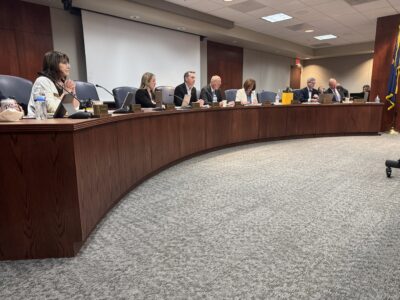
Even though we’re living in a country with 9 percent unemployment, journalist and author Andrew Ross Sorkin said Thursday that it could have been much, much worse.
“We were looking at 25 percent unemployment in this country,” one year down the road had the nation taken no action in the bank bailouts of 2008, he said.
That figure had been confirmed by Henry Paulson, a former U.S. treasury secretary, as a figure that the government was considering at during the crisis.
Sorkin, who covers mergers and acquisitions for the New York Times, is an anchor on the CNBC television show “Squawk Box” and is the author of the book “Too Big to Fail,” delivered the Kansas University School of Business’ Anderson Chandler Lecture on Thursday.
He took the audience back to 2:30 a.m. on Sept. 18, 2008, 45 minutes after Lehman Bros. failed and after Merrill Lynch agreed to be sold to Bank of America.
When the taxpayers took action to bail out the banks, it was the next dominos that could have fallen that would have been really troublesome, Sorkin said. The people in the room making the decisions for the U.S. government, he said, were really worried that a series of bank bankruptcies would lead to a bigger issue.
“General Electric was going bankrupt next,” he said, taking its 287,000 jobs around the world with it. The effects of that bankruptcy would have been worse than many countries going bankrupt, he said.
The effects could have spread to all kinds of companies, he said.
“All of a sudden, the kid flipping burgers is being affected by the guy in pinstripes,” he said.
Government officials, he said, weren’t extremely forthcoming about the full magnitude of the problem. When he asked stakeholders why, he said the answer was almost always the same.
“If we had actually told the public what we knew, we would have only made it worse,” Sorkin said.
He got the idea to write his book —which was based on interviews with 200 principals involved for more than 500 hours — after waking his wife up at 2:30 a.m. on Sept. 18 and telling her all the things that were going on. It almost was like a movie, he said.
“No, Andrew,” she said. “It’s like a book.”
In the end, they were both right. HBO picked up the book and made a movie that aired earlier this year.
Today, he said, the economy still faces many challenges, and he said if people aren’t paying attention to what’s going on in Europe, they should be.
He said path to recovery would be painful, and whatever the solution is will take a long time. Regardless of people’s political opinions on President Barack Obama’s jobs plan, he said that we don’t need a jobs plan for 12 to 18 months.
“We need a jobs plan for the next decade,” he said.
Everyone in the room, he said, should take some responsibility for how we got here, and he said patience and willingness to withstand an amount of pain will be required to get us out.
“We are the ultimate ADD society, and I would argue we’re getting exactly what we’re paying for,” he said.


Comments
LJWorld.com doesn’t necessarily condone the comments here, nor does it review every post. Read our full policy. Also, read about banned accounts and harassing comments.
Liberty_One (anonymous) says…
"“We were looking at 25 percent unemployment in this country,” one year down the road had the nation taken no action in the bank bailouts of 2008, he said."
Yes, 25 percent unemployment among bank CEOs. The rest of us would have done just fine. You see, the banks would simply have been liquidated and bought up by those banks that hadn't screwed up. However, it just so happened that the banks that had screwed up and were looking at failing had lots of friends in DC. The real purpose of the bailouts was to protect friends from their mistakes.
thinkinganalytically (anonymous) replies…
It is not clear that we would have all been fine. "Simple" liquidation could well take years if not decades to be resolved, and in the meantime the resulting uncertainty would through every financial contract into doubt. It seems very reasonable to think that the unemployment level would have reached as high as it was in the great depression.
Liberty_One (anonymous) replies…
Actually, liquidation and economic restoration usually took about six months to a year, historically.
And what's worse is that the bailout didn't solve the underlying problem of bad money. Banks are STILL failing on a regular basis. A quick liquidation would have gotten it over with. The bailout is causing every financial contract to be in doubt over a much longer period of doubt, killing our economy. If the banks had been allowed to fail we would have had about six months of pain as the bubble burst and the economy readjusted and then it would have been over. This years and years of pain is awful. Why would anyone prefer that?
LarryNative (anonymous) replies…
I believe that the banks of today are a much different animal than the banks of the 30's. The majors are so tied up in the market and real estate that they were all going to go down. Even local banks were not financially sound and not properly collaterized. We also would have seen the downfall of the largest insurer in the world which would have started a domino effect as home owners defaulted and banks were stuck with worthless properties. Due to the the deregluation of banks, the world banking system was going to collapse.
Liberty_One (anonymous) replies…
You mean due to overregulation. The banks are too much controlled by the government who protects them from bad decisions. If the government deregulated the banks and let the ones that make bad decisions fail, they would have been a lot more prudent. Since they are overregulated and protected from the free market, they took full advantage of the moral hazard and look where it got us? Overregulation causes this lack of prudence, more regulation will lead to even less prudence. That's not a good thing.
Allowing the bad banks to fail so the good ones could buy up the assets would have been the best solution. It's like giving a drunk driver his car back to bail them out. They're just going to do it again. Give the sober drivers the keys by allowing them to buy up the assets of the drunk drivers. Doing this will put the economy on a much sounder footing, setting the stage for a real recovery. Propping up the bad investments only prolongs the misery. Yes, if the banks were allowed to fail the dip would have been deeper, but it would have been over faster. Six months to a year of a bad economy is better than five years of a bad economy.
thinkinganalytically (anonymous) replies…
Why would it have been over faster? Is it not faster to get a sober driver in the car of a drunk person then force the drunk person to sell the car on the open market?
rtpayton (anonymous) says…
Where's the bail out money that's been paid back to the government? Shouldn't that money have been used to pay down the debt the government now owes. I would shutter to think some Washington policy maker takes that money as a loan never to be paid back. Reminds me of a young college student that wrote a letter to the editor wanting her college loans to be forgiven.
Liberty275 (anonymous) says…
Frankly it would be worth the risk of higher unemployment to punish anyone found guilty of crimes that led to the meltdown and suitable civil punishment for financial gurus that got too loose with their investments. Instead, we have set the precedent that the American people will bail out those with clout that leverage themselves into an untenable position and let criminals that abuse the system remain unpunished.
On a related note, GM should have been allowed to go bankrupt to punish union greed. While I would never dispute the rights of unions to negotiate, allowing GM to reorganize would have relieved them going forward from much of the excess the UAW has by virtue of virtual blackmail forced upon our carmakers over the last several decades.
If you push you employer into insolvency, then you get what you deserve.
I practice what I preach. I have made less money of late because business is slow, and I get off the clock and go home so I don't sit doing nothing while my employer pays me. I'd rather lose the money than force my employer to pay me when he isn't making adequate money off my labor. I don't want things I don't earn.
Cant_have_it_both_ways (anonymous) replies…
I fully agree on GM. They should have walked away from this company and watched as someone would come in and buy it. Machinery and workforce in place. New rules, new ideas, and new concepts. What we have is the same old crap that got them there in the first place. As for them paying the taxpayer back, I don't believe it. I am sure there has been some creative accounting and other things we will never know about. The problem with the market place is over regulation. No one I knows complains about dirty air or water, but try to do just about anything else with out having to jack with some city, state or federal employee who is afraid to make a decision, pay all the fees and wait for a couple of years. No wonder businesses are moving off shore.
jafs (anonymous) replies…
According to testimony before Congress, total union wages and benefits accounted for about 10% of their overall expenses.
And, unions did in fact make a number of concessions to the automakers as well.
camper (anonymous) says…
From Wikipedia
Of the $245 billion invested in U.S. banks, over $169 billion has been paid back, including $13.7 billion in dividends, interest and other income, along with $4 billion in warrant proceeds as of April 2010[update].
Originally expected to cost the U.S. taxpayers as much as $300 billion,[1] by December 16, 2010, the Congressional Budget Office (CBO) estimated the total cost would be $25 billion,[2] although Treasury Secretary Timothy Geithner argued that the final cost would be still lower.[3] This is significantly less than the taxpayers' cost of the savings and loan crisis of the late 1980s
hear_me (anonymous) replies…
TARP has been paid off and is turning a slight profit. TARP only bailed out the big guys. See
http://money.cnn.com/2011/03/30/news/...
srj (anonymous) says…
I totally agree, the bailouts had to be done, unpopular as they where. Bush's best moment, he stepped aside and let Paulson do his thing. No bank was safe, bank runs where happening. I
Liberty_One (anonymous) replies…
Bank runs are good for the economy. The problem was unsound money and reality was setting in. The banks are still failing, it's just taking longer, making the pain and misery take longer too.
Why would you want to extend the recession?
snap_pop_no_crackle (anonymous) says…
Oh, that's a ringing endorsement for the current regime.
Sigmund (anonymous) says…
“We were looking at 25 percent unemployment in this country,” one year down the road had the nation taken no action in the bank bailouts of 2008, he said."
Much closer to what was said (paraphrased) he "had a off the record meeting with someone at Treasury/Fed who projected a 24% unemployment if nothing was done." It wasn't clear if this was the same person who also predicted no more than 8% unemployment if the stimulus was passed. As Yogi Berra famously said, "Prediction if very hard, especially of the future."
The more interesting moments came when he discussed what countries, states, and cities are too big to fail, the Eurozone will probably not get bailed out, to big to fail also means "too big to manage," there is more concentration in banking now than in 2008, and that Fannie/Freddie should be phased out (or at least not backed by US Taxpayers).
What was not discussed, and I wished had, is does the policy of to big to fail create a moral hazard encouraging risk taking where profits are private but losses are covered by the tax payers and if companies are now too big to manage what makes him confident that the US economy isn't too big to be effectively managed by the Treasury and Federal Reserve.
I would have also liked some discussion of his belief in Keynesian economics in light of the recent Nobel Prize in Economics being awarded to Sargent and Sims whose works independently showed why government stimulus do not work as intended. "Sargent’s work suggests that government stimulus programs such as those advocated by John Maynard Keynes have a limited effect on the economy because consumers and companies realize the measures will be temporary."
http://www.businessweek.com/news/2011...
FalseHopeNoChange (anonymous) says…
Without the printed money we would have had Obamavilles on Wall st. Oh. Wait a minute. Anyway, Obamavilles are alot nicer than the Hoovervilles of the 30's. Without the printed money, Obama couldn't have started wars in Libya and Uganda either. Lady Michelle couldn't have taken $20,000,000 in vacation trips this year and Obama couldn't have raised a billion in campaign funds. He couldn't of even been able to bet on Solyndra or buy guns for drug lords in Mexico. So yes. We could have been alot worse off.
its_just_math (anonymous) says…
Does Obama's class warfare fit in here somewhere? I was eagerly awaiting this dialogue; that Obama saved us all from ultimate disaster. Well, we haven't seen what still awaits us.
tuschkahouma (anonymous) says…
lies sell well to those who don't accept reality.....they don't accept the reality that somewhere
in east Texas walks a man with an acute inability to speak publically who wrongly
convinced a bunch of draft dodging neocon hawks to invade countries that had
little or nothing to do with 9/11 and ran up huge debt borrowing from China instead
of raising taxes or selling war bonds as in previous conflicts. I sure felt confident to live within
my means when this dimwit told people to keep mortgaging their homes for the suv's,
scond homes and the like after 9/11...you say solyndra...I sat haliburton...
you want to keep your denial and lay this at Obama's feet I'll remind you over
the objections of your amnesia who started this mess....$12 trillion of this
debt existed before Obama....please remember this through your denial....
Liberty_One (anonymous) replies…
You republicans are to blame, tuschie. You overspent, you went to wars without funding, you paid off your corporate buddies, you ran up a huge deficit. Bush is your mistake and you need to own up to it.
atiopatioo (anonymous) replies…
You are trying to think like a european immigrant when you are not one. That's like a man knowing how a women feels when she is pregnant. What's next? You going to tell us how much Obama knows how to run the economy in this european immigrant country?
tbaker (anonymous) says…
So if the government hadn't bailed out the banks, we would have had 25% unemployment for a year. So I guess that means the 10% unemployment we've had for several years is somehow a better deal? Our constitution provides a solution for problems like these - bankruptcy. Free markets are not supposed to reward failure. Allowing poorly ran business to fail and go bankrupt protects all of us because the market is then allowed to function by buying up the portions of the companies that still have value, and disposing of the rest. In the end, the consumer gets better-ran companies and ; more value for the money we all spend. When business failure is protected by the government, the market cannot correct the problems; poorly ran companies/banks remain. The same people (politicians and business people) who caused the terrible economic disaster in 2008 are still in their jobs. Spending tax dollars we have to borrow to “bail” them out just guarantees the problem has not been fixed and those who caused it remain in their positions able to create the next disaster we will all have to pay for.