Gov. Sam Brownback speaks Tuesday during the Flint Hills Visioning Summit held at Camp Wood YMCA near Elmdale in the heart of the Flint Hills. Brownback encouraged the development of more tourism opportunities in the area.
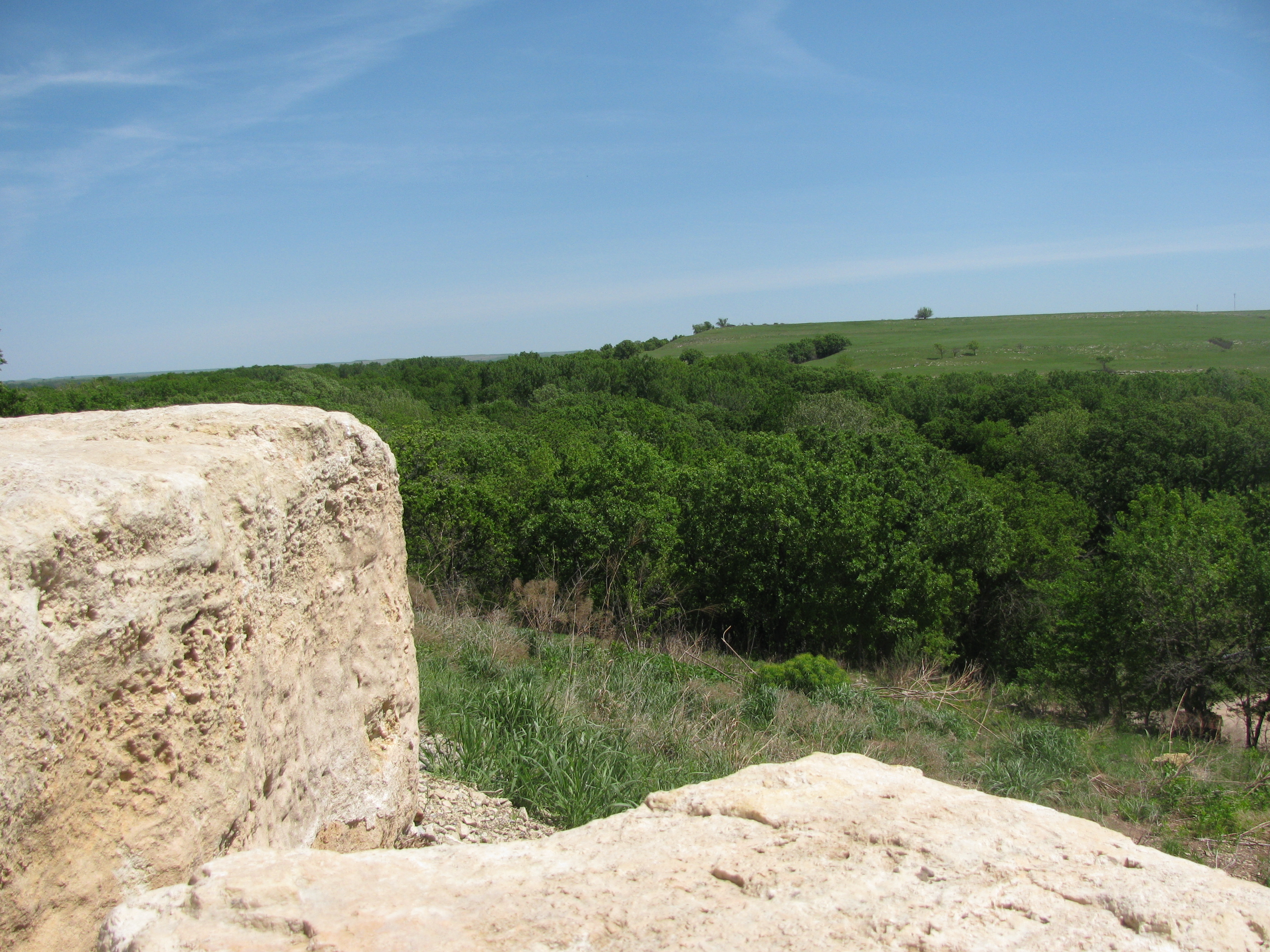
The view of the Flint Hills on Tuesday outside the Camp Wood YMCA Ritchie Lodge. At a summit on tourism in the Flint Hills, officials said they hoped the beauty and cultural heritage of the area combined with the tallgrass prairie will add up to something that people want to see and experience for themselves.
Reader poll
ELMDALE On a picture-perfect day, Gov. Sam Brownback stood in the middle of the Flint Hills and said that Kansas needs to do a better job of luring tourists to the area.
"It's a beautiful thing that exists and is now being discovered by the rest of the world," Brownback said Tuesday to more than 100 people who gathered at the governor's Flint Hills Visioning Summit.
Outside the Ritchie Lodge at Camp Wood YMCA, a brilliant sun shone on a bright green rolling landscape.
"There is no better view than outside that window right now," said state Sen. Jeff Longbine, R-Emporia. "We need to share the view with people across the United States."
Those gathered have succeeded in making the Flint Hills a tourist destination for thousands, but they said more needs to be done.
The appeal of the hills, the last remnants of the tallgrass prairie and a cowboy culture can be the anchor to developing more hiking, bicycling and horse riding opportunities, Kansas Wildlife and Parks Secretary Robin Jennison said.
"Combine this resource with the history and heritage of the area, and we have something that is truly marketable," Jennison said.
The Flint Hills stretch across most of eastern Kansas, from Marshall County in the north to the Kansas-Oklahoma border. It is home to the largest remaining area of tallgrass prairie.
One of the challenges in developing tourism in the region, is the lack of public access since there are few public lands in Kansas, Jennison said. He and Brownback said that will require working with private landowners to purchase easements for increased tourism opportunities.
Brownback said he hoped the summit would produce specific projects that the group could pursue.
He is holding a series of summits on key areas of the Kansas economy. Last month, the first summit was held in Wichita on the aviation industry. Future ones will deal with biosciences, the military and renewable energy.
Brownback stated the obvious -- Kansas lacks beaches and mountains -- but he said the authentic nature of the prairie is something that appeals to people.
Leroy Alsup, county administrator of Cowley County, said he attended the summit to find out "how we can use this asset to improve the economy in our area."
Darla Stewart, with the El Dorado Convention and Visitors Bureau, said she was there to listen and learn. "We've been pleased with efforts so far," to promote the area, she said.


Comments
mae 2 years, 1 month ago
In moving from Topeka to Wichita, I've traveled the highway down quite a bit. I go back and forth between family and friends. There is nothing about the Flint Hills that is appealing. Not even a sign or a tourist destination, nothing. I heard about them, but they just look like some fields with little elevation that I wouldn't even call hills.
ferrislives 2 years, 1 month ago
I drive that area quite a bit on I-70, and I see a sign for Flint Hills every time.
jaehawks 2 years, 1 month ago
mae,
I agree, who would go out of their way to see some small hills? Brownback is delusional--if he were interested in creating revenue for the state, maybe he should allow Kansas' wind energy to expand
mseybold 2 years, 1 month ago
the best way to appreciate nature is to get out of your car and into it. On a road trip I stopped in at the Tallgrass Prairie Nature Preserve north of Strong City, went to the visitors center and took a walk on a short trail and gained a new appreciation for the Flint Hills.
TimW 2 years, 1 month ago
I'm a native New Englander, a camper, and a hiker. I've spent the last 30 years exploring every peak, valley, and river of the White Mountains of Maine & New Hampshire. There's nothing I like more than spending time outdoors.
When my wife took her job and said "We're moving to Kansas", I'll admit that I had nothing but the dullest pictures in my head of what our new home would look like. Thunderstorms, tornadoes, endless fields of nothingness.
Well, color me surprised. It sure is different, but I've found that I love it nonetheless. Here's the problem: Access.
I'm used to a place where a good 75-80% of the land is national forest or owned by paper companies (in Maine at least, by law they must give public access to their leased land), here the land is all private. I've been to both Konza and Tallgrass several times, but I want more. There seem to be little, to no, backcountry opportunities in Kansas.
I would love to pitch a tent in the middle of the prairie with nothing around for miles in any direction, look up at the stars, listen to the wind whipping up my tent. As far as I know, you can't do that here. In New England I could stop my car almost anywhere and feel safe hiking through the woods to whatever it was that caught my interest. In Kansas, it seems to me that ALL the land belongs to a farmer or a rancher and that I'm not welcome.
Obviously I'm not suggesting that we take land from private citizens and make it public, nor would I suggest that I be entitled to tromp across any land I want with reckless abandon. However, if there are opportunities to acquire land (cheaply), the state should take it AND PUBLICIZE IT.
There is backcountry beauty in Kansas, but there's A.) no access to it and B.) the little that you can get to isn't publicized/advertised enough that people know about it.
...and before someone jumps in with it, while there are plenty of state parks/fishing lakes/campgrounds none of them seem to offer much in the way of backcountry camping. It's more of the lay down in your tailgate, drink a beer, and blast country music camping, which I'm not a fan of.
just_another_bozo_on_this_bus 2 years, 1 month ago
I believe Kansas has the lowest percentage of publicly owned land of any state in the union. Something like 98% of it is privately owned, and very little of that is accessible to the public.
hermann2626 2 years, 1 month ago
This is the most thoughtful response to this article, and I think TimW is right on the money here.
I love the Flint Hills. I've lived all over the western US in my 55 years and it's as beautiful as any place I've seen, IF you are willing to get off the highway.
Now the bad news: Kansans can be a bit sullen. It doesn't hurt to be nice, folks. Smile. You live in pretty nice state.
tanzer 2 years ago
Sullen! That is what it is! I called it the oval face of oppression when I first moved here 12 years ago.
none2 2 years, 1 month ago
I once saw that lake. It was beautiful!
I have to say I also saw Clark County Lake in the southwest. It is a very beautiful lake, and it isn't flat around there like most people think western Kansas is.
culturechange 2 years, 1 month ago
I think the Flint Hills are beautiful in the spring and summer. If you have ever seen a Flint Hills lake or pond, the water is surprising clear and very rich looking. Like nothing I have ever seen. The Flint Hills could use some more medium sized lakes.
Here is something that KS citizens need to know. A KDWP (Kansas Dept of Wildlife and Parks) rep told me that the state spends hundreds of thousands of dollars per year on Watershed Program projects in Kansas. These programs often build water diversions structures and lakes/ponds on private property for flood control. These private landowners get a good deal of state funds to design and construct these land improvement features on private property. The private land owners are not even required to allow public access for hunting and fishing. This goes back to Tim's comment about who much land is private an unavailable.
KDWP has a F.I.S.H. program which opens up private land for recreational use. The land owners are paid by the dept and the land is regulated by KDWP for hunting and fishing, etc. It seems that participation in this program should require these land owners to participate in this existing program. This way the public benefits from tax money spent improving private land by access to it.
As an example, the State build Crizter lake just west of Mound City KS in 2006. It is 220 acres of new lake on private property. KDWP is negotiating with the owner to get access but has not gotten it yet. The law in KS needs to be changed to require public access to this lake when State fund are used to build such feature. The citizens should be able to enjoy this lake instead of it being horded by private citizens after the State paid for it.
TimW 2 years, 1 month ago
Just as an illustration of some of the differences between states (and I believe this is an East/West thing and not specific to the two states I'm using to illustrate the point).
Here in Kansas private land seems to be private. In a state like New Hampshire (where my father owns a 16 acre parcel that he cannot restrict) ALL private land is considered public and open for recreation unless certain stipulations are met by the landowner.
Now there is a long history of respect for the land up there and while I have seen signs of camping, and even met a couple of campers, on my father's PRIVATE land, there's never been a single problem (no litter, vandalism, etc.).
Here in Kansas if I went for a hike on undeveloped land I half expect to come over a ridge and have a shotgun in my face (exaggerated for effect. In short, I just don't have the feeling I'd necessarily be welcome).
Any program to encourage private landowners to welcome (and even advertise, after all, how else would I know where I'd be safe to explore) recreational use of their land would be a positive thing.
none2 2 years, 1 month ago
Could you explain a bit more how things work back there? For instance, does your Dad live on the land, or he is an absentee owner? If he lives on those 16 acres, are you saying that hunters, boaters, hikers, etc can just drive into his drive way, park and go out and do their thing? Don't they need to talk to your Dad in advance? Are they allowed to drive 4 wheel drives on your property or drive in boats for lakes? What if there are livestock? Are you promised that they will shut all gates that they pass through? What if they are deer hunters that shoot at the crack of dawn. Can they even shoot wildlife on your Dad's property without paying your Dad? (Obviously, they at least had to get a state license to hunt.) Is it ok if the gunshots wake your dad up? What if a stray bullet kills livestock or accidentally hits someone at your dad's place. (That may sound like a strange question but a little girl in the countryside between Linwood & Desoto was shot in the head most likely from a hunter's stray bullet. http://www2.ljworld.com/news/2008/feb... )
I'm just trying to understand how things work elsewhere as it seems so foreign in my mind. FYI, There were times I would have loved to walk on private property. For instance, I always wanted to follow the paths of rivers in western Kansas -- ie the ArKansas & Cimmaron River. However, I dismissed such ideas as one would have to get permission from EVERY land owner along the path. (Hopefully someday someone will do that and it will end up in a documentary on Kansas rivers that we can all view.)
TimW 2 years, 1 month ago
Basically, the answer to most of your questions is yes.
There was, but is no longer, a dwelling on the property, so nobody lives there anymore (his parents, my grandparents, did retire there and live for a little over 10 years). I don't know for sure but I imagine that there are state laws about shooting firearms within a certain distance of a residential building, so I assume that would lessen the risk of an accident.
He COULD post the property as no hunting, but there are certain procedures that need to be followed which include proper signage I believe posted a minimum of every 100 yards, and in his case, because of the size of the parcel (and 16 acres ain't exactly huge) subdividing and fencing the land.
As far as things like livestock go, there really isn't any. 90+% of the land north of Lake Winnepisaukee (sp?) in NH is federally owned national forest, heavily forested, and mountainous. There really is not much of a culture or history of farming or livestock there. The land just wouldn't support it.
A lot of the public use of private land staff isn't even written into law anywhere, but it is recognized by the courts as being part of "common law".
I would imagine that so much of the land being federally owned to begin with is a big reason why public access to private land is, and always has been, allowed. If so much is national forest, why force people to move around these small pockets of privately-held land (that probably wouldn't even be marked) to get from one wilderness area to another.
Maine is different as the percentage of private land is MUCH higher, but a huge percentage is owned by paper/logging companies who as part of their leases are required to allow access. There is a long history in Maine (and lots of New England) of viewing nature as something for the public to access, enjoy, and appreciate.
none2 2 years, 1 month ago
I really appreciate you taking the time to respond. We all tend to think "America" is pretty much the same everywhere. However, the property rights you are stating seem so foreign to me. So it is good to know how they differ.
I do think I would have problems with shooting if there were any risk to people or to livestock. I also would find it weird if there was a recency if people were just driving up, parking on your property, and doing whatever they wanted with not even asking permission. I think it would be a bigger issue if your particular property was "popular". What is the sense of living in the country if lots of people "just show up". However, perhaps along with common law is common courtesy where some of these issues were not big deal. However, imagine a farmer who hears a scary noise and rushes out with just his shoes, his skivvies and a gun to check out if a preditor has attacked his live stock, only to find that while he has gone to check on his livestock, he also has voyers. I guess I'm thinking it just seems somewhat uncomfortable. Again, the best analogy I could make is if you had stranges walking around your yard in town. If they weren't your neighbors, you might be tempted to call the police to make sure they aren't there to steal or vandalize.
I do think we all need to be exposed to nature, otherwise we don't understand WHY there are environmental laws if our view of the environment is watching a nature shoe on TV or going to a zoo. I just hope that any such public access on private property involves some respect for the privacy of the owners, safety for them and their livestock, and no vandalizing.
none2 2 years, 1 month ago
One thing I might point out about private/public ownership in Kansas is the rails-to-trails that are being created. (NOTE: While one one hand I fear we are destroing the ability to ever use rail again, at least if there is no business with an interest in them at least the rails can be used for nature lovers.)
I really don't know how the rights work. I wonder what happens when you go so far on the trail where you are done for the day. Do they allow tents? How far do the former rail easement go if you must stay on public property? Are they publicly owned, or some rail company, or revert to the nearby private owners? Some trails close at night, so I would think that presents its own problem.
FYI, for those that don't know that there are some major trails around here (not all completely finished): a) Landon trail -- Topeka to the Flint Hills Trail (Note: It passes through the former town of Richland, KS which was leveled as part of the buildling of Clinton Lake: http://en.wikipedia.org/wiki/Richland...)
b) Prarie Spirit trail -- Ottawa to Iola. c) Flint Hills trail -- Osawatomie to Herington
(This trail intersects Prarie Spirit at Ottawa, intersects Landon at some point called the Lomax Junction [between Pamona the town and its lake])
There is a link to a report of a bike path being planned from west Lawrence (K-10 near the Clinton Dam) to the far west side of Clinton Lake where it would hook up with the Landon Trail at the former town of Richland. There has been no update to any infomation on this trail it for a long time. The trail name is Free-State Pathway, and the link I found was:
http://www.kanzatrails.org/ourconnections/freestatepathway.html
Jimo 2 years, 1 month ago
I believe your description is partly accurate but also misleading.
All private land in the U.S. is private absent some retained right or easement. Government policies and methods can, however, significantly influence the nature of those limitations. For example, in NH, there is a legal presumption of access by the public unless the private land is posted otherwise. There is also the problem of damages for trespass (none?). Who would pursue legal action against hordes of people determined to walk the woods of New England? Kansas ranchers don't really have the practical impediment.
In your example, four key matters lead to the different results: A. The public has a much higher interest in the forest of N.H. than the plains of Kans. That's just a fact. It doesn't mean that is more important than the other.
B. Following from A, NH has pursued an aggressive policy of conservation easements and (tax) incentives for private parties to preserve land (with the side benefit of public access). Kansas too could (a century or so into the future) end up in a similar place if it also pursued such a course. Absent a keen public interest in the Flint Hills, this won't happen.
C. The federal government plays a role in NH because a century ago all the New England forests had been cut down and despoiled. Under what's called the Weeks Act, the U.S. purchased this land and turned it into national forest land. (This in contrast to the West where the U.S. never disposed of the land to begin with.) The U.S., or Kansas, could purchase whatever land they want to. But the fact is, back to A, the public has little interest in this and would consider the expenditure a waste.
D. Kansas has one federal land - the Cimarron National Grassland (owned by, ironically, the U.S. National Forest Service) in the SW corner. It, like in N.H., was land purchased back from private ownership by the gov't, this time under a Depression-era law called the Bankhead-Jones Act, which gave 'socialist' relief to farmers who owned the most marginal worthless land ever to see a plow. (Not that giving away the land by the U.S. in the first place wasn't 'socialist' as well - just a reminder to the libertarians that the gov't has routinely interfered with private enterprise for the length and breadth of American history.)
riverdrifter 2 years, 1 month ago
The access issue is why the Flints will never be a viable venue for tourism. Much of them is owned by absentee owners and is used as a private playground or leased out for hunting or whatever. BTW, the Flint Hills will never approach the quality of deer hunting that we have right here. Probably the greatest hunting opportunity there is the greater prairie chicken. Hunters from across the country come to hunt them but a few hard-core hunters checked in at the Bluestem Motor Lodge in Eureka is some kind of hard-scrabble tourism -at best.
The_Big_B 2 years, 1 month ago
Leave the Hills alone. Their main attraction is that all of you are NOT there.
tanzer 2 years ago
Exactly! I travelf or work a lot and it is one of the things I enjoy - no traffic - no cars on the road. I travel to the south for holidays - gulf coast, Atlanta, etc - and HATE the traffic! The paucity of people on the roads is Kansas best attraction some days.
nomansland 2 years, 1 month ago
As long as Brownback is governor should be enough to keep most simple-minded folks from out of state visiting the Flint Hills. Not that its very scenic anyways.
Kontum1972 2 years, 1 month ago
Did Custer feel the same way about the Little Big Horn?
Kontum1972 2 years, 1 month ago
so will this bring Kansas out of the economy mess it is in......?
Kontum1972 2 years, 1 month ago
mb some casinos will help....
Jimo 2 years, 1 month ago
One day Sam is a small government conservative that can't stand to waste taxpayer money on art. The next day Sam is a big government conservative, wasting taxpayer money on some pet project that a child could see through as a boondoggle.
happyhippy 2 years, 1 month ago
Brownback is against a wind farm being built in the Flint Hills, but I bet he'd be all for a coal plant.
Yeoman2 2 years, 1 month ago
I have been through the flint hills many times while still visiting my family in Oklahoma. I have never, not even once, been motivated to stop anywhere in this area to observe the wind, dust, blowing grass and trash ever.
It never ceases to amaze me at the ability of people with twisted agendas to stir up non-issues like the flint hills, the sacred Haskell swamp or other worthless issues to assuage and stroke their demented personalities and to attack the sensibilities of most of the rest of us with the usual important issues to face daily. I think this governer is totally off the mark with all his grandstanding to create some sort of holy nirvana from a plain old windswept prarie in his attempts to prevent building much needed facilities to generate electricity from renewable resources. Which is what this is ALL about.
jayhawklawrence 2 years, 1 month ago
When I heard that Brownback was cutting the Arts Commission I thought about the tourism issue and wondered how the state can justify spending money to promote tourism but will destroy a low budget operation like the Arts Commission.
I used to be in the Art business and traveled extensively throughout the Rocky Mountain region where I visited many galleries and attended Art shows. My experience was that the artists oftentimes promote the culture of a particular area. Art, culture and the natural world are very interconnected.
So I think it is interesting how Brownback's mind works and confusing.
Certainly, when you understand the beauty of Kansas you have to wish for a way to promote it as the Kaw River group works at promoting the Kansas River and working to install more boat launches. This is a great program.
What Brownback is doing in the Flint Hills will be forgotten soon enough and he will perhaps win a few more votes from people who think he is a "good steward of the land" as Bush called himself.
But it is pure politics and nothing much will be accomplished from it.
Just a lot of nonsense as usual.
none2 2 years, 1 month ago
Actually, I think he doesn't want windmills in hopes that they find coal somewhere and we can start some strip mining in the area.
If they don't find coal, he would like a lot of music festivals with RV's, motorcycles, dirt bikes. Perhaps even another NASCAR race track.
verity 2 years, 1 month ago
Thank you to TimW, culturechange and multi for your thoughtful and helpful comments. It's nice to see some positive comments instead of all the "it won't work" negativity.
I grew up on the western edge of the Flint Hills. I think there is nothing more beautiful than the prairie on a misty day in the fall when the atmosphere saturates the colors---the rust, purple, gold and pink are incomparable. Probably because of what I am used to, mountains make me claustrophobic, especially in the places where you can only see the sun four hours a day. I like being able to see forever. Does anyplace else on earth have the sunsets we have in Kansas? Listening to the coyotes howl under the moon on a cloudless night and being able to see the stars and constellations without interference from city lights or mountains---what could be better?
Of course it would take some work and cooperation, but I don't see why the Flint Hills couldn't be a tourist destination. Where's that can do attitude---"to the stars through adversity"?
I disagree with Herman2626---I find Kansans to be some of the friendliest people I've come across. (You may not want to hear this, but Texans are very friendly also.)
"Much of them is owned by absentee owners . . . ." I keep seeing this statement made and I would like to know exactly what percentage. I know many "corporate farms" are in reality family farms which have been incorporated and wonder how many of the ranches in the Flint Hills have done the same thing, so on paper it looks like corporate, absentee owners.
The article makes it sound like the Flint Hills stop at the state border---they extend into NE Oklahoma where they are known as the Osage Hills. The Chapman-Barnard Ranch was purchased by the Nature Conservancy. Look up "Tall Grass Prairie Preserve in Oklahoma" to see how it has been managed and made into a tourist destination.
I doubt that Gov. Brownback's motives are pure, but that in itself doesn't mean that it is a bad idea.
jayhawklawrence 2 years, 1 month ago
Of course they are beautiful as are many places in Kansas. Kansas is full of beauty.
But it is a question of how we take care of the environment as much as how we choose to promote and make access easier for people to enjoy these natural wonders.
I have just lost faith in the politicians. They don't impress me as having anything but an ideological agenda.
Politicians are running the show and I think we need to realize that we are being played most of the time.
merrill 2 years, 1 month ago
Brownback talk is cheap.
He has no clue. It takes money to create tourism and then hope enough tourists show up to make the investment pay back at least in Kansas. Too many tourists and their RV's can ruin a place like the Flint Hills.
Brownback is out trying justify cutting off wind power in spite of the fact Kansas is rated number 3 in the nation for wind power potential.
He likes subsidizing expensive and toxic sources such as Nuke and Coal = fiscally irresponsible.
merrill 2 years, 1 month ago
Sam Brownback is following the same governing blueprint that Gov Scott Walker of Wisconsin is implementing.
According to Jim Hightower you'll find piles of right-wing money from the Koch brothers, the DeVos family, the Erik Prince(Blackwater Mercenary Army fame) family, and the Waltons of Wal-Mart.
verity 2 years, 1 month ago
Merrill, I have no doubt that you are right about Gov. Brownback's intentions. However, this can work if enough people want it to.
As I stated above, check out the Chapman-Barnard Ranch in NE Oklahoma.
Also "The Symphony in the Flint Hills" always sells out quickly even though the tickets seem a little pricey to me and the attendees have to make the drive out into the "wilderness." (Adults: $72.00; Children (12 & under): $40.00; Plus: $3 handling fee per ticket.)
I suggest, that instead of thinking of reasons why this wouldn't work, people join the Nature Conservancy and try to make it work.
verity 2 years, 1 month ago
I advocate building a wind farm and making it a tourist destination. I find wind mills quite beautiful and would certainly visit a wind farm.
From TimW's statements above, there does seem to be ways to do this without ruining the environment---surely if New Englanders can do it, middle America can.
The tall grass prairie is not the only unique area we have in Kansas. There is also the Cheyenne Bottoms and the Quivira National Wildlife Refuge which are not all that far from the Flint Hills.
Commenting has been disabled for this item.