

Miners not discussing details of ordeal
Chileans want to split earnings
Copiapo, Chile ? The first rescued Chilean miners out of the hospital celebrated their new lives as national heroes Friday, as word emerged that the 33 want to closely guard their story so they can fairly divide the spoils of their media stardom.
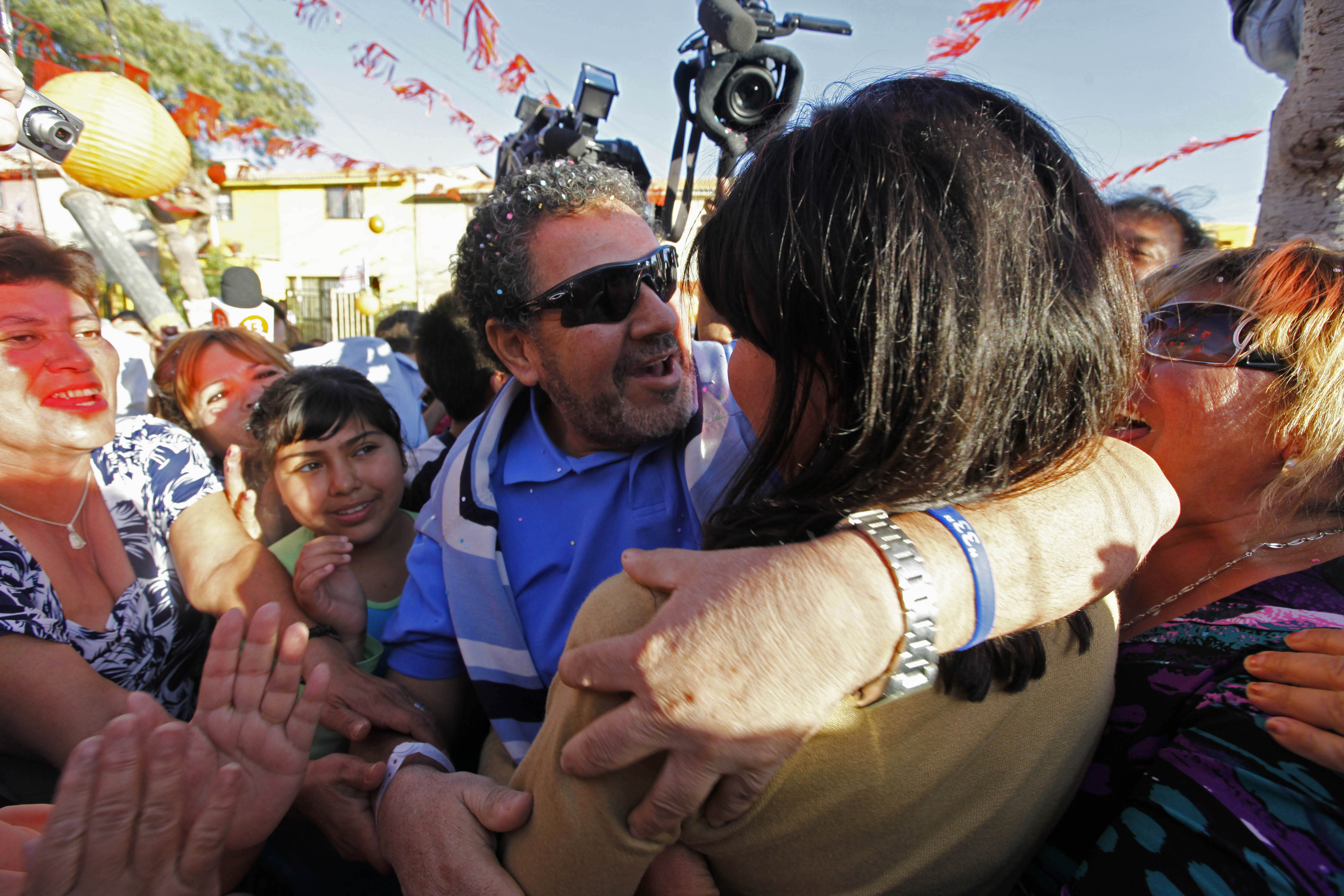
Rescued miner Luis Urzua embraces his wife, Carmen Rosa, as he arrives home Friday in Copiapo, Chile. Most of Chile’s 33 rescued miners headed home from the hospital Friday as heroes after their 69-day ordeal trapped deep underground.
That could explain why none of them have spoken publicly at any length or provided any dramatic details of their 69 days trapped a half-mile beneath the Atacama desert.
A daughter of Omar Reygadas, a 56-year-old electrician, said in an interview with The Associated Press early Friday that he told her the miners agreed to divide all their earnings from interviews, media appearances, movies or books.
“He also said we can’t say things to the media without their permission,” said Ximena Alejandra Reygadas, 37. “He said they need to decide what we can tell the media.”
Hundreds of reporters abandoned the mine and descended on this gritty provincial capital on Thursday after the world watched the nearly flawless rescue, through a narrow shaft it took a month to drill.
A shift foreman at the San Jose mine who is close to many of the rescued miners told the AP they have hired an accountant to track their income from public appearances and equitably distribute it.
“More than anything, I think the idea is to charge for the rights to everything that’s been shown about their personal life, of their odyssey. That way, they’re safe,” Pablo Ramirez said.
Ramirez, 29, had lowered himself deep into the mine’s bowels right after its Aug. 5 collapse in a failed attempt to reach his comrades.
“They’re going to be very close to the chest and will speak together as a group,” he said, while drinking rum and cola in a Copiapo restaurant.
Ramirez is out of a job with the roughly 360 other San Jose miners now that the government has decided to close the mine as unsafe. And while he said he’s got good job prospects as an experienced miner, “los 33” were probably the most in-demand people on the planet.
A Greek mining company wants to bring them to the sunny Aegean islands. Football teams in Madrid, Manchester and Buenos Aires want them in their stadiums.
Bolivia’s president wants them at his palace. TV host Don Francisco wants them all on his popular “Sabado Gigante” show in Miami.
On Thursday, still wearing the fashion sunglasses designed to ease their readjustment to sunlight, the men posed in hospital bathrobes for a group photo with President Sebastian Pinera.
Solidarity helped the men survive the angst and uncertainty of being trapped under a 700,000-ton block that collapsed at the very center of the mine — the area Ramirez said everyone thought was the safest because that’s where a 5-mile ramp winds downward in a spiral. It’s on the ramp’s periphery that the miners blasted open veins of gold.
For the first two weeks, no one knew whether they were alive.
After contact was made, a team of government psychologists engaged them in a grand social engineering plan, dividing them into groups, setting their work and sleep schedule, restricting the television and movies they could see. The miners were even barred from receiving iPods along with everything else fed them through the 5 1/2-inch pipe that served as their lifeline to the surface.
The chief psychologist, Alberto Iturra, left little to chance, and the assessment of the doctors who treated them was glowing. All the rest of the miners were expected to be out of the hospital Friday and over the weekend.
“We don’t see any problems of a psychological or a medical nature,” said Dr. Jorge Montes, deputy director of the Copiapo Regional Hospital.
Ramirez, as you’d expect from a man who embraces the risks of his profession, scoffed at the need for all the psychological treatment.
“When we first spoke to the miners down below … they weren’t in bad shape,” he said. “Psychologically, they weren’t in bad shape at all.”