

North Korea could be setting stage for Kim Jong Il’s heir
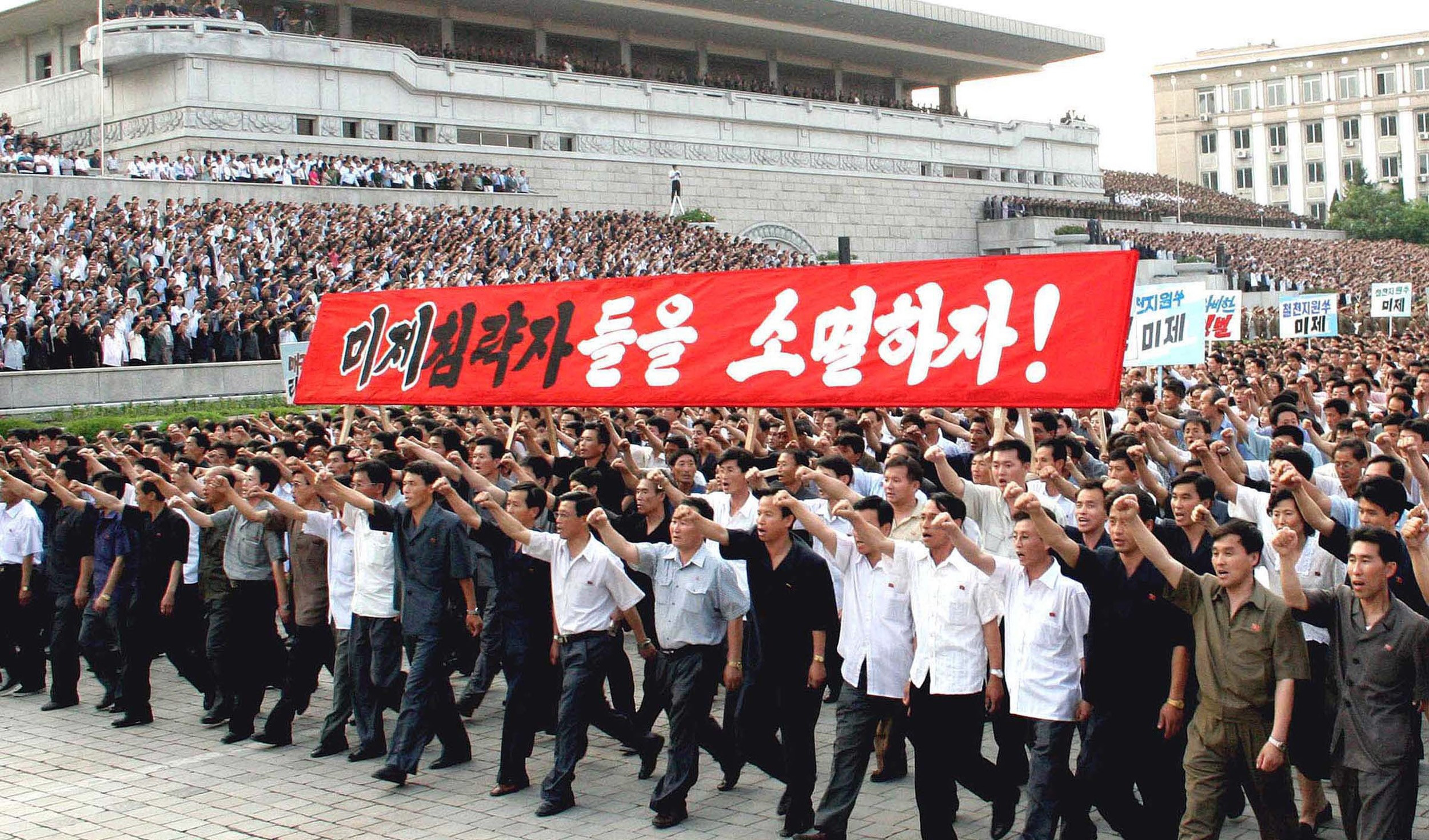
North Korean demonstrators chant anti-U.S. slogans as they march Friday in Pyongyang, North Korea. Tens of thousands of North Koreans rallied in their capital to condemn the United States and South Korea on the 60th anniversary of the start of the Korean War. The sign reads “Wipe Out U.S. Aggressors.” North Korea could formalize an attempt to transfer power from current leader Kim Jong Il to his third son, Kim Jong Un, analysts said after Pyongyang’s official state media reported Saturday that a rare meeting to determine government leadership will be held in September.
Tokyo ? North Korea could formalize an attempt to transfer power from current leader Kim Jong Il to his third son, Kim Jong Un, analysts said after Pyongyang’s official state media reported Saturday that a rare meeting to determine government leadership will be in September.
The planned handoff of power, a topic of speculation since Kim Jong Il, 68, suffered an apparent stroke in August 2008, comes as nuclear-armed North Korea is dealing with a crumbling economy, famine and the international response to its recent sinking of a South Korean warship. Outside North Korea, little is known about Jong Un, believed to be 27 years old. The murky succession process, combined with North Korea’s erratic behavior, has heightened concerns about a possible power struggle following Kim Jong Il’s death.
Saturday’s announcement, carried by North Korea’s Central News Agency, said the September convention will be to elect the ruling party’s “highest leading body.” But the report did not name Jong Un specifically.
“It seems that the people in Pyongyang now want to move fast — likely because they know something dangerous about the state of Kim Jong Il’s health,” said Andrei Lankov, a North Korean expert at Kookmin University in Seoul.
Since North Korea’s establishment in 1948, it has had two leaders — Kim Jong Il and his father, Kim Il Sung — and two previous comparable meetings, most recently in the 1960s, according to a South Korean media report. Kim Il Sung died of a heart attack in 1994, but his son’s succession — the first successful hereditary transfer of power for a communist nation — had been established publicly 14 years earlier.
North Korea watchers and those with sources inside the country believe that a rushed transfer of power, with little time given to boost Jong Un’s credentials, will further heighten the nation’s instability.
A North Korean collapse would touch off a race to secure its nuclear arsenal, raising the prospect of a showdown between South Korean and U.S. troops moving north and Chinese troops moving south. Add to that a large mass of refugees flooding into China, and there’s a recipe for chaos.
Earlier this month, North Korea convened the Supreme People’s Assembly, its highest legislative body, and reshuffled its leadership. Jang Song Taek, Kim Jong Il’s brother-in-law, was appointed vice chairman of the National Defense Commission, the de facto No. 2 leadership role. Because Jang reportedly favors the hereditary succession plan, analysts viewed the move as part of a larger strategy to pave the way for a smooth power transfer.
In early May, Kim Jong Il and a huge entourage traveled to China, stopping at the official state guest house in Beijing.
News media captured footage of the leader dragging his left leg, a presumed effect of his stroke. According to Marcus Noland, a North Korean expert and the deputy director at the Peterson Institute for International Economics, Kim Jong Il used the trip in part to receive China’s blessing for a dynastic succession. China, Noland said, suggested other leadership options be explored.
This week, South Korea’s National Intelligence Service director, Won Sei Hoon, was quoted in the South Korean media as telling parliament that Jong Un has begun participating more heavily in North Korean policymaking. North Korea, Won said, has also launched a propaganda campaign to build Jong Un’s profile.
There is no known adult photo of Jong Un. Between 1998 and 2000 he attended school in Switzerland, but he has taken a background role since returning to Pyongyang.