

Mexico justice means catch and release
Ciudad Juarez, Mexico ? Editor’s note: This is one in an occasional series of reports by The Associated Press examining why — four decades and $1 trillion after Richard Nixon declared war on drugs — the U.S. and Mexico continue to fight a losing battle.
It’s practically a daily ritual: Accused drug traffickers and assassins, shackled and bruised from beatings, are paraded before the news media to show that Mexico is winning its drug war. Once the television lights dim, however, about three-quarters of them are let go.
Even as President Felipe Calderon’s government touts its arrest record, cases built by prosecutors and police under huge pressure to make swift captures unravel from lack of evidence. Innocent people are tortured into confessing. The guilty are set free, only to be hauled in again for other crimes. Sometimes, the drug cartels decide who gets arrested.
Records obtained by The Associated Press showed that the government arrested 226,667 drug suspects between December 2006 and September 2009, the most recent numbers available. Less than a quarter of that number were charged. Only 15 percent saw a verdict, and the Mexican attorney general’s office won’t say how many of those were guilty.
The judicial void is a key reason why Mexican cartels continue to deliver tons of marijuana, methamphetamines, heroin and cocaine onto U.S. streets.
“It in effect gives them impunity,” U.S. Ambassador Carlos Pascual told the AP, “and allows them to be able to function in ways that can extend themselves into the United States.”
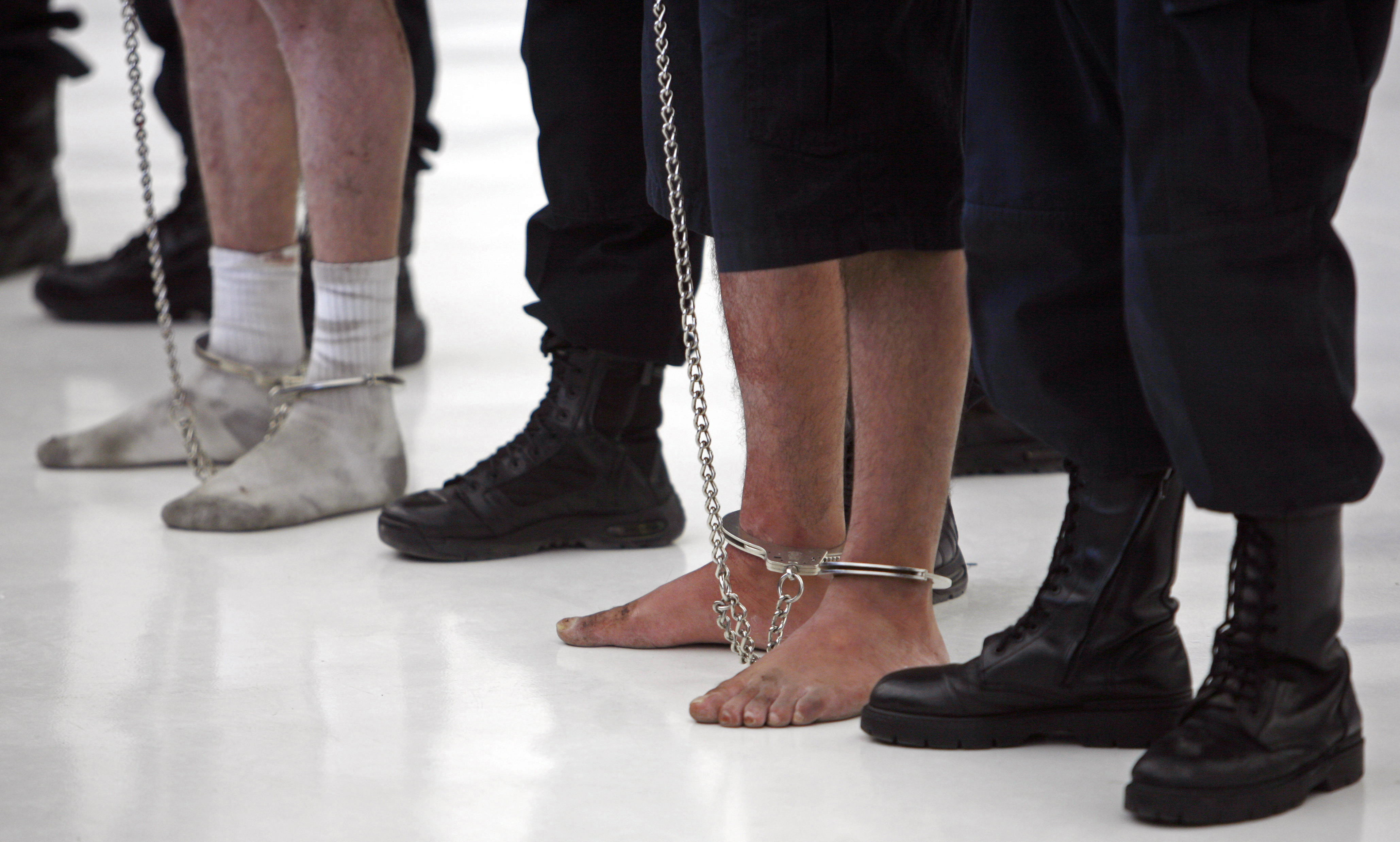
Federal police officers stand next to the chained feet of alleged members of the Sinaloa drug cartel, headed by Joaquin ‘El Chapo’ Guzman, during their presentation to the press in Mexico City in this June 10, 2009, file photo. An Associated Press investigation has found that three-quarters of the drug suspects arrested since Mexico’s President Felipe Calderon declared war on the cartels have simply been let go.
•••
Mexico’s justice system is carried out largely in secret and has long been viciously corrupt. Add a drug war that Calderon intensified, and the system has been overrun. Nearly 25,000 people have died in the war to date, and the vast majority of their cases remain unsolved.
The AP obtained court documents and prison records restricted from the public and conducted dozens of interviews with suspects’ relatives, lawyers, human rights groups and government officials to find out what happened after suspects were publicly paraded in key cartel murder cases.
In Ciudad Juarez, where a war between two cartels over trafficking routes killed a record 2,600 people in 2009, prosecutors filed 93 homicide cases that year and got 19 convictions, the AP found. Only five were for first-degree murder, court records show, and none came under federal statutes with higher penalties designed to prosecute the drug war.
“They never charge anyone with homicide because they don’t have the evidence, they don’t have proof,” said Jorge Gonzalez, president of the public defenders association. “They just show them to the media to give the impression that they’re solving cases.”
•••
Soldiers in Juarez routinely announce to the public that suspects have confessed to a shocking number of murders.
Hector Armando Alcibar Wong, known as “El Koreano,” killed 15, they said. But a year after his August 2009 arrest, authorities don’t even know where he is. Chihuahua state officials say they handed him over to federal authorities; the attorney general’s office says it never had him.
Soldiers told the media in 2008 that Juan Pablo Castillo Lopez was tied to 23 killings. He was never charged with homicide and was freed from state prison less than a year later. The army quickly arrested him again, saying he killed two more people within three days. Nine months after that, he still doesn’t face a homicide charge.
Oswaldo Munoz Gonzalez, known as “El Gonzo,” admitted to killing 40 people, according to the joint police-army operation in Ciudad Juarez. His family says he was tortured into that confession. Eight months later, he hasn’t been charged with a single homicide either.
Munoz was first detained in 2008 and accused of aggravated robbery but he was released after prosecutors failed to present enough evidence.
Two months after he was released, authorities say they nabbed Munoz during a traffic stop, and found drugs and guns in his truck.
His sister, Petra Munoz Gonzalez, says they’re lying — he was dragged from his home while his wife and two young daughters watched. She says her brother, a taxi driver and occasional bus driver with a third-grade education, does not drink or use drugs.
Munoz’s family didn’t know where he was until they saw him paraded on television days later, with guns and drugs in front of him.
“He told me, ‘I never killed anyone,'” Petra Munoz said. “He said he confessed because he had been tortured. He told me they put a bag over his head so he couldn’t breathe and gave him electric shocks down there (on his genitals) and beat him until he fell over in pain. Who would endure that?”
“I just ask that the truth be told,” she added. “Why haven’t they presented proof, or witnesses, or anything that incriminates him? It’s been almost a year.”
Chihuahua authorities say they can’t discuss open cases. Mexico Attorney General Arturo Chavez declined several AP requests for comment.
•••
Even Mexico’s president admitted the court system is inept recently as he touted a new judicial system that Mexico has begun to adopt.
“It fosters injustice, impunity and corruption,” Calderon wrote on the presidential website. “We need a profound change and that’s why we have begun an unprecedented effort to modernize and redesign our legal system.”
That effort, with aid from the United States, started under a constitutional amendment passed by the legislature, approved by all 32 states and signed by Calderon in 2008.
Under the old system, defendants are presumed guilty until proven innocent, proceedings are carried out almost entirely in writing, and judges usually rubber-stamp whatever government prosecutors and investigators hand them. Without public scrutiny, mistaken arrests, bungled investigations and false confessions are commonplace.
With the reform, defendants are presumed innocent until proven guilty; police must investigate crimes and collect evidence before making arrests; a panel of judges decides whether there is enough evidence for the case to proceed, and trials are argued orally in courts open to the public.
The law calls for the changeover to be completed by 2016. The U.S. Agency for International Development has provided training in forensics, interviewing and courtroom arguments to 550 Mexican prosecutors. Some 5,000 federal police officers have taken basic investigation courses, also with U.S. funding. The Obama administration is requesting $207 million in its 2011 budget for judicial and government reforms in Mexico.
The new system was piloted in Chihuahua state, home to Ciudad Juarez, in 2007 — just before the Sinaloa and Juarez cartels began their bloody war to control drug routes into the United States. All Chihuahua prosecutors and judges were trained in the new techniques.
But even state prosecutors say the drug war has stymied the new system.
Soldiers, who under Mexican law can’t do police work, routinely bring in evidence such as illegally obtained confessions that judges are forced to throw out.
“The numbers of arrests increased tremendously but the numbers of prosecutions virtually didn’t change,” noted Pascual, the U.S. ambassador.
Since the reform was implemented, 98 officials who had received training — police investigators, forensic experts, prosecutors — have been assassinated by gangs, said Carlos Gonzalez, spokesman for the Chihuahua attorney general’s office.
Nobody has been arrested in any of those killings.