This year’s fifth-graders will get more opportunities next year to participate in athletics, academic clubs and other organized after-school activities.

Sixth-graders to participate in more activities
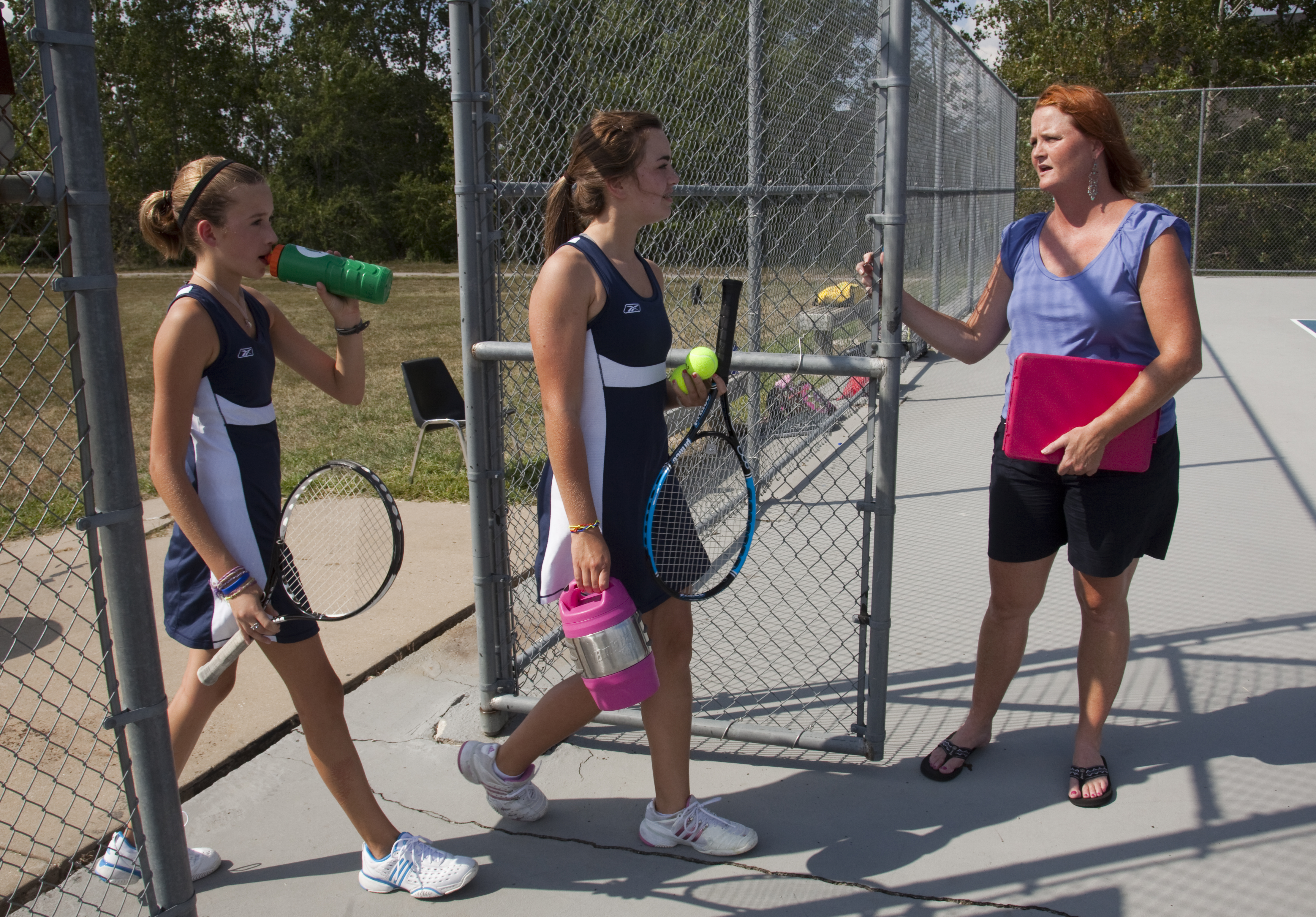
Moving the sixth-graders to junior high means they will be able to participate in sports and other extra-curricular activities. Enlarge video
Seventh-grader Alison Gehrke returns the ball Monday during a tennis tournament at Southwest Junior High.
Thanks, middle schools.
Such increased offerings are among the benefits envisioned by district leaders and administrators, as they prepare to create what Superintendent Rick Doll describes as “true middle schools” in Lawrence: buildings for sixth, seventh and eighth grades, rather than the current seventh, eight and ninth grades.
“I would like sixth-graders to feel like they have a range of opportunities to be involved in,” said Trish Bransky, in her 16th year as principal at Southwest Junior High School, 2511 Inverness Drive. “Having kids be engaged in school, you’ve got them hooked and they want to be there — that’s three-quarters of the battle. They’ll show up. They’ll work for you. They’ll have a sense of community. …
“It really works.”
On the sidelines
Sixth-graders answering “yes” to this statement on the annual “Communities that Care” survey: “There are a lot of chances for students in my school to get involved in sports, clubs and other school activities outside of class.”
• 2010: 67.9 percent in Lawrence, 83.5 percent statewide.
• 2009: 66.1 percent in Lawrence, 83.6 percent statewide.
• 2008: 64.5 percent in Lawrence, 83.0 percent statewide.
• 2007: 69.6 percent in Lawrence, 83.6 percent statewide.
• 2006: 71.1 percent in Lawrence, 83.2 percent statewide.
The upcoming shift of grade levels will arrive after five consecutive years of Lawrence sixth-graders indicating on surveys that they have far fewer opportunities for such activities than their counterparts statewide.
While elementary schools offer band and orchestra, and possibly a morning track program or an after-school chess club, current junior highs feature more. At Southwest, for example, all grades may take part in Drama Club, Stock Market Simulation and International Club. There’s also a Science Club, Geography Bee, a Model United Nations and a White House Decision Center.
District committees are busy grappling with transition issues for all schools, including the movement of sixth-graders into what next year will be middle schools. Decisions still need to be made about which school sports, for example, sixth-graders will be able to participate in. Same for band, orchestra and other activities.
But the promise of more and varied offerings is there, Bransky said, and that’s something that should help Southwest’s youngest students feel right at home.
“It builds a community,” she said.


Comments
LJWorld.com doesn’t necessarily condone the comments here, nor does it review every post. Read our full policy. Also, read about banned accounts and harassing comments.
cato_the_elder (anonymous) says…
6-8 "middle schools" are holding tanks in which no one is ever challenged. The "middle school philosophy" holds that kids that age are too tender to be pushed, so they just stagnate. Ask anyone who attended junior highs in Shawnee Mission and then suffered through "middle schools" in that district with their own children. At the age when all kids should be kicked in the butt as much as possible, the touchy-feely crowd in charge of this nationally believes just the opposite. Public education in this country continues to commit suicide unchecked. How sad.
srj (anonymous) says…
Is this a press release from the school board? Notice they did not talk about sport teams? Those are about gutted due to cuts, with more to come.
Did_I_say_that (DIST) replies…
Close. More like a Public Relations release or a Public Service Announcement.
KU_cynic (anonymous) says…
National statistics bear that out, cato, as US students fall dramatically off the academic performance curve relative to international competitors at the middle school/junior high level. Seems to me that American kids just coast for a couple years in terms of critical thinking, math, language acquisition and verbal skills, and so on.
USD 497 leaders seems to be telling me that my soon-to-be middle schoolers will have more opportunities for a bunch of extra-curricular distractions. That doesn't impress me; that worries me. Instead, tell me how progress in critical thinking will be advanced, giving my kids the tools necessary for excellence in high school skills, college applications, and so on.
More basics, less fluff.
workingmom87 (anonymous) says…
Curious question as the mother of a current 5th grader; have they considered moving beginning music into 5th grade so students are more ready when they enter junior high?
fanaddict (anonymous) replies…
It was discussed and the plan is to keep it starting with 6th grade. They will save a lot of money because all of those band and orchestra teachers won't have to travel to 4-6 different schools a day.
youngjayhawk (anonymous) replies…
The best option would be for your 5th grader to begin private instrumental lessons or better yet, a year of piano.
fanaddict (anonymous) replies…
I agree, piano lessons would be ideal. They usually don't let 6th graders play percussion unless they've had 2 years of piano first
nascarmomma (anonymous) replies…
But how many band teacher's will lose their jobs with not having the grade school band? Maybe in 5th grade they should have a music class to introduce the different types of instuments so they know what one the really want to play. My son picked the clarinet then changed to the sax in 7th grade. Being able to have played the sax in 6th grade would have saved the cost of buying a clarinet!
guesswho (anonymous) replies…
They cut band from 5th grade several years ago. Doubtful they will restart it any time soon (unfortunately). 6th grade band was almost cut this last year. Not everyone can afford private music lessons.
Cogito_Ergo_Es (anonymous) says…
Interesting how they kept throwing out that word 'community.' Why? Are we to think our 6th graders have no sense of community in their elementary schools? The elementary school is the easiest place to gain a sense of community when you are there for 7 years! I can't think of any neighborhood elementary school in Lawrence that doesn't have a strong sense of community, just look how hard those families fought to keep their schools open last year! All because they had a strong sense of community, even without sports or stock market simulations. I don't think Middle Schools/Jr. Highs have the market cornered on 'community.'
KU_cynic (anonymous) says…
Ditto to that, cogito. My children are members of a family, of a faith community, a sports-and-activities community, a scouting community, and a community of friends, I don't need USD 497 to provide a community to my children; I need it to provide talented instruction in math, English, science, history, civics, foreign languages, and such.
merrill (anonymous) says…
"This year’s fifth-graders will get more opportunities next year to participate in athletics"
I've wondered many times how many parents have children with knee damage or ankles,shoulders etc etc after participating in public school athletics?
Is pain management worth it?
Clevercowgirl (anonymous) says…
If we want to ramp up our children's education, the initiative will have to come from the parents. It is clear that the district is too busy stirring the pot, and putting out fires and propaganda. Don't wait for the district to do it. Long ago, a teacher friend of mine told me that parents have a lot of power over the education of their kids. Use it. If the middle school does not require enough of our children, we must require the school to teach them better. The parents and teachers must engage as a team. Far too may parents and citizens complain about the quality of resources for education, but do nothing about it. On another note, are we EVER going to read a balanced article about the doings of the school district? Why not speak to people who have differing views from the district on a given topic. I am really sick of reading such slick, one-sided drivel.
Cogito_Ergo_Es (anonymous) says…
Amen! Apparently our S.B. can do no wrong. You can't get the other side of the story until you read the comments below! I wouldn't mind seeing some real investigative reporting going on either. Why not ask some questions of your own LJW, make some calls, dig up some answers, and make these people accountable for their actions? Don't wait until mid-year when we're in the middle of the school budget crisis and the threat of school closure looms. You sit back and wait until they throw you a carefully worded press release, then write an article. People want to know what the board plans to do and why (and don't tell me they don't have their whole agenda planned out yet, they know. Just as I know who I won't be voting for come the next School Board election.) We want to start these discussions now.
Made_in_China (Paul R. Getto) says…
"At the age when all kids should be kicked in the butt as much as possible, the touchy-feely crowd in charge of this nationally believes just the opposite. Public education in this country continues to commit suicide unchecked. How sad."=== Cato: Interesting perspective, which is not supported by brain research and the patterns of normal development. Were you constantly "kicked in the butt" between the ages of 12 and 14?
-----
"As before, individual differences appear due to differences in life experiences up to this point. From the point of view of something like the Piagetian stages, new functions are being acquired and sharpened on a somewhat non-synchronized schedule so that we see the appearance of what are called decalages: the spreading of developmental stages over ages (vertical decalage) and over the parallel domains in which the same functions can be employed (horizontal decalage)." http://www.brainstages.net/Stages1.htm
A good place to start? Reread your Piaget. This genius intuited much of what was later discovered when new technologies began letting us 'see' into the developing brain.
Clevercowgirl (anonymous) replies…
Huh?
Did_I_say_that (DIST) replies…
Surely you recognize the adage? If you can't baffle them with brilliance, then buffalo them with B.S.
Clevercowgirl (anonymous) replies…
Actually Did... It is "Dazzle them with your brilliance or baffle them with your B.S. FYI
Did_I_say_that (DIST) replies…
You are correct Clever.
I think it was a Freudian slip since the attempt at brilliance was so baffling. :-)
cato_the_elder (anonymous) says…
Made_in_China, the notion that functioning brains of any sort were involved in the creation of the "middle school philosophy" is the laugher of the day. The public at large has no idea of how continually duped they are by schemes like this.
monkeyspunk (anonymous) says…
I could care less either way, because in the end, it has nothing to do with what the schools are called but more about how the schools educate our children.
Regardless of what cato would have you believe, the fact is there is no "set in stone" model of how a middle school or a junior high should be run. In many circles the terms are interchangeable. For example, one of the comparisons of the two I found online was in middle school ( 6-8 grade in this example from education.com) students attend an alternating block schedule of classes while in Junior High ( 7-8 from education.com) students attend a class schedule more similar to High School in that they attend the same classes every day on a period system.
When I was in 5th grade we had a block schedule to prepare us for 6th grade in Middle School. 6th grade was a block schedule but in 7th and 8th we switched to a period based schedule to prepare us for High School. The building managed to stay erect and we weren't firebombed by the Kansas Dept. of Education for our misuse of the term "Middle School".
Concerns about quality of education and philosophy of teaching are questions that should be asked every year, not just in those years when the system is reorganized slightly.
cato_the_elder (anonymous) says…
Monkeyspunk, while I agree that middle schools are not all administered the same, the "middle school philosophy" hasn't changed since it was first inflicted on American public education in the early 1970s. It's a classic education fad: If it ain't broke, fix it anyway. The reason I posted what I did was to emphasize that the grouping of grades isn't what's controlling. A 7-9 junior high school, for example, can be run utilizing most if not all of the usual "middle school" characteristics, including interdisciplinary team teaching, lack of striven-for excellence, lack of recognized success, lack of any kind of competition, the presumption that adolescents are too fragile to be challenged either academically or in extracurricular activities, the overall notion that no one can be allowed to win anything or be judged the best at anything - and the paramount guiding principal that no one can be allowed to fail at anything. For example, it's quite common for middle schools to do away with any activity that requires someone to win an elected or appointed position, e.g. editor of the school newspaper or class president - solely because in doing so, someone else's feelings may get hurt. Competitive athletics that have been traditionally available, at least to 8th graders (football, basketball, volleyball, swimming and the like) are replaced by non-competitive activities such as whiffleball. Lawrence parents need to be vigilant as ever to monitor how USD 497 implements this. Based on experience, my money's on the touch-feely, "nobody's feelings get hurt" crowd running the show. Bets, anyone?
merrill (anonymous) says…
Keep these sites close by:
http://www.usd497.org/
http://www2.usd497.org/AboutUs/MeetTh...
I would say to keep an eye on the agendas and not way until something shows up in the LJW which is mostly incomplete.
Plan to view these meetings in order to to discover who votes how and if these people have done serious homework. OR are they simply allowing the Chamber of Commerce to do the thinking. question authority could be the rule of thumb. Attend the meetings in groups
of 15-100 concerned taxpayers.
USD 497 taxpayers are who these people work for.... NOT the other way around.
Cogito_Ergo_Es (anonymous) says…
Quite right Merrill. There IS an official heirarchy/line of authority. Have you seen it? Our building principals and other administrators are overseen by the administrators, Kim B. and Frank H. They are, in turn, overseen by Dr. Doll, who is supervised by the school board, who is overseen, by, wait for it...
"The Community."
We are the top of that pyramid. Perhaps some of them need a reminder?
Made_in_China (Paul R. Getto) says…
"Lawrence parents need to be vigilant as ever to monitor how USD 497 implements this. Based on experience, my money's on the touch-feely, "nobody's feelings get hurt" crowd running the show...." ==== There was an interesting example of this several years ago when junior high cheerleader selections became an issue. It was interesting when the administration suggested just allowing those who wanted to cheer to represent the school. Only a few of those who expressed interest were eliminated, but the proposal failed. Some of the parents who spoke basically said, "Kids, particularly girls, need to learn how to 'win' and 'lose' at an early age. How else can they learn to be b*tchy women and compete in the workplace later on?" An interesting perspective, which, like some of the brain development arguments in this thread, does not match up with modern business practices, where the old militaristic model is giving way to more cooperative, team-based activities. What goes around comes around, eh?
cato_the_elder (anonymous) says…
Made_in_China, you have proven my point. If parents remain involved and insist on knowing what is really going on, they can influence the outcome if they are sufficiently vigorous in sticking to it. The best solution, of course, is to run for the school board, which is precisely what far too few capable people in Lawrence have done for about three decades now.
akt2 (anonymous) says…
In our school district 9th is high school. I have a ninth grader. It is interesting to watch the transition from middle school to high school for these kids. Socially they are ready. Academically they are ready. They basically cruised thru 8th grade. Not much homework because they could finish the assignment in class. Most of them are 14 now. They need to be with other teens, not tweens. They are the "babies" now. Incoming freshmen. They have choices. They have homework, which is probably one of the biggest (and saddest) changes for them. They have teen rules, and consequences. Instead of "no running in the hall", it's "no public display of affection". They have 4 years, instead of 3 to mature to a level to be able to make life choices. It seems like a really good fit for these kids who 3 months ago thought they were so mature and worldly. Another year of middle school was the last thing they needed.
merrill (anonymous) says…
Is there truly any need to students to be doing class per se 5 days a week?
Let's talk 3 days in class and two days to read and do written homework. The two days could be done at home,classroom or study hall.
Yes the the teaching staff would still be at school 5 days a week. No doubt they could find plenty to do. Grading papers,preparing for tests/lab experiments etc etc. Teaching staff put in plenty of time after hours perhaps these two days would be helpful. Not only would they be doing themselves some benefit but also be there for students who have questions and/or need help with homework.
And the school library would be open as well for research work.
All in all could this empower the student, feed comprehension, improve testing and make school less stressful yet more interesting?
Cogito_Ergo_Es (anonymous) says…
I agree, 9th graders belong in High School. What I am not sold on is 6th graders (11/12 yr. olds) spending their time with 8th graders (13/14yr olds). Who said we had to have a 6-8 middle school? Why was there virtually no discussion about a 7-8 Jr. High model? When I questioned board members they only replied, that two years didn't give the teachers enough time to get to know the students. They don't know them now! Each teacher will have a given child for at most one year, maybe only one sememster, so why prolong the agony of Jr. High? It's only a stepping stone to the greater freedoms of High School, (all academics aside). The process of maturing from a tween to a teen is not a three year deal. They can be in the nurturing environment of their elementary through 6th grade, transition quickly through Jr. High, then be off to High School. The school board could have closed Central Jr. High and operated three Jr. Highs that way. Instead they chose to decimate the populations of our smaller community elementary schools. All in preparation to close several of them this year. Oh, wait, that's right, this is in the best interest of our 6th graders. Nevermind all the K-5th graders that will no longer get to call their community school, home.
akt2 (anonymous) says…
The sixth graders did really well in my child's class also. They were actually fairly wild when they first started 6th grade. No more recess. No more navigating the halls in single file. They had two lockers to learn. Hall locker and gym locker. They changed classes instead of having a homeroom. The sixth graders had their own area in the school for classrooms and lockers. They weren't mainstreamed with 8th graders. The teachers took exta time helping them to transition. It was just so well managed. There were teachers and staff everywhere on a constant basis. This included the principal. Very high visibility before, during and after school. Inside and outside of the building. These kids were as nurtured as a child can be. The office staff also did a tremendous job. As a parent, if you have the time to volunteer a few hours now and then at your child's school, do it. The opportunity allows you to enter as a neutral party. You can see first hand what goes on in the classrooms, in the halls, in the office. The different interactions and behavior does not change because you are in the building. It helps to understand what goes on for real in these schools.