

Mosque issue pushes limits of tolerance
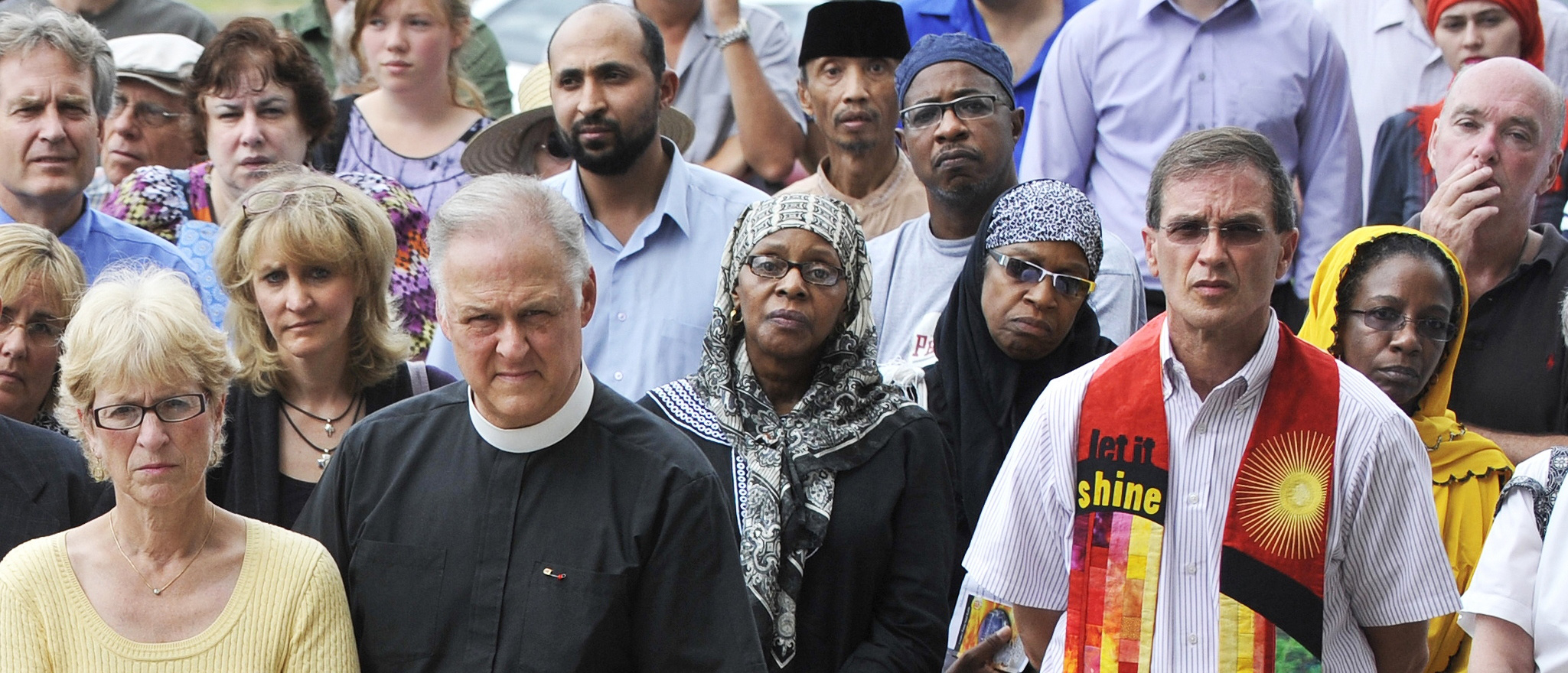
Muslims and people of other faiths gather Aug. 13 at the Capitol in Hartford, Conn., to discuss what they call “Islamophobia” across the country and concerns for their safety during the holy month of Ramadan. As rancor swirls around the issue of whether a mosque and Islamic cultural center should be built two blocks from the New York site where the destroyed Twin Towers stood, Americans are being forced to examine just how tolerant they are — or are not.
The word tolerance comes from the Latin “tolerare” — to bear. In our dictionaries, we define it as, among other things, the “freedom from bigotry or prejudice.”
Its meanings are almost as numerous as the people who express them, as recent entries in the visitor comment book at the Simon Wiesenthal Center’s Museum of Tolerance in Los Angeles suggest.
It means “to respect other races even if u hate them,” says one commenter, signed only as G. “Acceptance,” says another, Alejandra, adding, “To me, tolerance is tinged with the negative aspect of ‘putting up with’ someone or something, but not fully embracing it.”
As rancor swirls around the issue of whether a mosque and Islamic cultural center should be built two blocks from the New York site where the destroyed Twin Towers stood, Americans are being forced to examine just how tolerant they are — or are not.
The issue has always been with us. Against the backdrop of Puritan rigidity and the infamous Salem witch trials, the Founding Fathers made sure the concept of tolerance was woven into the very fabric of the young American republic.
In 1790, in a letter welcoming newly elected President George Washington to Newport, R.I., on behalf of “the children of the stock of Abraham,” Moses Seixas reflected this view. “Deprived as we heretofore have been of the invaluable rights of free Citizens,” he wrote, he saw the hand of God in the establishment of a government “which to bigotry gives no sanction, to persecution no assistance.”
In reply, Washington assured the Jewish leader that the birth of the United States meant a new birth of freedom and respect.
“It is now no more that toleration is spoken of, as if it was by the indulgence of one class of people, that another enjoyed the exercise of their inherent natural rights,” he wrote. This would be a country, he pledged, where “every one shall sit in safety under his own vine and figtree, and there shall be none to make him afraid.”
If Washington’s promise remains part of the nation’s creed today, it’s still true that disputes like that involving the New York mosque test the limits of that tolerance.
“We were never as tolerant as we thought we were,” says the Rev. Barry W. Lynn, executive director of Americans United for Separation of Church and State. “I think that the rock on which tolerance is built is often more like sandstone than it is granite. It is easy to erode at any times when problems in the culture develop.”
More religions
Despite the current imbroglio over the Manhattan mosque, the Rev. Patrick McCollum says he believes Americans are becoming more tolerant. His proof: The fact that his house hasn’t been firebombed in a while.
“There were people actually killed and such for having beliefs different than the dominant belief system,” says the San Francisco man, a Wiccan minister in the “sacred path” tradition. “And that doesn’t happen as much anymore.”
McCollum, 60, has been involved in a seven-year federal court battle over California’s policy of employing as state chaplains only Protestants, Catholics, Jews, Muslims and adherents to Native American religions. He attributes both his struggle and the Manhattan mosque fight to what he calls the “dominant religious lens factor.”
Even so, he interprets the latter as a sign of growth.
“I think that the intolerance that we’re experiencing right now is that for the first time in a long period of time, since almost the founding of our country, we’ve actually begun to ALLOW pluralism to surface in our country,” says McCollum. “So we’ve started to uphold the ideals that our country was founded on … and the people who’ve been in the dominant position begin to feel like they’re under attack.”
‘Penchant for toleration’
Although not declaring his outright support for the mosque planners’ real estate choice, President Barack Obama has defended their constitutional right to be there.
Not everyone was satisfied with his words.
“I think to reason in that manner is to shortchange American identity; it’s not to apprehend fully the robustness of American identity,” says Brad Stetson, co-author of the book “The Truth About Tolerance: Pluralism, Diversity And The Culture Wars.”
America’s “penchant for toleration,” as Stetson puts it, is “beyond question.” But he says that tolerance has always been “circumscribed by some understanding of what was best for the commonweal, the health of the social body.”
“It’s not necessarily intolerant to say no,” says Stetson, who also lectures at Chapman University and California State University, Long Beach. “Governing bodies at various levels of a deeply pluralistic society like ours have a duty to consider the range of public sensibilities … a given decision affects, and not merely reflexively grant the naked exercise of rights upon request.”
Why build it there?
Lynn can understand why some people are so upset about the Islamic center plans. “I’m not saying that everybody who is against building this mosque is some kind of a bigot,” he says. But is building the mosque really the equivalent of, as former House Speaker Newt Gingrich suggested, putting a Nazi sign “next to the Holocaust Museum” in Washington, D.C.?
Yes, says 88-year-old Abe Rosenblum.
In 1943, Rosenblum was taken from his home in the Carpathian Mountains and “drafted” into the Hungarian labor force. When the Nazis occupied the area, he and the other Jews were sent to a ghetto, then loaded into boxcars, and eventually wound up in Mauthausen, a notorious concentration camp not far from Adolf Hitler’s hometown of Linz, Austria.
By the time the Russians liberated him from another subcamp in 1945, the 6-foot-1 Rosenblum weighed just 85 pounds. His father, grandparents and five sisters all perished. Only he and his oldest brother, who had emigrated to Chicago in 1939, survived. Rosenblum eventually joined him, settling in the suburb of Skokie, Ill.
In 1977, Rosenblum and the many other Holocaust survivors who settled in Skokie were horrified when Frank Collin and his National Socialist Party of America announced plans to march there. Although the courts eventually upheld Collin’s right to parade, the march was called off after Chicago, Collin’s original target, agreed to grant him a permit to rally there.
Rosenblum does not believe that Islam is an inherently violent religion. But he says Muslims have no more business building a mosque so close to ground zero than an order of Carmelite nuns had to establish a convent outside the walls of the Auschwitz concentration camp.
His voice rising, he asks why another New York site can’t be found. “You have to build it there, where people suffered? … It hurts me even to talk about it. Because I know what these people feel, those people who lost their loved ones.”
Finding acceptance
If Americans are conflicted, they can be forgiven, says tolerance museum director Liebe Geft. She admits to finding the word “problematic” herself.
Geft — whose paternal grandmother and namesake was among Lithuanian Jews rounded up by their neighbors ahead of the Nazi invasion, taken out to the woods and shot — would like visitors to define tolerance “in a much more active way, putting respect into practice.”
“It’s not a mandate to accept everything,” says Geft, who grew up in Zimbabwe and has lived on four continents. “There are limits to what a civil society should tolerate. And when the human rights and dignities of others are being trampled and denied, that’s not acceptable in a country that advocates rights and freedoms and dignity for all.”