Advertisement

Archive for Monday, April 26, 2010

Medicaid challenges loom, officials say

April 26, 2010

Advertisement

— The availability of taxpayer-funded health insurance is going to increase dramatically over the next few years, and states need to take the lead in controlling costs, officials said Monday.

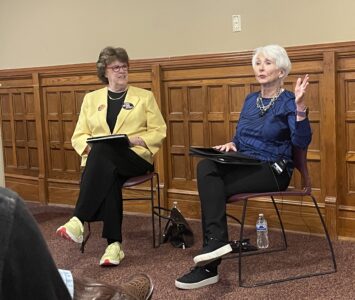
“We see this train wreck coming, and we have to take steps to prevent that,” said Andrew Allison, executive director of the Kansas Health Policy Authority.

“The cost-containment imperative is really in our face,” said Deborah Bachrach, former director of New York’s Medicaid plan and now president of Bachrach Health Strategies, a consulting firm.

Their comments came during a forum examining costs of Medicaid, a federal- and state-funded program that serves more than 300,000 low-income families and Kansans with disabilities at an annual cost of $2.5 billion.

Bachrach said federal health insurance reform will provide coverage to 32 million more people nationwide by 2014, and half will be added to Medicaid. In Kansas, that means about 100,000 additional people enrolled in Medicaid, Allison said.

By 2020, Medicaid will be the largest payer of health care, covering one-quarter of the U.S. population, Bachrach said.

Federal rules and political realities prevent cutting eligibility for Medicaid, the services provided and the payments to doctors and other providers.

That means any savings would come from managing patient care more efficiently, Bachrach said.

She said states are going to have to require more efficient health care delivery systems, such as identifying hospital readmissions that are preventable.

And she said a recent decision by Gov. Mark Parkinson and leaders in other states to cut Medicaid payments as a way to handle current budget problems was short-sighted. Parkinson ordered a 10 percent cut.

“It impedes access and it does zip,” for improving quality of care, Bachrach said. She said some states have challenged the legality of Medicaid cuts because under federal law Medicaid payments must be sufficient enough so that services are available to Medicaid enrollees to at least the same extent as they are available to the general population in the area.

Comments

neuhofel 3 years ago

$2.5 billion for 300k people? That calculates to be $8,333 per person each year! or $694/month. Granted there are some "very sick" people in that pool, but certainly less than 20%. Surely, we can figure out how to provide neccessary health care for that amount of money. You can purchase "concierage" comprehensive primary care for about $100/month in many parts of the country. Call me a skeptic, but something in these numbers just doesn't add up.

0

Liberty275 3 years ago

“We see this train wreck coming, and we have to take steps to prevent that,”

I saw it in 2008 when obama was ahead in the polls.

0

roosmom 3 years ago

"300,000 low-income families and Kansans with disabilities at an annual cost of $2.5 billion."

Is a misleading statement because it doesn't explain all the services. Home and Community Based Services (paid for by Medicaid) are for people with Autism, Physical Disabilities, Intellectual Disablities, Severe Emotional Disturbance, Traumatic Brain Injury, Frail and Elderly in addition to medical equipment, and case management. This was designed to keep people out of insitutions that costs much, much more, and allow people to remain at home or live in the community. It is cost effective and there are thousands on the waiting list for the services in Kansas right now that need these services. Without the HCBS services, the strain on the state would be much higher.

You also can't forget long term care of nursing homes. That is also a large portion of the above amount. It is my understanding that the increase in Medicaid eligible people will be lower income persons who would now qualify under the HCB. I don't think it speaks to persons with disabilities that are already waiting for assistance.

0

none2 3 years ago

Your comment is so true. I don't know the current costs of nursing home care, but back in 2003 I had my grandmother in a home for $3,000.00 a month -- western Kansas. The prices nearer here were more expensive and didn't seem as clean or as nice.

One thing that is debatable is HOW they cut costs. For instance for the elderly, some could stay in their homes longer if long term physical therapy was a bigger part of home health care equation. Unfortunately, physical therapy benefits for the elderly are pretty limited and stop when no progress is seen. However, things like physical therapy are not so much about improving as much as maintaining what level of strength you have.

0

ilikebutter 3 years ago

roosmom has it right, also, even the cost is going to increase it won't increase $8,333 for every person that is added. A lot of these costs are incurred in salaries, equipment, certifications, etc. The costs would be charged to Medicare if 1 million people were added or dropped, they are fixed costs. Because of economies of scale the actual cost per person will go down, but the overall cost will go up.

I agree we need to do work, figure out ways to cut costs, increase service but I'm a little disappointed by the coverage of the story--it seems like there were a lot of quotes passing out blame, and no quotes discussing the solutions that were proposed. I really am hoping someone at the health care forum was proposing ideas.

0

artichokeheart 3 years ago

I think the word Loom" is used way too much in headlines on the LJWorld.

0

average 3 years ago

@neuhofel -

The Medicaid report to the Legislature may give some insights.

http://www.khpa.ks.gov/legislative/download/2010Testimony/Medicaid%20Savings%20Options%20-%20April%2026%20-%204-26-2010%20pqh.pdf

The populations getting Medicaid via disability are the expensive ones. 18% of enrollees but 47% of expenses. Expanding Medicaid won't expand that wedge, because the Medicaid-level disabled are already in the system.

Families and children are well over half of Medicaid enrollees, and less than a quarter of expense. Even though 40% of births in Kansas are on Medicaid (!). Adding more to that population may not explode the costs as much.

0

jackbinkelman 3 years ago

Here is an excellent example of why treatment for certain disabilities is so expensive. It would not surprise me AT ALL to find many more examples in other areas.

Five years later: re-examining the financial burden of boosting with Norvir

http://journals.lww.com/aidsonline/Fulltext/2008/11120/Five_years_later__re_examining_the_financial.24.aspx

http://blog.prescriptionaccess.org/?p=271

0

Commenting has been disabled for this item.