

Fort Campbell takes steps to stop soldier suicides
Fort Campbell, Ky. ? Thousands of soldiers, lined up row upon row across the grassy field, stood at rigid attention to hear a stern message from their commander.
Brig. Gen. Stephen Townsend addressed the 101st Airborne Division with military brusqueness: Suicides at the post had spiked after soldiers started returning home from war.
“It’s bad for soldiers, it’s bad for families, bad for your units, bad for this division and our Army and our country and it’s got to stop now,” he insisted.
It sounded like a typical, military response to a complicated, tragic situation. Authorities believe that 21 soldiers from Fort Campbell killed themselves in 2009, the same year that the Army reported 160 potential suicides, the most since 1980, when it started recording those deaths.
But Townsend’s martial response is not the only one. There has been a concerted effort at Fort Campbell over the past year to change the mindset to show no weakness, complete the mission.
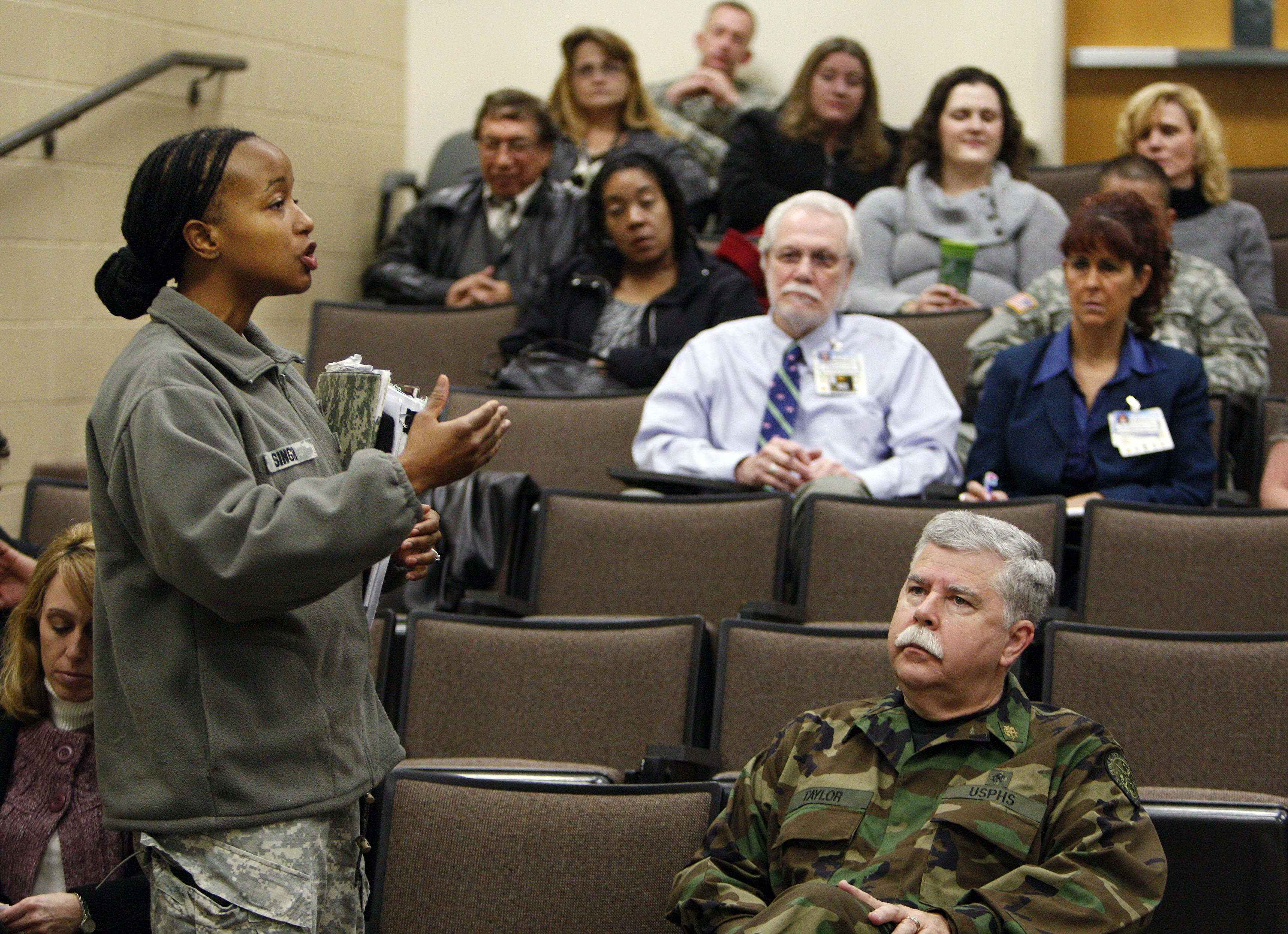
Dr. Tangeneare Singh, left, a psychiatrist at Fort Campbell Army base, speaks to counselors at a seminar on suicide prevention in Fort Campbell, Ky., in this Jan. 21 file photo. The fort is trying to reach out to soldiers who may be struggling with mental illnesses and change the traditional military mindset to show no weakness.
Army doctors like Tangeneare Singh reach out to soldiers struggling with depression, trauma-related stress and other mental illnesses. Staffers like Daina Cole track data collected from Fort Campbell’s soldiers, looking for evidence of problems. And platoon sergeants like Robert Groszmann are trained to listen carefully to soldiers to detect signs of trouble.
“It really is a paradigm shift from the old Army that tells you to suck it up, rub some dirt on it and you’ll be fine,” Groszmann said.
• • •
Spc. Adam Kuligowski’s problems began because he couldn’t sleep.
Last year, the soldier was working six days a week, analyzing intelligence that the military gathered while he was serving in Afghanistan. He loved being a part of the 101st Airborne Division, like his father and his great uncle.
But Adam, 21, was tired and often late for work. He was falling asleep while on duty. His room was messy and his uniform was dirty.
His father, Mike Kuligowski, attributes his son’s sleeplessness and depression to an anti-malarial medication called mefloquine found in his system. In rare cases, it can cause psychiatric symptoms such as anxiety, paranoia, depression, hallucination and psychotic behavior.
But instead of medical help, Adam got push-ups. Once, he got angry, throwing his gun on the ground and telling his commander to send him to jail. He was given an Article 15 nonjudicial punishment for misconduct and assigned kitchen duty during his days off. Finally, his father said, his first sergeant threatened to take him off his intelligence job.
Adam wrote a note telling his dad, “Sorry to be a disappointment.” Then he shot himself inside a bathroom stall with his rifle.
When the Army closed their investigation into the soldier’s suicide, his father said an investigator told him that Adam’s problem was that he was unable to conform to a military lifestyle. Mike Kuligowski did receive a note from the general commanding the division at the time: “We don’t know why this happened,” he wrote.
Kuligowski was not appeased. “It reminds me that officers know absolutely nothing about the plights of the soldiers who are under their command,” he said. “What kind of leadership is that?”
But Robert Groszmann is convinced that the right kind of leadership is at hand.
Groszmann was one of the first NCOs trained in the Army’s resiliency program at the University of Pennsylvania, part of the movement to provide more holistic soldier training. It emphasizes one-on-one conversations between leaders and soldiers about how to think positively, become more self-aware, build character and be prepared for stress.
The staff sergeant knows which soldiers in his unit are struggling. It’s his job to step in and help them through these rough patches, said Groszmann, a 30-year-old noncommissioned officer in the division’s 4th Brigade Combat Team.
• • •
While commander of Fort Campbell’s hospital, Brig. Gen. Richard Thomas saw thousands of soldiers returning from war, some with physical and some with emotional injuries. But something was preventing early treatment: the stigma that those injuries carried in the world of the military.
Many soldiers would open up about symptoms if they were given the opportunity to talk one-on-one with a counselor right after coming home, rather than just fill out a survey, he said.
Now an assistant surgeon general, Thomas says the Army is piloting a project to provide counseling time to battalions and brigades immediately after completing deployments. A similar approach is being applied to detecting mild traumatic brain injuries, which can lead to increased risk for mental health problems, he said.
Some soldiers will never step foot inside a behavioral health clinic; they fear the stigma, and they fear also that a diagnosis could lead to a medical discharge, said Dr. Tangeneare Singh, a combat veteran herself and chief of the department of behavioral health at Fort Campbell.
So any soldier who walks into one of the several medical clinics on post, whether it’s for a twisted ankle or trouble sleeping, is screened for depression and PTSD symptoms. Soldiers who report such symptoms to their primary doctors are assigned a case manager, like Tina Robertson, a licensed nurse.
The number of patients being treated at the behavioral health clinic has increased by 60 percent, from 25,400 in 2008 to nearly 40,000 in 2009.
To handle the expanded need, they’ve increased the number of counselors in that clinic to 60 last year, compared with 36 in 2008. In all, Fort Campbell has about 100 counselors, some of whom work in areas like social work, family advocacy, substance abuse and children’s behavioral health.
Singh and Robertson say they’ve seen an increase in soldiers coming in with stress signs as the 101st Airborne Division’s next deployment nears; nearly 20,000 soldiers from the division are leaving for another deployment, the fourth or fifth tour for most units.
During this time, alcohol and drug abuse can intensify, as well as spousal abuse or domestic incidents, she said.
Authorities at the post are more vigilant about indications that something is amiss. Last summer, Daina Cole was looking at data that showed a large amount of alcohol-related incidents, like drunken driving, in one unit.
Cole, as the installation’s risk reduction manager, tracks high-risk behaviors such as arrests or reports of domestic abuse among the installation’s 30,000 active-duty soldiers. She also looks at two surveys soldiers fill out after returning from a deployment. These data create a kind of emotional snapshot of individual units that is being used to uncover and treat shared stress or behaviors among their soldiers.
After presenting the data to the unit’s command, the soldiers were enrolled in a drinking and driving prevention program. After the weekend, the data showed no major spike in drinking incidents, she said.
• • •
Groszmann, the NCO, is getting ready to deploy with his soldiers this summer to Afghanistan. He’s planning to test the Army’s resiliency training while in combat. He plans to travel to the tiny, remote outposts and remind his soldiers that while they may be shot at and be sleep deprived, they can make it through these hardships.
“When you make a bad decision, when you have one bad night, and you’re able to bounce back from that,” Groszmann said, “then we’ve won.”
National
Republicans and some Democrats back contempt for the Clintons in House Epstein probe
Immigration officers assert sweeping power to enter homes without a judge’s warrant, memo says

Trump cancels tariff threat over Greenland, says NATO agreed to ‘framework’ of future Arctic deal

‘Be The People’ campaign wants to unite hundreds of millions of Americans to solve problems

Trump’s Greenland threats spark outrage from EU, test NATO alliance
Testimony ends in Uvalde officer’s trial
Witness testimony ended Tuesday in the trial of a former Uvalde, Texas, school police officer accused of failing in ...