

Pakistan outsources part of terror war to border militia
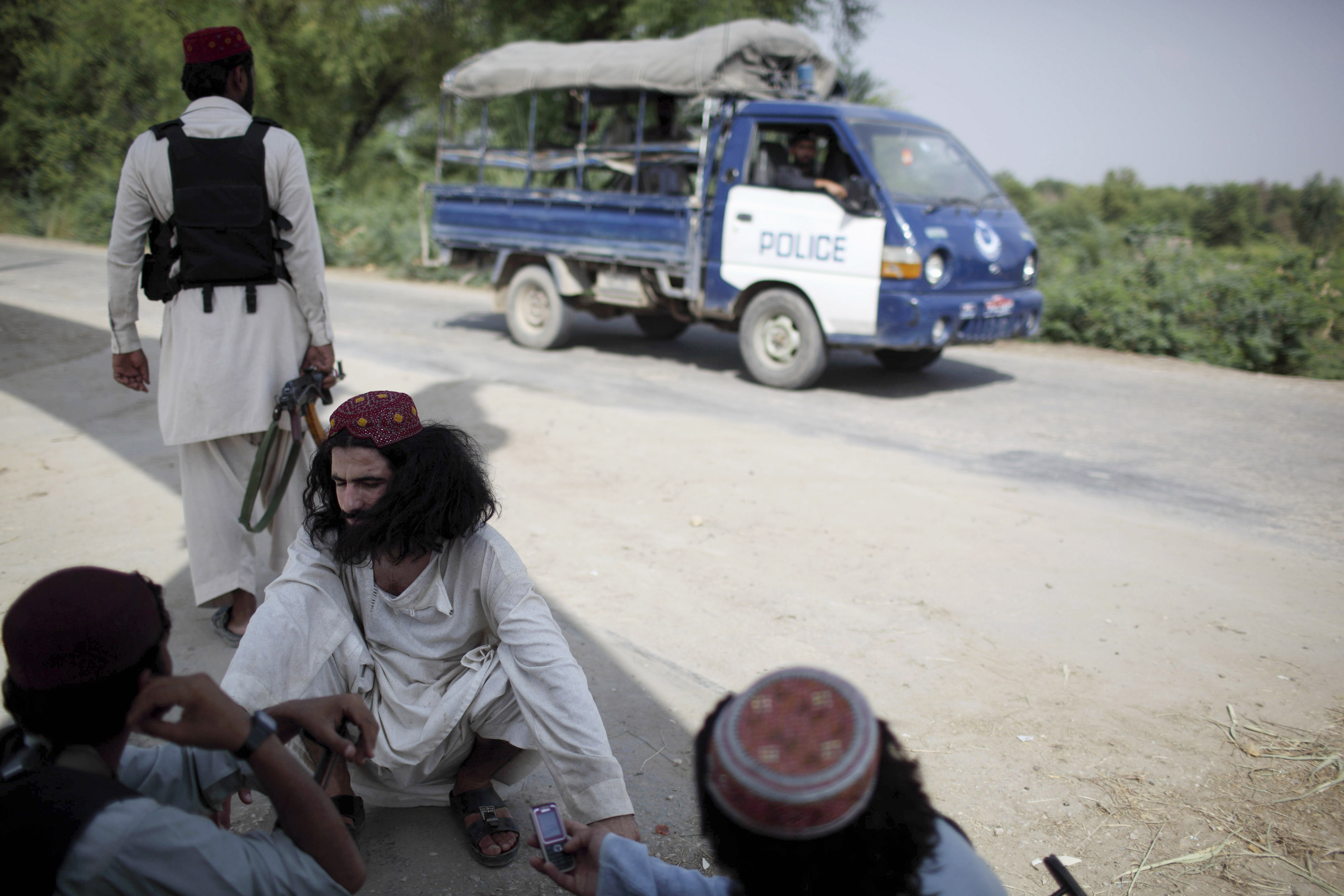
Taliban fighters belonging to a pro-government faction chat on the street near their headquarters last week in Dera Ismail Khan, Pakistan, while a local police truck passes by.
Dera Ismail Khan, Pakistan ? They wear their hair and beards long, Taliban style, and support attacks on U.S. and NATO troops in Afghanistan. Yet the fighters are tolerated and — many believe — backed by Pakistan because they share a common enemy: the country’s most deadly terror network.
Pro-government militias like this one on the border of the country’s lawless tribal regions are an important plank in the campaign against the Pakistani Taliban following the slaying of its chief, Baitullah Mehshud, in a CIA missile strike last month.
They know the enemy and the terrain, need no motivation and their willingness to fight means fewer army casualties. And with the Pakistani Taliban ranks said to be in disarray following the death of their leader, some of their fighters could be persuaded to change sides and join the militants.
But critics say Pakistan risks creating a monster by linking up with them and other militias. While tribal feuding ensures they are enemies of Baitullah’s men for now, they are cut from the same militant cloth he was. Any alliance with the state could be temporary, and one day authorities could find themselves fighting their former proxies.
Militant Islam
The United States, which gives millions of dollars in civilian and military aid to Pakistan each year, will be particularly concerned with the militia in Dera Ismail Khan because it still espouses militant Islam. The group’s logo proclaims the need for war in the name of God. The confusion is apparently reflected in the name that some in the town have given the group: “the government Taliban.”
Fighters from the Abdullah Mehsud militia met The Associated Press at their headquarters in the city, just outside the Taliban stronghold of Waziristan. On the banks of the river Indus, the town has a large police and military presence.
Abdullah — who was killed by security forces two years ago — and Baitullah are not related. They come from different subtribes of the Mehsud, the major clan in Waziristan.
The fighters operate openly in the city. Toting automatic weapons, they travel the streets in battered pickups and keep a makeshift prison in their headquarters, located in a side street about half a mile (one kilometer) from the town center. They claim to have killed or executed 70 of Baitullah’s men over the last year.
“(Baitullah) Mehsud’s fighters are killing the common men,” said Baz Mohammed, a top commander flanked by heavily armed fighters.
Last July, a Baitullah loyalist assassinated the group’s former leader, Qari Zainuddin, as he slept in a room in the headquarters. Mohammed was shot four times in the leg in the attack and now walks with crutches. The attack left two bullet holes in the wall of the room.
“Yes, we will take revenge,” Mohammed said. “If we don’t, what is the point of our group?”
Hours after visiting the headquarters, an Associated Press reporting team was detained by the army for 12 hours at a hotel and its members had their cell phones seized. Members were released on condition they leave the town and return to the capital immediately. No formal reason was given for the detention, but a military official in Islamabad later said local authorities — who are on the lookout for foreign terrorists — were concerned about the team’s identities.
Afghanistan attacks
Mohammed and others said they supported attacks inside Afghanistan, but that attacking the Baitullah group was their priority goal at the moment. U.S. officials say militants based on the Pakistani side of the border are to blame for much of the violence plaguing Afghanistan eight years after the American-led invasion.
“Where people are suffering from oppression, we have to fight. That is God’s order,” Mohammed said.
They declined to answer when asked whether foreign al-Qaida militants should be given sanctuary in the tribal regions — another major concern of the West, which fears the area remains an international terrorist hub.
One fighter, Abdullah Haq, said he used to belong to the Pakistani Taliban but left last year in a disagreement over attacks on targets inside Pakistan. On his cell phone, he keeps pictures of captured Baitullah men — including two bound and gagged prisoners he said the group had executed last week after taking them to the tribal regions.
Rooting out deeply entrenched militants from the border regions is a massive task for Pakistan’s stretched military, which has tried and failed to defeat the insurgents in Waziristan before. It has been accused in the past of being soft on militants who concentrate their energies on the Afghan side of the border, allowing it to direct resources at those posing a direct threat to Islamabad.
Army spokesman Maj. Gen. Athar Abbas denied the military had any links with the Abdullah militia and another pro-government group led by Turkistan Bhitani in the nearby town of Tank. Abbas referred questions to the civil administration in the area, whose officials did not make themselves available for telephone interviews.
Still, Abbas acknowledged the fighters were useful in the battle against the Pakistani Taliban, which has carried out scores of attacks across the country over the last 2 1/2 years that have triggered international fears over the safety of Pakistan’s nuclear weapons.
“If you have to fight the big devil, you welcome anyone in that fight,” Abbas said.
Observers say there is little doubt the militias have received or continue to receive support from security agencies, either cash, weapons or logistics. In August, army gunships were deployed to repel a Pakistani Taliban attack on the stronghold of Bhitani, intelligence officers said at the time.
“We have the full support of the government side,” said Mohammed, who declined to elaborate on the exact nature of their relationship. “We have a free hand to attack Mehsud’s men in this area.”