

Iraqis face tough times starting over
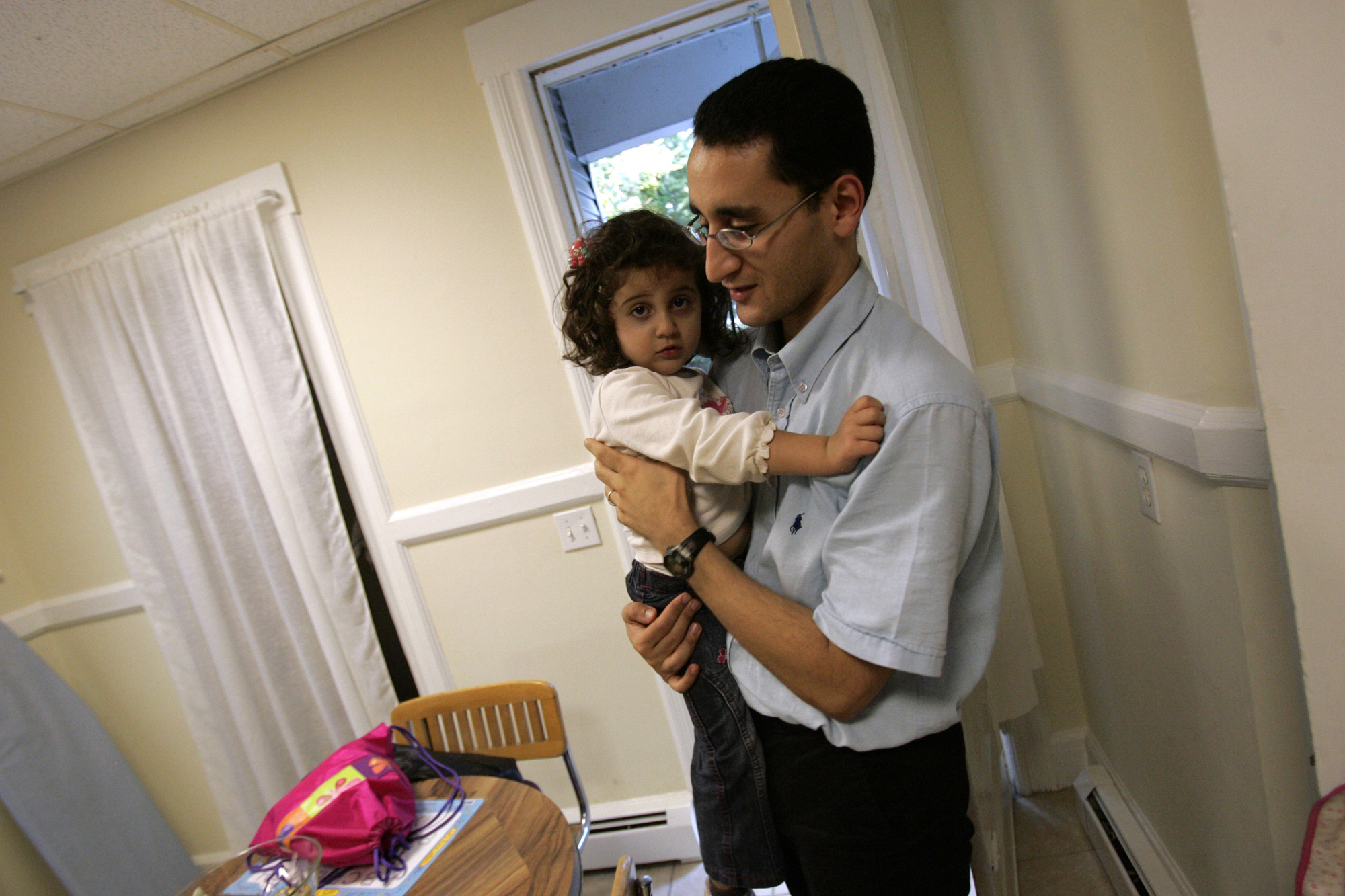
Saif Alnasseri greets his daughter Sarah Alnasseri, 3, as she arrives Aug. 30 at their Plainfield, N.J., home. The family left Baghdad in December 2008 because they feared for their safety. Saif was a pharmacist and Iraqi translator and is now a pharmacy technician.
Her mansion in Iraq was bombed, her medical career and future in her beloved country dashed the day she found a white envelope on her car windshield. Inside was a single bullet. Wassan Yassin was marked for death.
She knew she had to flee. She eventually landed in America, far from where her life was threatened, her sister was shot and her co-worker kidnapped. Her new Florida surroundings offered a haven from the horrors of war.
But there is no happy ending. Not yet, at least.
Yassin’s first year here has been marked by frustrating — even humiliating — experiences: A small apartment in a crime-scarred area of Jacksonville. Food stamps. And no job, even though she’s a gynecologist who also morphed into a construction company executive during the war.
Saif Alnasseri, a 31-year-old wartime translator and journalist, has fared better. A former pharmacist at a large Iraq hospital, he now is a pharmacist’s assistant in a New Jersey drug store. Life in America has been a trade-off: His job supervising dozens of workers, his comfortable home and lush garden in Baghdad are gone, but he has something else — security.
“We are safe here and this is very important to us,” Alnasseri says. “But there are a lot of things I spent years building in Baghdad. … I was very well-known in my neighborhood. They called me doctor. I had a lot of people who respected me. Here I’m starting from the beginning. From zero.”
“Every day I say, ‘OK, I made the right decision,”‘ he adds. “After two hours, I say, ‘Did I really?”‘
For thousands of Iraqis, resettling in America has been an agonizing transition filled with questions, doubts — and, sometimes, despair.
Many Iraqis have discovered that gold-plated resumes have opened few doors in a nation reeling from its worst economic decline since the Depression. Stories abound of Iraqi professionals doing menial jobs — a doctor flipping burgers, a druggist washing dishes.
Iraqis also have struggled to navigate a confusing bureaucracy and an overburdened social service system that has sometimes run of out money to help provide their basic needs.
“Everything is kind of conspiring to make it a particularly difficult time for them,” says Bob Carey, a vice president of the International Rescue Committee, a refugee assistance agency. “There’s the declining economy, the conditions from which they come, the conditions in which they arrive, the fact they’re often highly skilled professionals with sometimes high expectations.”
“It is,” he says, “the perfect storm.”
Exodus of Iraqis
Only a trickle of some 2 million Iraqi refugees have resettled in America since the war began. Most have poured into Syria, Jordan or other neighboring countries.
About 38,000 Iraqis have come to the United States in the last three fiscal years, compared with just hundreds in the three prior years. The overwhelming majority are refugees; others received special immigrant visas, awarded to translators or those who’ve worked with the U.S. government or contractors.
The State Department says the exodus of Iraqis didn’t start until 2006, after the bombing of the mosque in Samarra ignited sectarian violence.
Advocacy groups and some lawmakers have long accused the U.S. government of being too slow to respond to the Iraqi refugee crisis, imperiling those who’d been targeted because they’d worked with Americans. Some of the delays were blamed on the many layers of security clearance.
But things have improved. After Capitol Hill hearings, a new law making it easier for American-affiliated Iraqis to move here and the appointment of a State Department adviser to deal with the issue, the pace of admissions has picked up dramatically since 2007. The Obama administration this summer also named a coordinator of Iraqi refugee efforts.
Even so, only 20 percent of at least 20,000 Iraqis with American ties who’ve applied have arrived in the United States since 2003, according to an April report by Human Rights First. Some wait more than a year in other countries, unable to work. “It has the potential to put them in this cruel psychological limbo,” says Ruthie Epstein, the report’s chief author.
Once Iraqis do arrive, they face new problems.
Many Iraqi refugees interviewed in Atlanta and Phoenix had exhausted government and social service aid, according to a recent report by the rescue committee.
“We really do have a moral obligation as a country to help them start over with basic tools in a dignified way,” Carey says. “Right now, that’s not happening.”
Hollywood ending?
Iraqis who arrive with Hollywood-inspired visions of their new homeland quickly face a sobering reality.
Mustafa Al Waeli has an advanced degree in software engineering, but that hasn’t provided steady work for him in Louisville, Ky.
But it’s not just the lack of money that troubles him.
It’s the “cultural shock,” he says. “We’re used to seeing America through Hollywood movies. It’s nothing like that. It’s very tough. It’s a hard life.”
In Iraq, Al Waeli says, he could always turn to a relative or a friend in times of need. “Here we have nobody to depend on,” he adds.
And yet, Al Waeli doesn’t regret moving here.
“I know the American dream is available,” he says. “I know I need to work hard to get it. This is my country now. I will never leave it. It’s the land of opportunity. I don’t care where I was born. I care where I can live in peace.”