Archive for Wednesday, November 18, 2009

Lawrence schools preparing for another round of budget cuts

Adobe Flash player 9 is required to view this video
Get Adobe Flash player

The Lawrence school district is preparing for two more rounds of cuts from the state in coming months that could bring the total budget shortfall to 10 percent of its operating budget.

November 18, 2009

Advertisement

The Lawrence school district is preparing for two more rounds of cuts from the state in coming months that could bring the total budget shortfall to 10 percent of its operating budget.

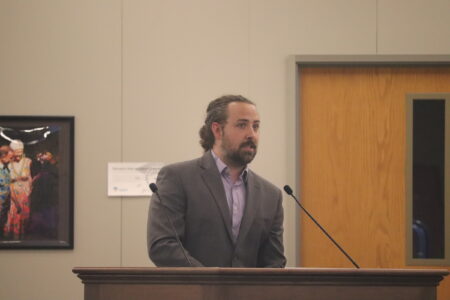
“It really is getting brutal at this point,” Superintendent Rick Doll said.

The district has already cut more than $2 million and is looking at another $2.2 million to be slashed in December. That number includes cuts in weighted funding, such as that for at-risk students and English as a Second Language learners. With another cut expected in January before the Legislature returns to Topeka, Lawrence’s number could approach $6 million in total cuts for the 2009-2010 school year.

“That fundamentally changes the way we have to operate,” school board President Scott Morgan said.

However, the district leaders believe they can make it through this year by absorbing costs through their contingency fund and by keeping half the instruction and professional development budgets frozen.

“There will be instructional classroom supplies that are not purchased beyond the basics,” Doll said. “There’ll be lots of professional development that we need to do for our teachers to make them better teachers that are not going to happen.”

The contingency fund has about $6.3 million currently, but the district needs to keep about $4 million of that pool to make payroll for just its certified staff.

“It scares us because we don’t think the financial crisis is over because if the Legislature chooses not to enhance revenue, then they’re going to cut us again next summer,” Doll said. “Then what do you do without making draconian cuts to teachers and increasing class sizes?”

Adding one student to each classroom would save the district $1 million, but the additional student wouldn’t be across the board.

“What it means is that some class will end up with 34 kids in it and there’s nothing we can do about it,” Morgan said. “That’s how we get at it.”

The board has tried to protect the classroom as much as possible, but that luxury can’t be guaranteed as budgets get tighter.

“We have to balance the budget, and the state of Kansas has to balance their budget,” Doll said, “so there would be no choice.”

Comments

LJWorld.com doesn’t necessarily condone the comments here, nor does it review every post. Read our full policy. Also, read about banned accounts and harassing comments.

  1. KSManimal (anonymous) says…

    Marion,

    Thank you for that brilliant demonstration of the standard right-wing "repeat it often enough, and it becomes true; ignore it often enough, and it goes away" strategy.

    Budget cuts = general fund dollars.

    Astroturf = capital outlay dollars

    State law prohibits mixing of those funds. Your smarty-pants statement shows that either you're ignorant or you're dishonest. Perhaps both.

  2. multiagelearner (anonymous) says…

    Eliminate learning coaches...make sure the staff you hire can do their job and learning coach are not needed! You hired 12 people to do the job two people used to do.

    Close a school that has a total enrollment of less than 150! If there are going to be classes of 34 there shouldn't be ant of 15 or less!

    Don't require or pay for an ELL endorsement or Praxis test but reward those who do or will complete the endorsement. Finally loose a few positions at the Palace!

    Right wing or left, conservative or liberal if this district focuses on what is really best for kids and not being a research program fir administrators doctoral thesis' it may make decisions a little less painful and a lot more focused!

  3. average (anonymous) says…

    "Close a school that has a total enrollment of less than 150!".

    What school is that? Waky Valley at 218 and Woodlawn at 223 were the smallest ones, last I knew.

  4. budwhysir (anonymous) says…

    I am curious, all the talk of budget cuts, and building closing but no real mention of the square footage cost of educating our children. The one thing I do learn from this article is this, our children are not learning near enough from public education to obtain a job that makes them capable enough of repaying the cost of their education back into the community. Think about it, if it would save 1 million dollars per kid to add one person to each class, these kids should currently be obtaining jobs that would pay several millions of dollars per year in salary.
    4million dollars is needed just to pay our certified employees???? Shouldnt this include the employees in the ivory tower???? Lets start looking at cuts at the upper level first.
    I am interested in looking at the complete physical budget for the system. This would allow us to make a decision on if equal cuts are being suggested at the top of the ladder.

  5. multiagelearner (anonymous) says…

    New York has just over 100 students. Less than 150 and it is a K-6 school. It includes a fulltime principal and janitor. Compare that to langston hughes at 500!

  6. Made_in_China (Paul R. Getto) says…

    "The Lawrence school budget is grossly obese and needs to be cut back severly (sic)." ==========
    An interesting allegation. Given that we continue to elect tax-cutters who want smaller government, we may soon see where the remaining "fat" is in social service budgets. The state's budget mirrors local school operations. 80% or more goes to human needs. It's time to examine who is getting the goodies and who is left behind to pay the bills. Evaluate tax exemptions and the overall tax structure, then take it from there. An honest conversation would astound some people, who will have trouble figuring out why almost 75% of the potential sales and 90% of the property is not taxed. Buckle up, folks. It's gonna be a rough ride.

  7. boothillbilly (anonymous) says…

    basically, you want good schools, you need efficiency. Yet, while efficiency is essential, so too is funding. The two cannot be separated. If you don't have funding, you do not get textbooks, quality teaching, and any ability to begin to teach analytical thinking (you know, the thinking that cannot be easily quantified). If you do not have efficiency, you cannot allocate resources to the teachers and subjects who need them.

    Entrenched bureaucracy and administrative positions merely exacerbate this problem. Most teachers do not get into teaching for the money, but because they have a sense of vocation and hope for the future. They believe that what they are doing is important, and care that students get the best education.

    Instead, continued cuts, plus an asinine reliance upon quantitative testing is merely setting up students for failure in college, the job market, and the world economy. Yet, here we go, more funding cuts. Thanks to no child left behind (aka, the federal shoot your wounded program), many college students are unable to take higher level math and science courses which rely upon analytical thinking, because they were not taught analytical thinking, only how to take a multiple-choice test. Therefore Schools of Education are the only option for them, if they want to get a college education and pass their classes. Thus, a downward spiral is gradually progressing.

    You want crappy schools and unprepared students, cut funding while keeping inefficiency and administration in place.

    You want a good school system, increase funding, trim the fat, and provide extra help for struggling students. Teach non-quantitative analytical thinking.

    Otherwise, put your head between your legs and kiss your @$$ goodbye, because the rising generation is unable to assume the mantle of leadership.

  8. LarryNative (anonymous) says…

    Can public schools have fundraisers like the private schools? Not selling wrapping paper but an event with auction items. I was at a Catholic school fundraiser and they raised something like $60,000 in one night.

  9. average (anonymous) says…

    @multiagelearner:

    Really? Could be (haven't paid close attention), but last year New York school had 284 students.

    http://online.ksde.org/rcard/building...

    If it's down to 'just over 100' this year, it seems that they've targeted it for a shutdown.

  10. kugrad (anonymous) says…

    New York is a true neighborhood school that serves a population with low SES, a high percentage of families qualify for free and reduced lunch. Despite this, New York has maintained extremely high academic standards and does an excellent job educating students. It should not be closed. It is an excellent school.

  11. whatthehell (anonymous) says…

    Many reading and commenting here are more knowledgeable on specifics, but generally speaking...this has got to stop!! Clearly it is more expensive to educate our young today than it was in the past, yet we continue to make cuts. I have three children in two different schools and the requests for supplies and various items from the teachers is non-stop. Music and arts programs have been cut, athletic teams are only available for the very best players. We need more money in schools, not less. I can't say where it is going to come from but our society will continue its downward spiral if we cannot educate our children.

  12. Did_I_say_that (DIST) says…

    Here is a can of worms to open up. The 2005-2006 budget showed that $10,395,000, out of the $56,784,464 budgeted for “Instructional Expenditures,” was spent for Special Education. That is, 18% of the money spent in the classroom went to support students with exceptionalities.

    2006 Budget Link: http://www.ksde.org/LinkClick.aspx?fi...

    By the way, that same budget also shows that an additional $54,471,649 was spent that year on non-instructional expenditures.

  13. Escapee (anonymous) says…

    Easy.

    1. Put some of those LHS overpaid old goats (...teachers) out to pasture and bring in some lower paid new teachers. This will not only save $$ but improve learning and breathe new breath into that stale environment.

    2. Have a few tax payers sit in the office at LHS for a day. Observe the WAY over 'administrated' dollars at waste there. They've got about 800 people doing the jobs of perhaps a needed four or five! Ridiculous!!!

    3. Bring some parentals into this picture. There are plenty of schools that utilize parent volunteers in school offices (main office, nurse's office, athletics, etc.). I know Lawrence Public Schools are averse to bringing in parents for ANY reason...but this should be considered a cost saving ingredient.

    'Belt-tightening' thus far has not ruffled nearly enough feathers in the admin. category for my money. This is the first course of action -- long before talking class size, and school closures.

  14. honestone (anonymous) says…

    Don't close elementary schools. A neighborhoods population age fluctuates. The neighborhoods that are full of school age children now will soon find less and less school age children in them as the population of that neighborhood ages. 15 years later the "old" people will be selling their homes and new young couples will start buying those houses and the school age population will rise again UNLESS..
    the school board shuts down the local school. The young parents will find neighborhoods that do have a local school and "no school" neighborhood will die. The housing will deteriorate along with the infrastructure and the people that can't afford to live in the neighborhood with a local school will move into the cheaper "no school" neighborhood and the neighborhood will further deteriorate. It is a version of urban flight

  15. Fangorn (anonymous) says…

    Many people seem to have much of the specific data at their fingertips. Does anyone know what the per pupil expenditure is in USD 497?

  16. Did_I_say_that (DIST) says…

    Fangorn (Anonymous) says…
    "Many people seem to have much of the specific data at their fingertips. Does anyone know what the per pupil expenditure is in USD 497?"

    The 2006 budget was $11,000 per student; it has increased since then.

  17. Did_I_say_that (DIST) says…

    It is interesting math, to say the least, when a per pupil or per classroom cost is considered. At $11K per student, an overpopulated class of 25 grosses $275,000. The highest paid teacher, with benefits, may account for up to $100K of that budget. The remaining $175,000 .... ?????

  18. sherlock (anonymous) says…

    on the athletic fields: its a million a year in payments for 10 years, plus $225.000 per year in just interest! The district had to borrow the "lions share"---they call it "leasing!" They had supposedly $2.3 million left over from the 2005 bond vote. (that was supposedly for improving elementary schools) So one perhaps could say they didnt spent part of the bond money on what it was voted for! Then later they changed and said they had $3+ million, dont know where they found a little more!
    But if you watch and listen it seems they can usually "dig" up money when its necessary altho they plead hard times!

  19. Escapee (anonymous) says…

    Athletics...now there's a subject for some commentary.... How 'bout teaching kids to read and write, and add and subtract before worrying about astroturf!!! Or for that matter new fields to play on. With two universities within a mile's walk from one high school -- we 'needed' this??? That was the biggest shuffle in the history of USD 497!!

    Where are our priorities????

    Again, I ask, what about the administration dollars here? Clearly we haven't hired anybody yet that knows how to maintain a budget!!

    It's absolutely nuts that these 'extras' keep getting done when the activity in the actual classroom is eroding faster than an ice cube in your favorite Starbuck's beverage.

    Looney tunes Lawrence!! Glad I escaped!!!

  20. Fangorn (anonymous) says…

    Did_I_say_that, thanks for the figure. It is an interesting question, and some of it at least has a good answer. Buildings and their upkeep can be expensive. Support staff from lunch cooks, to assistant principals, to the guys who mow the lawn in the autumn and plow the parking lots in the winter all must be paid for their services. So some of the "gross" profit from the classroom covers all these other expenses. How efficiently that is done is perhaps another question.

    My daughter attends a private school. We lack some of the nicer amenities of the public schools, but I think she is getting a stronger, broader education. She is diagramming sentences most high school seniors wouldn't touch and she is learning Latin. But all this is done on much less than $11,000 a year. Perhaps the public schools could benchmark some of the processes private schools use to control expenses?

  21. KSManimal (anonymous) says…

    Did I say that - (quote): "The highest paid teacher, with benefits, may account for up to $100K of that budget."

    Thank you, D-I-S-T, for illustrating how misunderstood teacher compensation really is. Your estimate is nearly double the actual number.

    Maximum USD 497 teacher salary (Ph.D., > 15 years service): $58,830.

    Total health insurance paid by district: $3,996/year

    Total retirement benefit paid: $720/year.

    Total maximum salary and benefits: $63,546.

  22. Did_I_say_that (DIST) says…

    @ KSManimal - Recheck the statistics. The typical full-time employee will cost approximately 40% more than salary for all benefits. Your numbers are leaving a lot of indirect compensation out of the formula; social security match and workman's compensation, just to name two. By the way, the maximum salary is NOT $58,830. The master contract allows for COLA increases and grandfathering. If your post is indicative of what teachers, administrators, and the public believe the actual cost of an employee is, then you are correct: teacher compensation is misunderstood.

    However, my post was not about the cost of a teacher. In fact, your formula (although incorrect) better makes the point. Using your formula, there is $211454 per classroom spent on things other than directly teaching the student.

  23. Fangorn (anonymous) says…

    Another commonly misunderstood aspect of educators' employment is the number of hours worked per year. Factoring that in changes the picture considerably.

  24. remember_username (anonymous) says…

    Fangorn - interesting observation about private school education. I've dealt with university students from a variety of locations and a selection of foreign, public, private, and even a few who were home schooled. While my observations are completely anecdotal I've found, on average, the students who attended private schools appeared better prepared for university. Again it's anecdotal but I believe parents who pay to send their kids to private school are more invested in their child's education, and it's become quite obvious to me that parental involvement is the biggest factor in success of today's children.

  25. mom_of_three (anonymous) says…

    "Again it's anecdotal but I believe parents who pay to send their kids to private school are more invested in their child's education"
    Invested is right. Too bad we all can't afford to send our kids to private school. Some private schools cost as much as college.
    But I am just as invested in my kids education.

  26. Escapee (anonymous) says…

    Teachers, don't even BEGIN the whining.... You, as a group, are the most ungrateful, misinformed people when it comes to counting hours worked and hours paid for services rendered on the planet! I seldom hear complaints for vacation time allotted for this job!?!?

    I agree with Fangom -- private schools hold a whole different attitude when it comes to budgeting. They live within their means, they know the meaning (and importance) of a real budget. And they plan (P - L - A - N) for expenditures to keep up with the necessities that insure above average performance from their 'product' -- their students.

    The students are their priority. Not a community image.

    Now I can even understand where the lines become a little gray when talking about public schools and an 'image'. But the bottom line must always reflect a responsibility -- an obligation -- to produce well rounded, well educated students...not athletes, or arenas for public inspection.

    A public school education should mean that the door of opportunity is always open and available for every American who walks the dirt of this country.

    If we do not get serious about maintaining this part of the American Dream...you might as well resign yourself to a life of class structure, because soon enough that will be all we have is the haves and have nots. And the lack of responsibility shown in the running of Lawrence's public schools will surely have them majoring in 'have nots'.

  27. Fangorn (anonymous) says…

    remember_username: I agree wholeheartedly that parental involvement is essential, although the form that takes may vary. Thomas Sowell found that the best kind of parental support - the find that ANY parent can give - is support for the school and the teachers. This meant supporting the school's disciplinary policy, rather than fighting it every time your child receives a consequence for negative behavior. It also means ensuring homework is done, even if the parents' lack of education means they can't really help. And yes, someone who is paying money to send their child to a school will certainly be more involved.

    mom_of-three: Oh, believe me! We really can't "afford" to send our children to a private school. There are a lot of things we go without right now. But we made this a priority, so we sacrifice for it.

  28. toe (anonymous) says…

    Simply reduce salaries across the board.

  29. JackRipper (anonymous) says…

    "multiagelearner (Anonymous) says…
    New York has just over 100 students. Less than 150 and it is a K-6 school. It includes a fulltime principal and janitor. Compare that to langston hughes at 500!"

    Let's see, the developers build all the crap out west and instead of parents making sure they have a school near by the developers get the school board to build them a new schools. Why didn't they just let the mommy and daddy's that already drive their precious bundles to the school drive them to the schools that already existed. To play games with the east Lawrence schools with kids that don't have as much already is bull and shows what kind of low life greedy ass types there are on the west side. After sucking all the life they can out of this city now they want to take more from those without. It truly is the Aspen on the plains as the elite in town try to run those without much out of town, probably all part of the plan to continue the gentrification of east Lawrence.

  30. JackRipper (anonymous) says…

    Someone has brought it up before but since the half day on Wednesday doesn't do anything to cut costs since the buildings are still up and functioning for all the "professional development" why don't they just go to four days a week and then there isn't the busing for a day, the energy costs, toilets flushed, etc, etc. The Wednesday thing is a joke anyway and if money is tight do we have the luxury of playing such stupid games?

  31. volunteer (anonymous) says…

    Every teacher I know snickers at the "professional development" attempts. That is one cut that will harm education the least, despite what some central office Adminstrators with an agenda (justifying their existence?) say.

  32. multiagelearner (anonymous) says…

    Average- The district released numbers on September 20th show Kennedy's enrollment this year is 135, that is 2 more than last year. It was reported to the state as a total enrollment of 133. Sorry, your about 100 off! The fifth grade class only has 13 students. If all schools had classes with only 13 kids in them they would all be successful.
    The only grade with more than 20 students in a class is 3rd grade with 26.

  33. multiagelearner (anonymous) says…

    New York, not Kennedy.

  34. workinghard (anonymous) says…

    Just got my property taxes and the portion going to the school district is almost 50%. The other half goes to city and county. So that means we can run the county and city on what it takes to run the schools.