

Are Pakistan’s nuclear weapons secure?
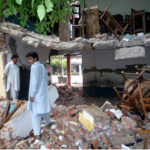
Residents examine a damaged portion of a government school wrecked by militants with explosives in Mingora, the main town of Pakistan’s Swat Valley. Clashes in a northwestern region covered by an increasingly fragile peace pact killed seven militants and one soldier Monday, authorities said, adding to strains on an agreement seen in the West as a capitulation to extremists.
Vienna, Austria ? The Taliban’s recent advances in Pakistan are intensifying concern about whether its nuclear arsenal is safe from terrorists.
Pakistan’s president says it is. Asif Ali Zardari, who meets President Barack Obama in Washington on Wednesday, recently proclaimed that “the nuclear capability of Pakistan is under safe hands.”
Available information suggests that Pakistan’s secret nuclear sites are protected by crack troops and multiple physical barriers, making the risk from an outright Taliban attack relatively low.
A more worrying prospect for some experts is possible infiltration by radical Islamists of Pakistan’s nuclear facilities.
Stringent security checks on personnel are meant to prevent that as well. But Pakistan’s nuclear establishment has seen serious leaks of nuclear knowledge and materials by insiders in the past.
Top government scientist A.Q. Khan operated a global black market nuclear network for more than a decade until he was uncloaked by U.S. intelligence. And the CIA has confirmed a meeting between Khan associates and Osama bin Laden before the Sept. 11, 2001, terror attacks.
The issue of Pakistan’s nuclear security is expected to come up during general discussions between Zardari and Obama on the Taliban insurgency.
Elements of the Taliban are associated with al-Qaida and are thought to have sheltered bin Laden for years in the rugged Pakistani border region to Afghanistan. The U.S. invasion of Afghanistan itself came after Taliban leader Mullah Omar refused to turn over bin Laden.
Bin Laden, in turn, has repeatedly expressed al-Qaida’s desire to acquire the bomb.
“We want to respect their sovereignty,” said Obama recently. “But we also recognize that we have huge strategic interests, huge national security interests in making sure that Pakistan is stable and that you don’t end up having a nuclear-armed militant state.”
Multilayered security systems are in place to prevent nuclear mayhem, according to information leaked or publicly shared by Pakistani officials.
Pakistan’s 60-plus warheads are believed to be stored separately from their delivery systems, with the nuclear cores removed from their detonators. The weapons are dispersed in as many as six separate locations, most of them south of the capital.
Additionally specially trained troops patrol the inner perimeter of nuclear weapons depots and related locations, with some declared no-fly zones. Electronic sensors and monitoring devices are mounted at outer perimeters. And personnel assigned to sensitive nuclear positions go through regular background checks conducted by Pakistan’s intelligence services.
In Washington Monday, Adm. Mike Mullen, chairman of the U.S. Joint Chief of Staff, told reporters that — while he is gravely concerned about Taliban advances in Pakistan and Afghanistan — “I’ve watched them improve their (nuclear) security fairly dramatically over the last three years.”
That includes trying to make sure those in positions of responsibility are reliable. William H. Tobey, the former deputy administrator for the U.S. National Nuclear Security Administration’s Office of Defense Nuclear Nonproliferation, described Pakistani officials in charge of the country’s nuclear weapons as “educated and professional.”