

Lapel pin interest grows into Hesston man’s hobby
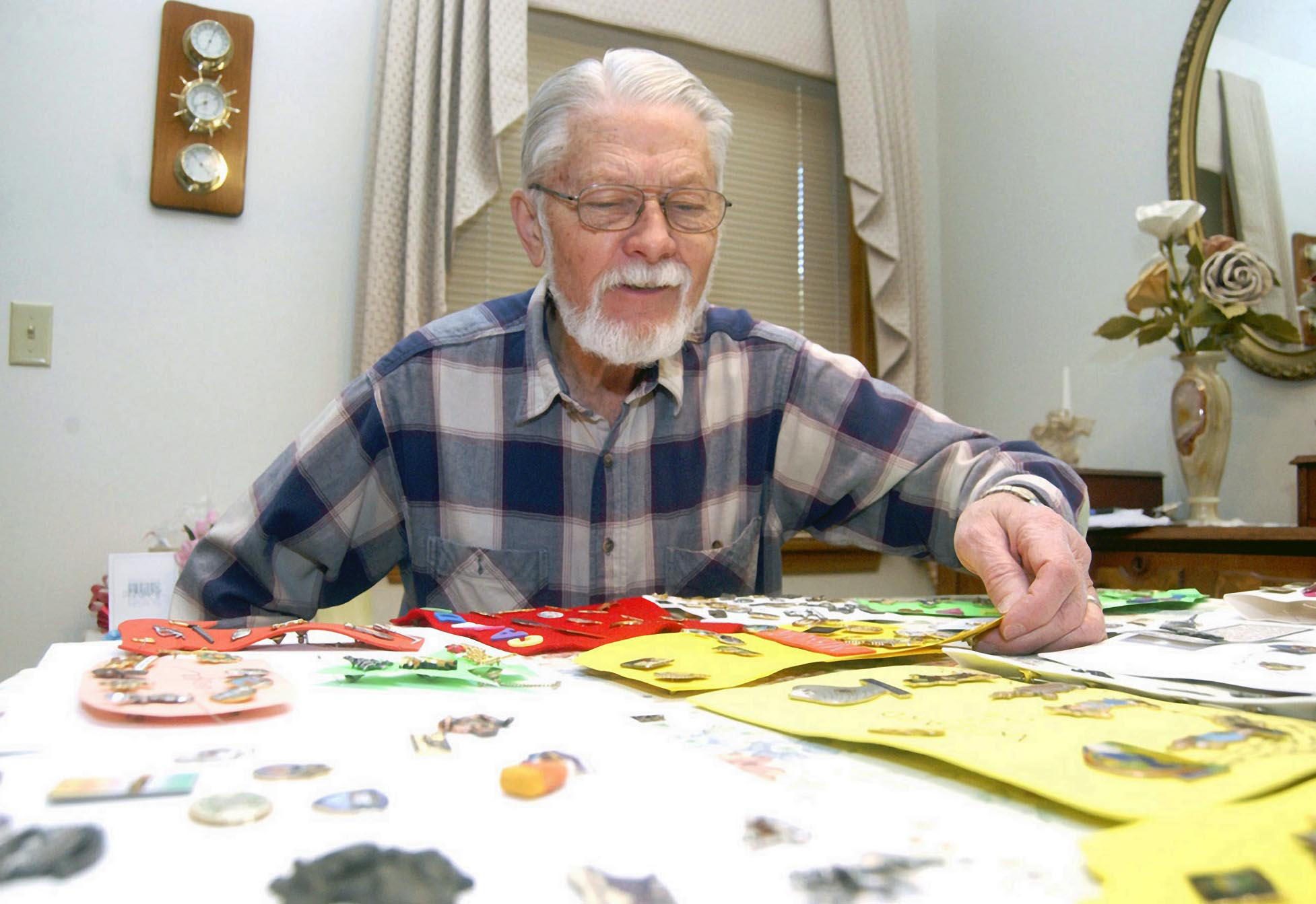
Harvey Thiessen looks over part of his collection of 605 lapel pins in this Feb. 28 photo in Hesston. He often collects them on trips and plans to keep collecting them as long as he can.
Hesston ? Visitors taking a look at Harvey Thiessen’s vast lapel pin collection aren’t just seeing a bunch of items, they’re viewing a sea of memories.
There’s the batch he picked up from a collector on a visit to Dollywood in Tennessee; then there’s a clothespin with a nail, a hokey “Hillbilly Tie Tack”; the Texas pins, including one with a pair of red cowboy boots and shiny gold star; the ones from a trip to Hawaii; and a batch of 34 pins from a trip last year to South Dakota’s Black Hills.
There are a lot of pins, too.
Thiessen pegs their number at 605, give or take a few.
Harvey’s wife, Lois, who is retired from Hesston Elementary School, takes a bemused approach to her husband’s hobby. While it’s his collection, she has her favorites, too, and likes to keep track of who gave what to expand the collection.
Collection’s history
Many of the pins were bought when the couple was on bus trips as part of Thiessen’s participation in the Kansas Mennonite Men’s Chorus.
The collection got going in 1968, but really picked up steam when Thiessen retired in 1999 from Hesston Corp., where he spent 40 years and eight months working in the service and tooling departments.
The couple moved from their country home to a low-maintenance duplex in Hesston, which allowed them to travel more.
Thiessen discovered the pins provided an ideal way to represent a locale, its heritage, culture and people.
Sometimes, they represent history. Thiessen points out a pin commemorating the 9/11 terrorist attacks. “We won’t forget,” he said softly, repeating the saying etched into the pin.
‘Wearable art’
Lapel pins once were used only by the military, said Manny Charro Ramirez, who maintains a Web site that sells lapel pins.
Current use is much more widespread, he said, and the pins are used by businesses, social service and civic organizations, and hobbyists to spread their message and seek support for their cause. The pins gain extra attention when worn by celebrities, he noted.
Some pins are made only to be a collectable or commemorate special occasions. Lapel pins, especially the more colorful and unusual ones, can be considered “wearable art,” he said.
Some of Thiessen’s pins fall into that category.
Part of the collection is light-hearted in nature, including a series of weather-related ones that allow their owner to wear one that relates to outside conditions, including full sunshine, snow, rain, partly cloudy or complete cloud cover.
Some represent beginnings, such as the pin marking the June 2, 2001, opening of the Kansas Speedway in Kansas City, Kan.
Others showcase industries, such as aviation, in which a hot air balloon, a Boeing 737, and the space shuttle are all represented.
Telling a story
Most of the pins are purchased for modest amounts; from $2.50 to $10 or so. With few exceptions, they don’t gain much in value either, but that’s fine with Thiessen as he isn’t counting on the collection to be a future revenue stream for him, and he doesn’t try to sell them. For him, the collection’s intent is to bring a story to the forefront.
A recent check of the online auction site eBay showed 7,035 lapel pins for sale at prices ranging from 50 cents for a shamrock pin to $28.50 for a set of NASA Apollo program pins.
The Thiessens don’t know of other lapel pin collectors, but, as Lois says, “We’re sure some are out there.”