

Poverty-stricken Gabon mourns leader
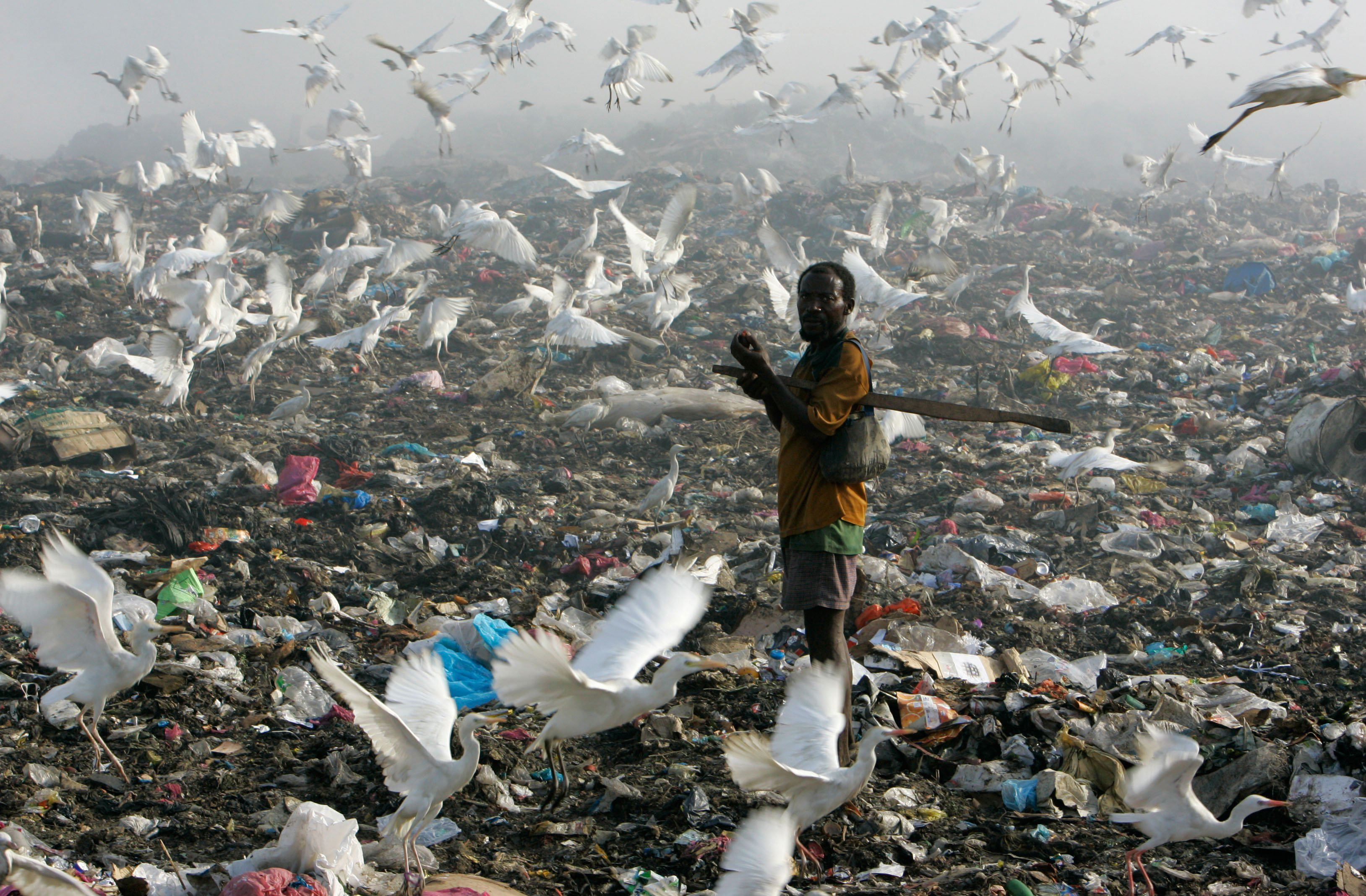
A man searches through trash for food at the main city dump in Libreville, Gabon, in this Feb. 29, 2008, file photo. When longtime dictator Omar Bongo died last week, he left behind at least 66 bank accounts, but most of the country Bongo governed for 41 years is still covered in jungle. A third of its people live in poverty so dire that some dig through the trash dump to feed their children.
Libreville, Gabon ? When longtime dictator Omar Bongo died last week, he left behind at least 66 bank accounts. The first family owned 45 homes in France, including at least 14 in Paris and 11 on the French Riviera. And they boasted of 19 or more luxury cars, including a Bugatti sports model that cost the Republic of Gabon $1.5 million.
But most of the country Bongo governed for 41 years is still covered in jungle. A third of its people live in poverty so dire that some dig through the trash dump to feed their children.
The contrast makes it all the more striking that hundreds of thousands of those people lined the streets of the capital this week to bid goodbye to the 73-year-old ruler who bled their country dry. Women wept and waved signs that said, “Merci Papa” — thank you, father. Businesses put up billboards with messages of loss, such as: “Gabon weeps.”
On a continent that has seen more than its share of presidents-turned-dictators, Gabon is perhaps one of the best examples of what analysts call “the chief complex.” So long was Bongo in power that his countrymen came to view him as a hereditary chief, a man whose authority is unquestioned.
The acceptance raises the question of what will happen now in a nation that calls itself a democracy but has in fact never known one. Gabon — where Bongo won election six times in a row — will hold its next elections within 90 days. And already, several of the estimated 30 children he fathered are rumored to be jockeying for power.
“The Gabonese don’t know what democracy looks like. Their point of reference is the village — and in the village, no one questions the chief,” said Anges Ratanga Atoz, a political science professor at Libreville’s Omar Bongo University. “And after all, what did Bongo do that was so bad? Did he kill anyone? No.”
Masses of Gabon’s 1.5 million people waited outside the airport last week for the convoy carrying Bongo’s body on a special flight back from Spain. Several thousand white and red roses were flown in from France for the funeral, and the coffin was placed inside the presidential palace, surrounded by cascading bouquets.
Bongo, the world’s longest ruling head of state when he died, was only 30 in 1966 when he was tapped to become vice president. The deal was reportedly brokered by France, the country’s former colonial ruler intent on maintaining its influence over Gabon. When President Leon M’Ba died of cancer a year later, Bongo took office.
With each passing decade, he consolidated power. He turned his country into a single-party state. Until 1990, he was the only candidate in elections. When opposition parties formed, he allegedly had supporters bussed from town to town to vote multiple times. In 2003, Bongo changed the constitution to get rid of term limits so he could continue running for life.
Bongo’s rise to power coincided with the country’s oil boom. In his first decade in office, oil production jumped 10-fold, even as prices rose because of the 1973 Arab oil embargo. In just one year, Gabon’s national budget tripled.
But as the money poured in, Bongo ignored basic infrastructure in exchange for grand projects. He spent a reported $800 million to build the sea-facing presidential palace and 52 villas to house his guests during a four-day summit of African heads in 1977, according to John Ghazvinian, an expert on Africa’s oil economies. By 1985, Libreville held the world record for per capita champagne consumption.
While much of the country still has no paved roads, Bongo spent 14 years and an estimated $4 billion to build a train. He diverted its route at a cost of hundreds of millions of dollars to reach Franceville, the capital of his native province. Since its opening, the train has required a $60-million-a-year subsidy to stay running.
Ghazvinian compared Gabon’s recent history to a person of modest means winning the lottery.
“What happens when you’re not educated and you don’t have a lot of money and you win the lottery? I think you’ll see that most people don’t end up investing the money. They spend it on prestige and ostentation — as Gabon did,” he said.
“It annoys me to no end when I see the Gabonese lining up to cry in front of his coffin,” said Gregory Ngbwa Mintsa, one of Bongo’s few critics, who was jailed after signing a lawsuit by anti-corruption watchdog Transparency International attempting to recover Gabon’s stolen riches. “The problem is that everyone aspires to be like him. We are in a system that has lasted 40 years. Even the poorest person now thinks that it’s normal for people in power to steal.”