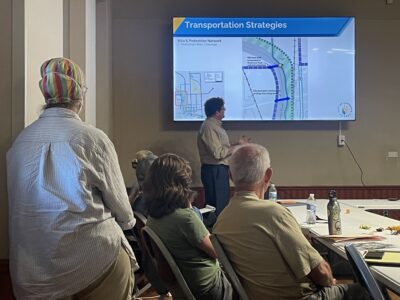
Geologists’ drilling project digs up past
Survey investigates resources deep within Earth’s crust
Dave Newell and his associates are drilling through 300 million years of history, with only another 1.3 billion years left to go.
All within the next two weeks.
The time-traveling task is part of the Kansas Geological Survey’s push to document the soil, rock and natural-resource conditions 3,000 feet below a patch of southwestern Douglas County, a drive to bolster energy-seeking efforts throughout the Midwest.
The history-laden material: A continuous rock core, measuring 2 inches in diameter, being cut from below ground and removed in 10-foot-long segments — appropriate to serve as both a reliable reference point and a fertile tactile resource for researchers, companies and others interested in both the Earth’s history and its future.
“These cores will be useful in many areas,” said Newell, a geologist and director for the survey’s drilling project.
The drilling site — nestled in the bottoms of a hilly area east of Lone Star — already has surrendered the first 700 feet of what will be a 3,000-foot-long core.
Within a week, the sample will reach into the geologic “basement” some 2,700 feet below ground, an area formed up to 1.67 billion years ago and considered part of the Earth’s crust.
In the many millennia since, Douglas County has seen its share of change.
“Three hundred million years ago we were in the tropics, near the equator,” said Lynn Watney, a senior scientific fellow at the survey. “Then we moved away, and went into drier conditions and cooler climates. Now we’re at a temperate latitude, in an interior continent, where we’ve got warm summers and cold winters.
“It was only 18,000 years ago that we had glaciers in this area, but an ‘instant’ in geologic time is just that: an instant.”
The core sample will allow scientists at the survey to catalog such changes in detail, by examining the changes in rock.
The rock also will be expected to release other information — most notably evidence of methane gas, trapped in microscopic pores in underground coal beds.
Such gas, collected from wells in southeast Kansas, generated about $160 million in revenue from natural gas last year, Watney said. The continuous core could help assist such efforts throughout the Midwest, by establishing a clear reference point for various formations and the rates of methane release that might be expected.
“That would have immediate, economic significance,” Watney said. “We’re trying to help identify trends for future resources, so we can do a better job of predicting what those coal seams would produce.”
The survey is using grant money to finance the bulk of the drilling work, and the core — to be kept in 250 boxes, weighing a total of 5 tons — will be kept in a storage building northeast of town, Watney said.
City Government
Developer seeks incentive from City of Lawrence to build 131 units of housing near Wakarusa and Queens

Lawrence city leaders will consider whether to keep Community Building open, make 2 other rec centers free to access
A STAR Bond application raises questions for city leaders about Costco and housing west of the SLT
Soccer gear honoring Lawrence history’s all-star team is now on sale as part of city’s public art exhibition
To honor public servants, Lawrence’s July 4 celebration will have a whole gallery of their photos on display; submissions open now