

Referendum on term limits, Chavez divides Venezuelans
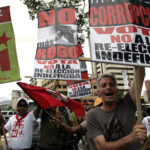
People hold posters as they campaign in favor and against Venezuela’s upcoming referendum Friday in Caracas. The referendum, if approved by voters Sunday, could allow Venezuela’s President Hugo Chavez to run for re-election indefinitely.
Caracas, Venezuela ? Before Hugo Chavez became president, Rafael Alvarez was so close to his older brother that he called him “papi.” Now the two don’t speak.
The Alvarez family is like much of Venezuela, split down the middle by 10 years of Chavez rule and a fierce struggle by his opponents to end it. A referendum Sunday that could remove constitutional term limits altogether has polarized the country even more.
Rafael Alvarez, a 59-year-old, U.S.-educated biologist, has been an increasingly fervent supporter of the president since his 1998 election. His brother Yldemaro, a 68-year-old retired accountant, has grown increasingly suspicious of Chavez and speaks out against him on a weekly radio program.
The brothers argued more and more during family events as the years passed, Yldemaro Alvarez said, but when the referendum campaign heated up, they stopped talking altogether.
“He’s polluted, just like half this country is polluted,” Yldemaro Alvarez said by telephone from his home in the central Venezuelan town of San Juan de los Morros. “Half this country is blind and fooled. I love him because he’s my brother, but we’re as far apart as the sky and the Earth.”
Rafael Alvarez declined to be interviewed, saying he would not talk to a U.S.-based news agency. Through a nephew, Alvarez said: “They just want to sabotage the president’s democratic process.”
In Venezuela, you’re either for Chavez or against him. There are Chavista newspapers and television stations, and opposition newspapers and television stations. There are pro-Chavez neighborhoods and anti-Chavez neighborhoods. Even the landscape is partisan: “Plaza Altamira is Chavista now” proclaimed a newspaper headline Wednesday, above an article saying an anti-Chavez campaign booth had disappeared from the square.
The president himself marveled in an interview Tuesday that some people may not have decided how to vote yet. He said all Venezuelans must determine the country’s future on Sunday, including “those who have doubts or are apolitical — that is, if there is still anyone who is indifferent to politics in Venezuela today.”
The undecided are few and far between, and the two sides are growing ever more distant.
“I feel a deep sadness for this divided, fractured country, split into two poles, radicalized and polarized,” said opposition student leader David Smolansky, 23. “This country had always been a paradise of coexistence of all types — racial, political, of ethnicities and of social classes.”
Chavez blames the opposition for the bitter divide.
“We are the peace ticket,” he said Tuesday. “Them? That sick pack of hatred? Ah, well. You want the country to enter a sea of violence and terror? … The referendum is to put the brakes on this madness, to prevent this madness from taking the reins of our country again.”
Chavez remains broadly popular, particularly among the poor, who have benefited from his oil-funded social programs and who were largely left out of earlier oil booms under governments further to the right.
But his attempt to amend the constitution in December 2007 met with a surprise defeat. That effort included a variety of crowd-pleasing changes like a six-hour work day along with a clause to enable the president to run for re-election indefinitely, but many worried that his power already had too few checks and balances.
This time, Chavez has narrowed the referendum to affect term limits only, and broadened it to apply to all elected officials. He also has campaigned incessantly, and the normally tireless Chavez has appeared exhausted.
The result: “Yes” has pulled even with — and perhaps slightly ahead of — “no” in recent polls.