

Use of nitrogen in tires gaining ground
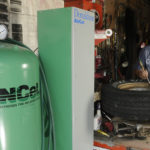
Performance Tire technician John Chronister fills a tire with nitrogen; the gas helps maintain the correct tire pressure and can prolong the life of the tire. While most people are trying to think of ways to improve gasoline mileage, a small thing like keeping your tires inflated to the right pressure can make a difference.
Richard Brown let the air out of the tires on his two cars two weeks ago.
The tires were refilled with dry nitrogen. Brown hopes the nitrogen will make winter more tolerable.
“I always had to grab the old hand pump and pump the things back up when it got cold,” Brown, of Lawrence, said. “With nitrogen I don’t have to do that now.”
That’s because nitrogen maintains tire pressure better than air and reduces chances of tire failure, tire vendors say.
Brown made the switch from compressed air to nitrogen after seeing a sign advertising nitrogen at Performance Tire & Wheel, 1828 Mass. Nitrogen has been available at the business for a little more than two months since it was purchased by new owners, manager Steve Montgomery said. Topeka’s two Performance Tire businesses have offered nitrogen for years, he said.
There are a few other tire and mechanical garages in Lawrence that offer nitrogen. Among the first to start, two or three years ago, were Harris Auto Repair, 811 E. 23rd St., and Doug’s Auto & Alignment, 530 Gateway Drive.
“It’s to try to get the tires to last as long as they can and have less maintenance for the customer to have to deal with,” said Doug Bahnmaier, owner of Doug’s Auto.
Tire and mechanical trade publications touted nitrogen a few years ago, and that led Bryan Harris, owner of Harris Auto, to try it. Customers who fill up with nitrogen have had no complaints, he said.
Nitrogen also helps cars improve their gas mileage, however slightly, Montgomery said. Because the tires stay properly inflated there is less friction between tires and the roadway.
“We’re not talking about saving 10 miles per gallon, but it does cut down on resistance,” Montgomery said. “In this day and age if there is a cheap way to save gas you should do it.”
Brown recently checked gas mileage after some driving and found that he improved by about 2 miles per gallon, he said.
The garages charge for the first fill-up with nitrogen, then refills are free. Prices range from $3 to $5 per tire.
Nitrogen use in tires is nothing new, although interest appears to be increasing, especially in this area, mechanics said. Nitrogen in tires on airliners and other big planes has been common for years. The military also uses nitrogen for tires.
Planes use nitrogen because it doesn’t have moisture and thus doesn’t freeze at high altitudes, said Lloyd Hetrick, president of Hetrick Aviation at Lawrence Municipal Airport.
Professional racers also use nitrogen in tires.
In a bulletin issued in 2006, the Rubber Manufacturer’s Association stated that nitrogen may contribute to minor reductions in inflation pressure loss. RMA also noted that tire inflation should be checked at least once a month whether air or nitrogen is being used.