

Paul Newman, Hollywood’s cool anti-hero, dies
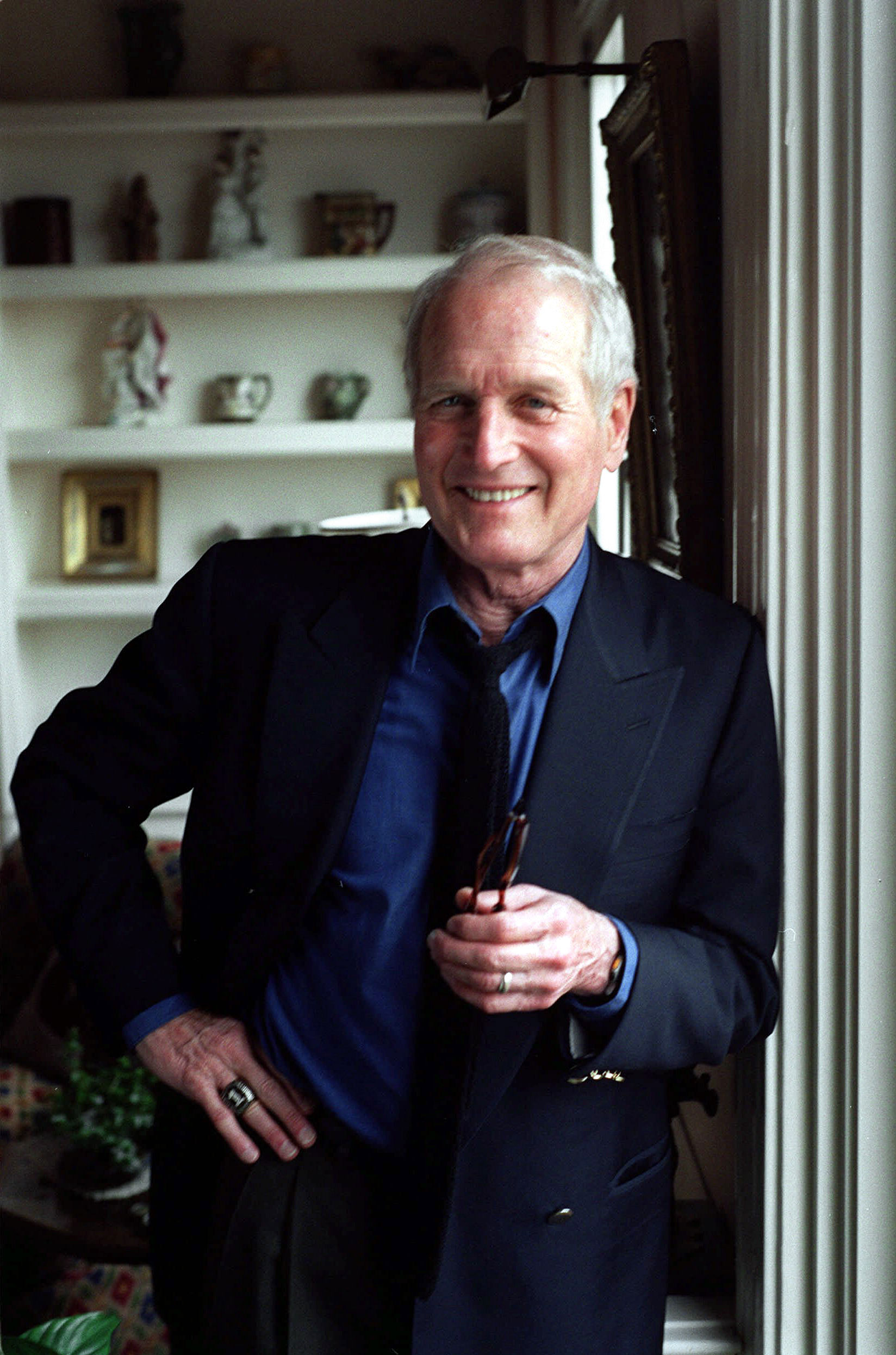
Actor Paul Newman poses in February 1999 at his apartment in New York. A spokeswoman for Newman said Saturday that the screen legend has died at age 83 after battling cancer.
Westport, Conn. ? Paul Newman never much cared for what he once called the “rubbish” of Hollywood, choosing to live in a quiet community on the opposite corner of the U.S. map, staying with his wife of many years and – long after he became bored with acting – pursuing his dual passions of philanthropy and race cars.
And yet despite enormous success in both endeavors and a vile distaste for celebrity, the Oscar-winning actor never lost the aura of a towering Hollywood movie star, turning in roles later in life that carried all the blue-eyed, heartthrob cool of his anti-hero performances in “Hud,” “Cool Hand Luke” and “Butch Cassidy and the Sundance Kid.”
The 10-time Academy Award nominee died Friday at age 83, surrounded by family and close friends at his Westport farmhouse following a long battle with cancer, publicist Jeff Sanderson said Saturday.
In May, Newman dropped plans to direct a fall production of “Of Mice and Men” at Connecticut’s Westport Country Playhouse, citing unspecified health issues. The following month, a friend disclosed that he was being treated for cancer and Martha Stewart, also a friend, posted photos on her Web site of Newman looking gaunt at a charity luncheon.
But true to his fiercely private nature, Newman remained cagey about his condition, reacting to reports that he had lung cancer with a statement saying only that he was “doing nicely.”
As an actor, Newman got his start in theater and on television during the 1950s and went on to become a legend held in awe by his peers. He won one Oscar and took home two honorary ones, and had major roles in more than 50 motion pictures, including “Exodus,” “Butch Cassidy,” “The Verdict,” “The Sting” and “Absence of Malice.”
Hollywood icon
Newman worked with some of the greatest directors of the past half century, from Alfred Hitchcock and John Huston to Robert Altman, Martin Scorsese and the Coen brothers. His co-stars included Elizabeth Taylor, Lauren Bacall, Tom Cruise, Tom Hanks and, most famously, Robert Redford, his sidekick in “Butch Cassidy” and “The Sting.”
“There is a point where feelings go beyond words,” Redford said Saturday. “I have lost a real friend. My life – and this country – is better for his being in it.”
Newman sometimes teamed with his wife and fellow Oscar winner, Joanne Woodward, with whom he had one of Hollywood’s rare long-term marriages. “I have steak at home, why go out for hamburger?” Newman told Playboy magazine when asked if he was tempted to stray. They wed in 1958, around the same time they both appeared in “The Long Hot Summer.” Newman also directed her in several films, including “Rachel, Rachel” and “The Glass Menagerie.”
“Our father was a rare symbol of selfless humility, the last to acknowledge what he was doing was special,” his daughters said in a written statement. “Intensely private, he quietly succeeded beyond measure in impacting the lives of so many with his generosity.”
A rebel, on and off screen
With his strong, classically handsome face and piercing blue eyes, Newman was just as likely to play against his looks, becoming a favorite with critics for his convincing portrayals of rebels, tough guys and losers. New York Times critic Caryn James wrote after his turn as the town curmudgeon in 1994’s “Nobody’s Fool” that “you never stop to wonder how a guy as good-looking as Paul Newman ended up this way.”
But neither his heartthrob looks nor his talent could convince Newman to embrace the Hollywood lifestyle. He was reluctant to give interviews and usually refused to sign autographs because he found the majesty of the act offensive.
Newman had a soft spot for underdogs in real life, giving tens of millions to charities through his food company and setting up camps for severely ill children. Passionately opposed to the Vietnam War, and in favor of civil rights, he was so famously liberal that he ended up on President Nixon’s “enemies list,” one of the actor’s proudest achievements, he liked to say.
Oscar-winner
A screen legend by his mid-40s, he waited a long time for his first competitive Oscar, winning in 1987 for “The Color of Money,” a reprise of the role of pool shark “Fast Eddie” Felson, whom Newman portrayed in the 1961 film “The Hustler.”
In that film, Newman delivered a magnetic performance as the smooth-talking, whiskey-chugging pool shark who takes on Minnesota Fats – played by Jackie Gleason – and becomes entangled with a gambler played by George C. Scott. In the sequel – directed by Scorsese – “Fast Eddie” is no longer the high-stakes hustler he once was, but an aging liquor salesman who takes a young pool player (Cruise) under his wing before making a comeback.
He won an honorary Oscar in 1986 “in recognition of his many and memorable compelling screen performances and for his personal integrity and dedication to his craft.” In 1994, he won a third Oscar, the Jean Hersholt Humanitarian Award, for his charitable work.
As he passed his 80th birthday, he remained in demand, winning an Emmy and a Golden Globe for the 2005 HBO drama “Empire Falls” and providing the voice of a crusty 1951 Hudson Hornet in the 2006 Disney-Pixar hit, “Cars.”
Off the screen, Newman was beloved in Westport, the upscale community about an hour north of New York. One of his favorite haunts was Mario’s Place, an eatery that Newman frequented with pals actor James Naughton or writer A.E. Hotchner.
In 1982, Newman and Hotchner started a company to market Newman’s original oil-and-vinegar dressing. Newman’s Own, which began as a joke, grew into a multimillion-dollar business selling popcorn, salad dressing, spaghetti sauce and other foods. All of the company’s profits are donated to charities. The company had donated more than $250 million, according to its Web site.
National

Unhealthy air quality in California city as huge warehouse fire burns for 3rd day
Judge orders Trump administration to restore National Park changes at sites that ‘disparaged’ US
Teens’ reading and math scores have stagnated, US test results show
WASHINGTON (AP) — Younger students have regained ground academically after the pandemic's disruptions while older ...

Lawyers for man accused of killing Charlie Kirk try to block death penalty

Trump’s name poised to come off Kennedy Center
