

Auto sales plummet with economy

Ray Ciccolo, owner of Boston Volvo Village, said his dealership was one of many caught in the middle as potential customers, automakers and lenders all behave more cautiously. Ciccolo is pictured at his auto dealership Monday in Boston.
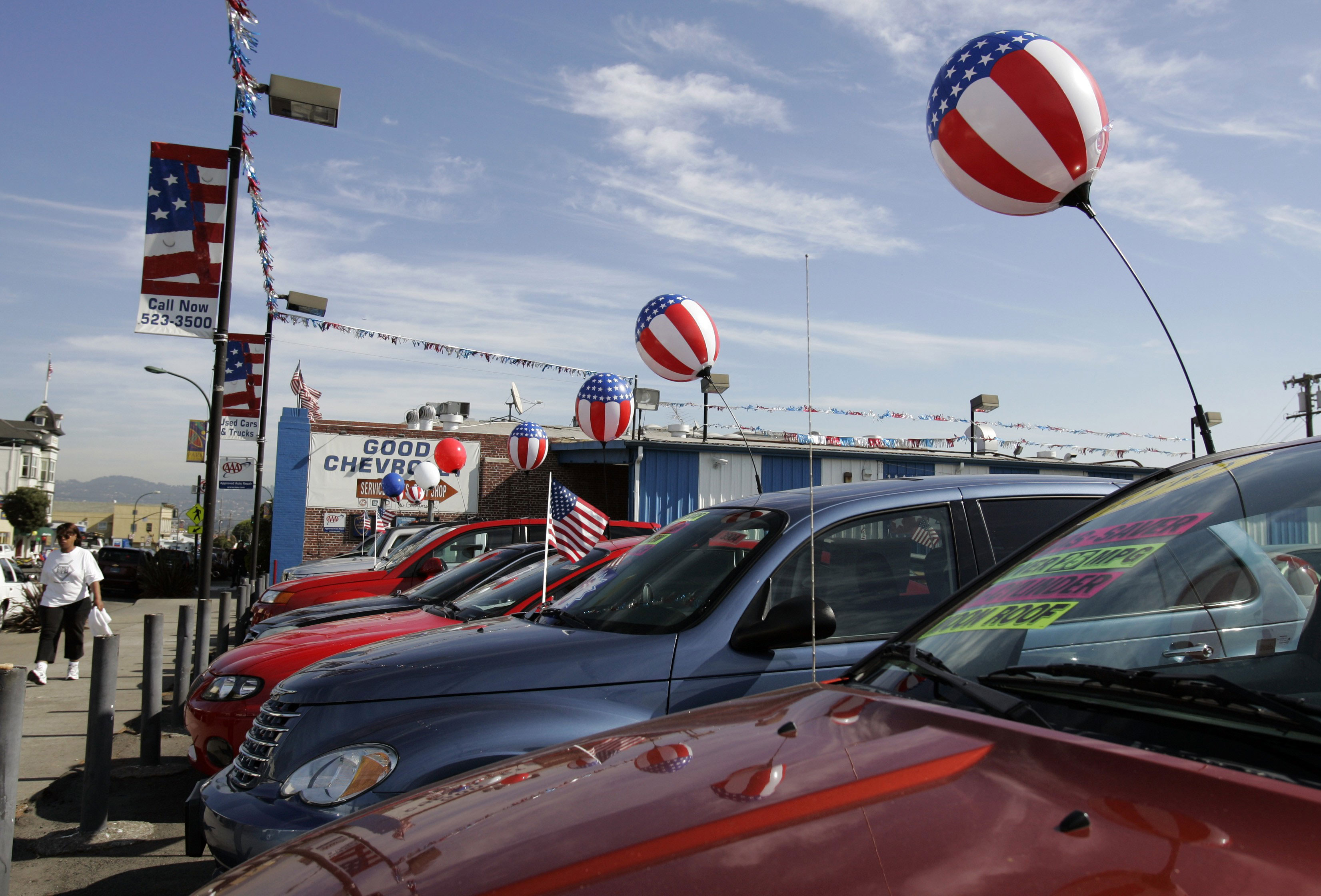
These vehicles were on display at a Chevrolet dealership in Alameda, Calif., this week, just before it closed. Americans steered clear of auto dealerships in September, sending sales of new cars and trucks tumbling as credit conditions tightened.
Auto sales dropped sharply in September as consumer unease mounted in the face of the crisis on Wall Street and restricted credit.
Toyota Motor Corp., Chrysler, Ford Motor Co. and Nissan Motor Co. reported U.S. sales declines of more than 30 percent for the month compared with September 2007, while Honda Motor Co. and General Motors Corp. showed sharp downturns as well.
Overall, the industry sold only 964,873 vehicles – a 26.6 percent slide from a year earlier and its biggest percentage drop in 17 years, Autodata Corp. reported Wednesday.
Industry executives blamed public unwillingness to make purchases amid the nation’s financial troubles, as well as lack of credit from lenders.
“It’s tantamount, really, to a natural disaster,” said George Pipas, chief sales analyst at Ford. Showroom traffic, he added, was at levels associated with “a large storm or the aftermath of 9/11.”
According to CNW Marketing Research, visits to auto dealerships in the last 10 days of September declined by 51 percent compared with the same period last year, the largest slide in at least 22 years.
In response, carmakers called on Congress to pass the massive financial system rescue plan, which is now being debated, as soon as possible.
“If the bill helps restore consumer confidence, let’s hurry up and make it happen,” said Don Esmond, Toyota’s senior vice president for automotive operations.
Toyota’s U.S. sales last month were down 32.3 percent from the year-earlier period, while Ford declined 33.7 percent, Nissan slipped 36.8 percent and Honda fell 24 percent. Since January, Toyota’s sales are down 10.4 percent, while Ford’s have fallen 17.1 percent. Maserati and Bentley were the only makers to post gains in September.
Until last month, Honda had been one of the few carmakers to show a net gain on the year, but declines in August and September have now sucked it down to an overall 1.1 percent downturn through the first three quarters. Truck and SUV-heavy Chrysler saw a 32.8 percent decline for the period, and is off 25 percent on the year.
GM had a relatively modest 15.5 percent decline, provoking a near celebratory response from the largest U.S. automaker.
“A few months ago, I’d have jumped out the window with these kinds of numbers,” said Mark LaNeve, head of sales and marketing for GM. “We’re in a kind of crazy market now.”
This has been a very difficult year for carmakers, with industry sales down 12.8 percent across the board since January. In September, manufacturers were on pace to sell 12.5 million vehicles for the year, far below last year’s total of 16.1 million, according to Autodata.
Consumer confidence has been sliding since last year, and carmakers were hammered by soaring gas prices in the spring and early summer. Lately, dealers complain that customers are being turned away because banks won’t approve loans for anyone without near-perfect credit. A salesman at Allen Gwynn Chevrolet in Glendale, Calif., said he was forced to turn away a consumer who wanted to buy a Corvette this week despite a relatively high credit score.
“We’re losing about three customers a day because of lack of credit,” said Pogos Yenkanyan, team manager for new car sales at Allen Gwynn. “That adds up to 100 cars a month.”
This year’s challenging conditions have made for a dramatically different selling environment. A prime example is Ford, which can no longer rely upon easy financing and generous lease terms to move the high-end, high-profit vehicles – such as the $31,000-and-up Expedition sport utility vehicle – that it specializes in.
In September, essentially only one high-volume Ford model, the compact Focus, showed a sales increase; it was up 4.7 percent. Expensive gas-guzzlers such as the Expedition, Explorer and F-150 pickup were down 37.4 percent, 67.3 percent and 41.6 percent, respectively.
Toyota, which still offers leasing and specializes in lower-priced vehicles, is doing little better. The Japanese carmaker boosted production of models such as the Corolla to meet soaring consumer demand in the early summer. Yet in September, deliveries of the Corolla were down 27.9 percent.
Toyota’s Esmond said that wasn’t because of a lack of credit; rather, it was because nobody was even making offers. The Wall Street crisis “certainly put the brake on consumers,” he said. “We had people calling to ask for their deposits back on Lexus orders.”
Michael DiGiovanni, GM’s top sales analyst, said that inventory control and dealer incentives – such as the two months of employee pricing GM offered through Tuesday – simply aren’t enough to drive business.
“We absolutely think it’s critical that the federal aid package be passed,” he said.