Court rules US paper money discriminates against blind
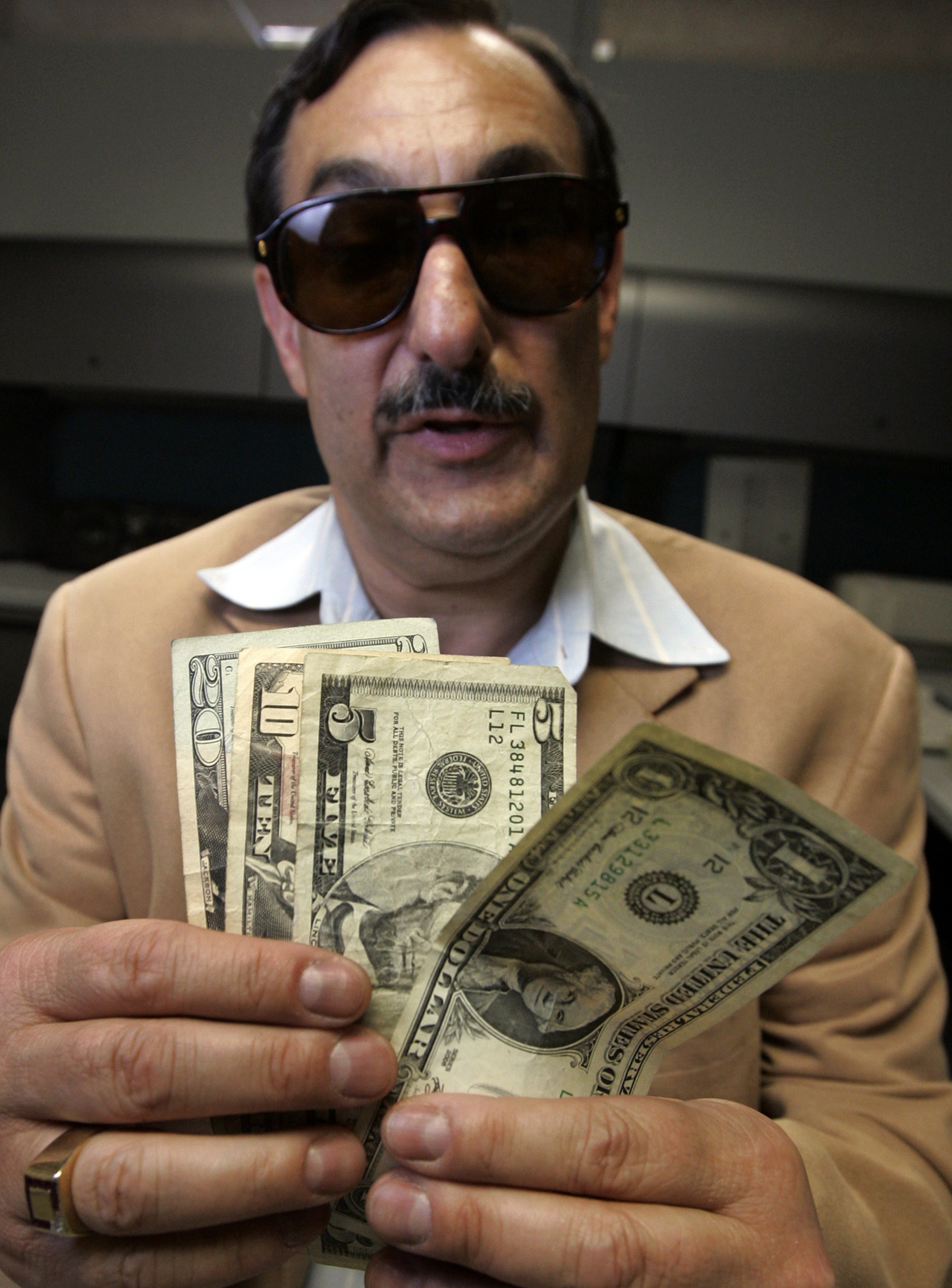
Mitch Pomerantz, president of the American Council of the Blind, holds U.S. currency, which cannot be differentiated by touch. A court ruling Tuesday could force the Treasury Department to make bills of different sizes or print them with raised markings or other distinguishing features.
Washington ? Close your eyes, reach into your wallet and try to distinguish between a $1 bill and a $5 bill. Impossible? It’s also discriminatory, a federal appeals court says.
Since all paper money feels pretty much the same, the government is denying blind people meaningful access to the currency, the U.S. Court of Appeals for the District of Columbia Circuit ruled Tuesday. The decision could force the Treasury Department to make bills of different sizes or print them with raised markings or other distinguishing features.
The American Council of the Blind sued for such changes, but the government has been fighting the case for about six years.
The U.S. acknowledges the current design hinders blind people, but it argues that they have adapted. Some rely on store clerks to help, some use credit cards and others fold certain corners to help distinguish between bills.
“I don’t think we should have to rely on people to tell us what our money is,” said Mitch Pomerantz, the Council of the Blind president.
Others say they manage but not always easily.
“When I pay for something and I get change back, I’m very slow and methodical. I’ll ask, ‘Is this the 10? Is this the five? Is this the one?'” said Kim Charlson, the library director at the Perkins School for the Blind, which is Helen Keller’s alma mater.
Some use electronic currency readers. But they can be expensive, and they sometimes have problems with new $20 bills.
“It’s slow,” said Sam McClain, who manages a snack shop in a legislative office building near the Georgia Capitol. He has a currency reader but usually relies on the honesty of his customers. “Sometimes I have 10 or 15 people in here, and I can’t use it.”
The court ruled 2-1 that such adaptations were insufficient under the Rehabilitation Act. The government might as well argue that there’s no need to make buildings accessible to wheelchairs because handicapped people can crawl on all fours or ask passers-by for help, the court said.
Courts don’t decide how to design currency. That’s up to the Treasury Department, and the ruling forces the department to address what the court called a discriminatory problem.
That could still take years. But since blindness becomes more common with age, people in their 30s and 40s should know that, when they get older, “they will be able to identify their $1 bills from their fives, tens and twenties,” said Pomerantz, of the Council of the Blind.
National
Obama Center opens with a call to defend democracy

College sports bill clears a key Senate hurdle despite SEC, Big Ten opposition
US tells states to deal with unemployment fraud or face penalties
The U.S. Labor Department told all 50 states on Wednesday that they need to get serious about fighting fraud and ...
Dangerous flooding from Tropical Storm Arthur, first of the Atlantic season, threatens Gulf Coast

‘A million years isn’t enough’: Victims’ relatives confront Gilgo Beach serial killer at sentencing