

Olympic flame’s Everest ascent grand but secret
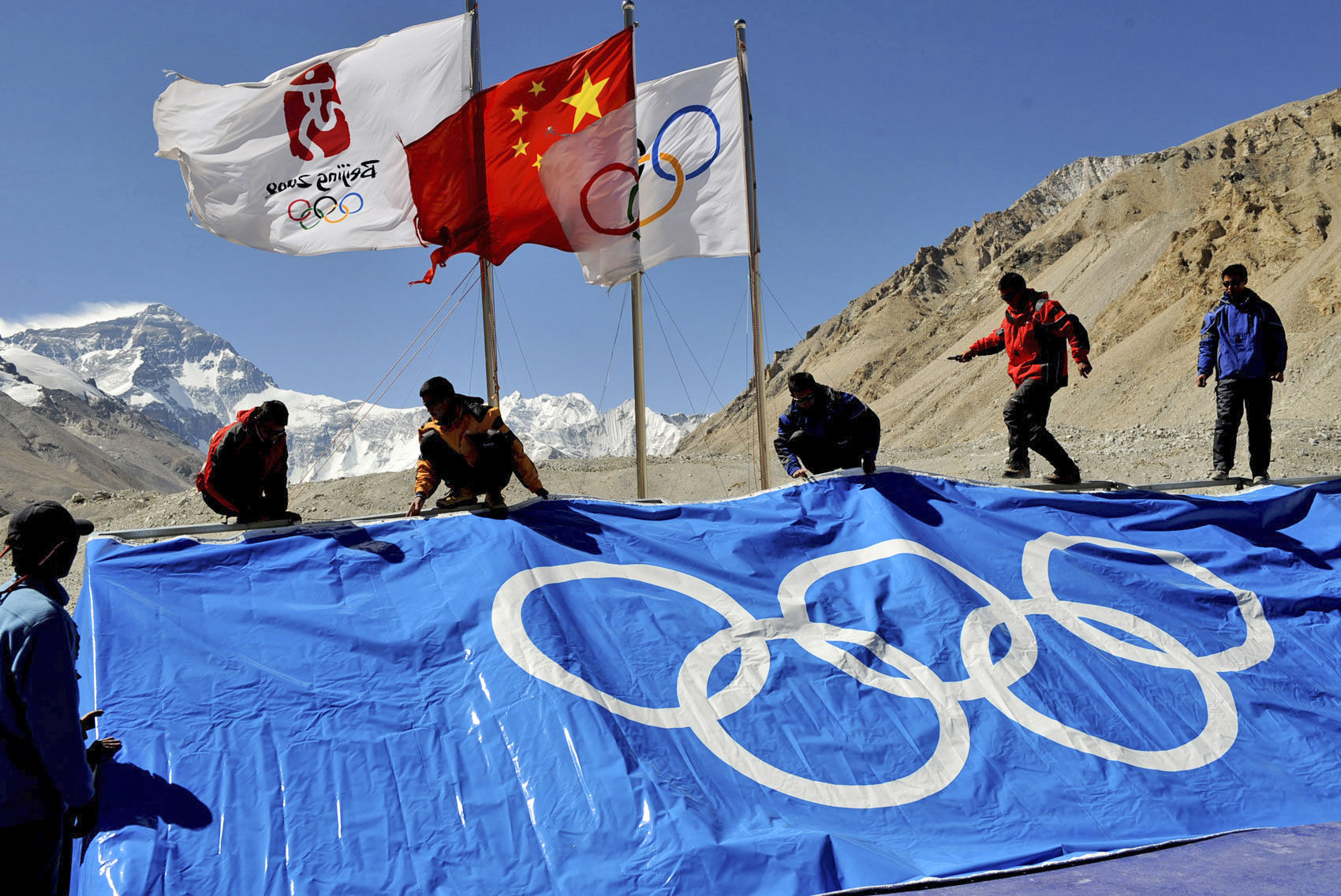
staff members lay a flag of the Olympic logo on Wednesday at the base camp of Mount Everest In this photo released by China's Xinhua News Agency. A team for weather report, communications, power supply, fire control and media is working at the base to ensure the success of the Beijing Olympic torch relay.
Beijing ? Chinese mountaineers made final preparations Wednesday to take the Olympic flame up Mount Everest in a grand but contentious feat that is being accorded an unusual mixture of fanfare and secrecy.
As China marked 100 days before the start of the Olympics, state-run television began the first of what were billed as elaborate and technically difficult live broadcasts from Everest’s base camp for the journey up the world’s tallest peak.
Mountaineers were completing the setup of a staging point at 27,390 feet for the final assault on the 29,035-foot summit, Chinese Central Television reported.
The Web site of Beijing Daily likened the lack of information to a “mysterious veil that has surrounded base camp.”
On Friday, state media reported that China has named the 50-member national team charged with carrying the flame to the summit of Mount Everest.
The team, including mountaineers and support staff, is composed of Han Chinese, ethnic Tibetans, and other ethnic minorities, such as Hui, Tu and Tujia, said Zhang Zhijian, a spokesman for the Chinese Mountaineering Team, according to the official Xinhua News Agency.
Climbing the 29,035-foot summit “is a collective job; nobody can do it alone,” said Zhang, who spoke to reporters at Everest base camp. The timing of the ascent depends on the weather.
Some media reports had speculated that the climb could come as early as Wednesday – when the countdown clock in Beijing marked 100 days to the Aug. 8-24 games – or Thursday – the May Day holiday.
A brewing storm made a climb in the next three days unlikely, the Xinhua News Agency reported late Wednesday, citing Yang Xingguo, the expedition’s weather expert at base camp.
To commemorate the 100-day mark, Beijing held a mini-marathon outside the nearly completed National Stadium, known as the Bird’s Nest, and a song gala, where actor Jackie Chan joined other celebrities to sing “Beijing Welcomes You,” which was written for the event.
Senior Communist Party leader Jia Qinglin urged all Chinese “to pool our patriotic passion to accumulate a mighty force that could overcome all difficulties to in a bid to hold a successful Olympics.”
Meanwhile, the Chinese and foreign reporters at Everest base camp wait.
Still billed as a spectacular event, the Everest climb is being given mixed treatment. With the torch relay dogged by protests and Beijing’s oft-criticized rule in Tibet drawing heated scrutiny after demonstrations this spring, organizers have placed a premium on security.
The Everest flame was specially designed to burn in frigid, windy, oxygen-thin Himalayan air. It is a sister flame to the one that made its way around the world and reached Hong Kong on Wednesday, returning to Chinese territory after a contentious month abroad.
Chinese officials did not publicize the flame’s travel to the Everest base camp, apparently to avoid protests. Beijing has also exercised its diplomatic clout, persuading Nepal to bar climbers from border-straddling Everest’s southern face to keep potential protesters from reaching the peak and spoiling the torch’s moment.
But the secrecy has also dented plans by organizers and CCTV, which spent heavily on special broadcast facilities, to promote a torch run that is physically challenging but that has been criticized by Tibetan activists as a symbol of Chinese domination of Tibet.
Oxygen bottles are a must above 25,750 feet, the Tibet Mountaineering Training School said. Everest’s northern face is said to be subject to harsher, windier weather than the Nepal side, with usually just two chances to make the summit in May, the choice season for climbing.