

Weather major facet in Sunflower State’s history
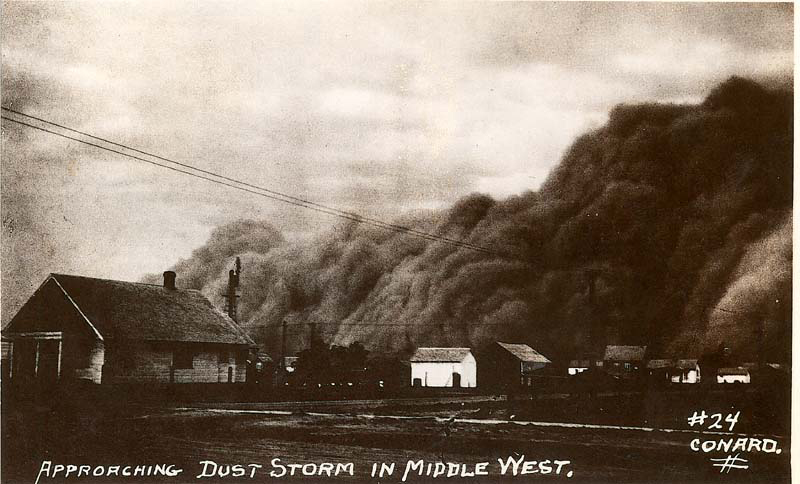
A dust storm approaches a farmstead somewhere in the southern Plains in this 1935 photograph taken by famed photographer Frank Conard, who was from Garden City. The wind was an enemy in the 1930s, causing troubles to farmers, but now some Kansans are trying to harness the wind to create energy through turbines.
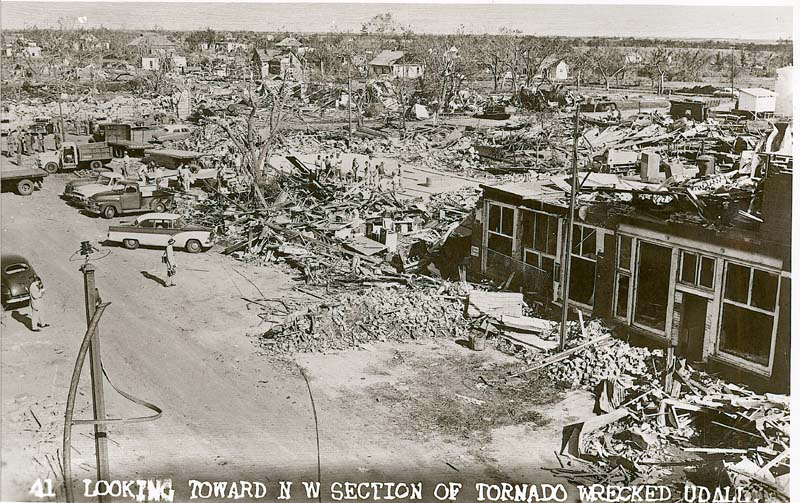
This photo shows the aftermath of a 1955 tornado in Udall, a town southwest of Wichita. Tornadoes such as the one in Udall, which killed 77 people, have become a part of the identity of Kansans.
Weather, no doubt, plays a role in lifestyle wherever a person might live.
But Craig Miner, the famed Kansas historian, thinks climate seeps into identity more in the Sunflower State than in most places.
“It’s a feature of our culture – we’re aware of it,” Miner said. “I sometimes say we have a little bit of an identity problem because we don’t know what kind of climate we live in.”
Ah, yes, that old saying: Don’t like the weather in Kansas? Wait 10 minutes, and it’ll change.
But weather is more than a joke here.
There are real consequences, both in damage, agricultural prosperity and even aviation.
Figuring it out
The early settlers in our state had a difficult time figuring out the climate of Kansas. Some of those pioneers settled here in wet years, only to be disappointed by drought in following years.
“Our climate is very cyclical – we’re going to have boom and bust, drought and flood,” said Rebecca Martin, assistant director of the Kansas Museum of History in Topeka. “We’re going to have extremes.”
And, Martin notes, the early propaganda marketing our state touted the weather – even though nobody really understood it.
“We were marketing the land back before it was settled with whites,” she said. “The material talked about it being beautiful, lush and tropical in nature – which might be true one year, and the next year, it might have looked like the face of the moon.”
Eventually, around 1900, Kansas farmers realized the hard, red winter wheat was the best crop to grow here. Kansas has been known as “the wheat state” for much of the time since then.
“They had a real difficulty determining what kind of agriculture they could carry on, partly because the weather was so variable in the long term and short term,” Miner said. “There were wet years and dry years. Now we talk about, ‘Well, it’s global warming.’ Here, it’s just Kansas.”
Windy state
Agriculture wasn’t the only industry to develop because of the weather. Wichita became the “Air Capital of the World,” in part, because the wind made ideal for flying airplanes. And now, turbines are sprouting up through central and western Kansas to create an industry for wind power in the state, much as windmills helped farmers pump water from the ground in previous generations.
And it’s for good reason – Kansas, indeed, is windy. Dodge City is the windiest city in the United States, according to the National Climatic Data Center, at an average wind speed of 13.9 mph.
But there was a time that wind wasn’t a good thing.
During the 1930s, wind storms stirred up clouds of dust that filled houses with layers of dirt.
The storms flew in the face of the pioneer adage that “rain follows the plow” – the idea that working the land and settling it would cause it to be fruitful.
Today, that seems about as foreign as the idea that, during the 1870s, a group of Kansans fired a cannon into the sky because they thought that would cause it to rain.
“Humankind has learned to reconsider their initial response, that we can control nature,” Martin said.
Twister identity
Speaking of wind – who could deny that tornadoes are a part of Kansans’ identity? Whether it’s dealing with an endless barrage of references to “The Wizard of Oz,” or dealing with the all-too-reality of tornado damage, cyclones are part of the state’s weather fame.
Kansas isn’t the nation’s leading tornado state, but it is close, according to the Web site www.tornadoproject.com. Kansas ranks fourth in the number of tornadoes.
Tornadoes have killed nearly 500 Kansans through the years, with the deadliest tornado coming in Udall, in southcentral Kansas, in 1955. Yet Martin said she thought Kansans have embraced the tornado image.
“Now, tornadoes are part of our identity,” she said. “Most Kansans go out on the porch and watch for them instead of going to their storm cellars.”
One source of weather pride – if it can be called that – for Kansas weather disappeared in 2006. Coffeyville, in southeastern Kansas, used to claim the United States’ largest hailstone, at 17.5 inches around and 1.67 pounds. It fell in 1970.
But a stone that fell in Aurora, Neb., in 2003 beat that record. It was 18.75 inches in circumference and weighed about a pound.
Miner, who teaches history at Wichita State University, said he likes to quote a former Wichita State president, Emory Lindquist, about Kansas weather.
“We have an inferiority complex. (Lindquist) said, if it’s a beautiful fall day, we say, ‘Gee, it’s just like Colorado,'” Miner recalled. “If it’s nice and cool in the summer, we say, ‘It’s just like California.’
“But if there’s hail or some horrible thing, we say, ‘Isn’t that just like Kansas?'”