

Monk-led protests reflect growing Buddhist activism
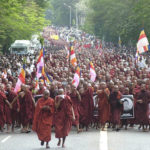
Buddhist monks march in a street in protest against the military government in Yangon, Myanmar, in this file photo of Sept. 24, 2007. Monk-led protests in Tibet and Myanmar reflect growing activism among Asia's Buddhists.
Bangkok, Thailand ? Buddhist monks hurling rocks at Chinese in Tibet, or peacefully massing against Myanmar’s military, can strike jarring notes.
These scenes run counter to Buddhism’s philosophy of shunning politics and embracing even bitter enemies – something the faith has adhered to, with some tumultuous exceptions, through its 2,500-year history.
But political activism and occasional eruptions of violence have become increasingly common in Asia’s Buddhist societies as they variously struggle against foreign domination, oppressive regimes, social injustice and environmental destruction.
More monks and nuns are moving out of their monasteries and into slums and rice paddies – and sometimes into streets filled with tear gas and gunfire.
“In modern times, preaching is not enough. Monks must act to improve society, to remove evil,” says Samdhong Rinpoche, prime minister of the Tibetan government-in-exile and a high-ranking lama.
“There is the responsibility of every individual, monks and lay people, to act for the betterment of society,” he told The Associated Press in Dharmsala, India, discussing protests in Tibet this month that were initiated by monks.
In widespread protests over the past three weeks, crimson-robed monks – some charging helmeted troops and throwing rocks – have joined with ordinary citizens who unfurled Tibetan flags and demanded independence from China. Beijing’s official death toll from the rioting in Lhasa is 22, but the exiled government of the Dalai Lama says 140 Tibetans were killed there and in Tibetan communities in western China.
Bloodshed also stained last fall’s pro-democracy uprising in Myanmar, dubbed the “Saffron Revolution” after the color of the robes of monks who led nonviolent protests against the country’s oppressive military regime.
In Thailand, followers of a Buddhist sect took part in street demonstrations which led to the ouster of Prime Minister Thaksin Shinawatra two years ago.
In Sri Lanka, the ultra-nationalist Jathika Hela Urumaya party, led by monks, has pushed for using brute force against the country’s Tamil rebels. In 1959 a monk assassinated a prime minister over a law giving some protection to the Tamil language.
Indeed, the activism reflects another side of Buddhist history. Despite the faith’s image of passivity, an aggressive strain has long existed, especially in the Mahayana school of Buddhism, practiced in Japan, Korea, China and Tibet.
The sohei, monks in Japan, fought pitched battles with one another and with secular clans for over 600 years until around 1600. China’s Shaolin Temple, a martial arts center to this day, was allowed to retain warrior monks from the 7th century by emperors who sometimes used them to put down rebellions and banditry.
Before China’s takeover of Tibet in 1959, warrior monks sometimes wielded more power – and weaponry – than the army. Lhasa’s Sera monastery, a hotbed of the recent protests, was particularly noted for its elite fighters, the “Dob-Dobs,” who in 1947 took part in a rebellion that took 300 lives.