

Lawrence resident sees Tibetan divide on Olympics
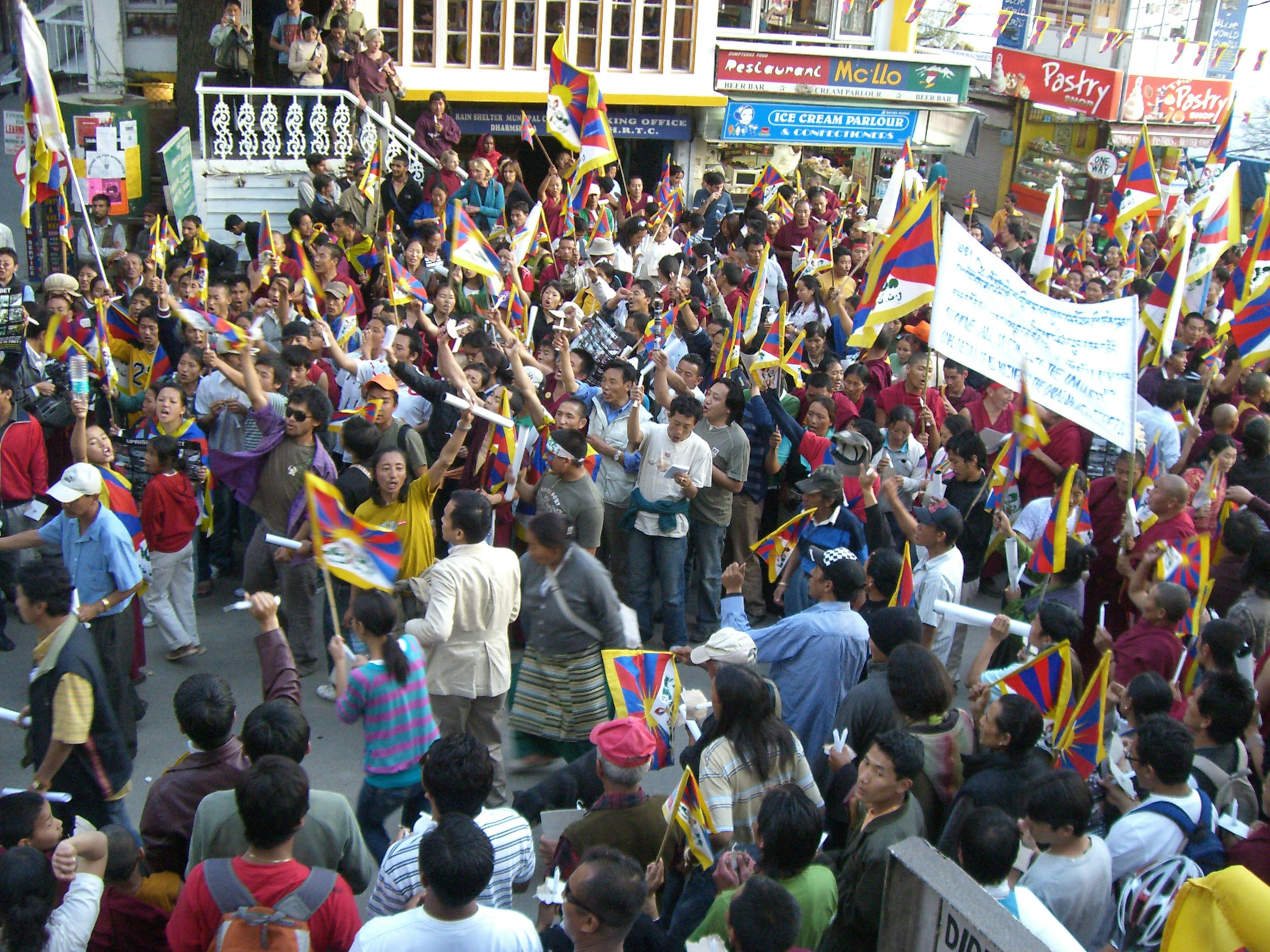
While working with Tibetan teachers in Dharamsala, India, the home of the exiled Dalai Lama, Lawrence resident Ling-Lung Chen has gotten an up-close view of pro-Tibet demonstrations.
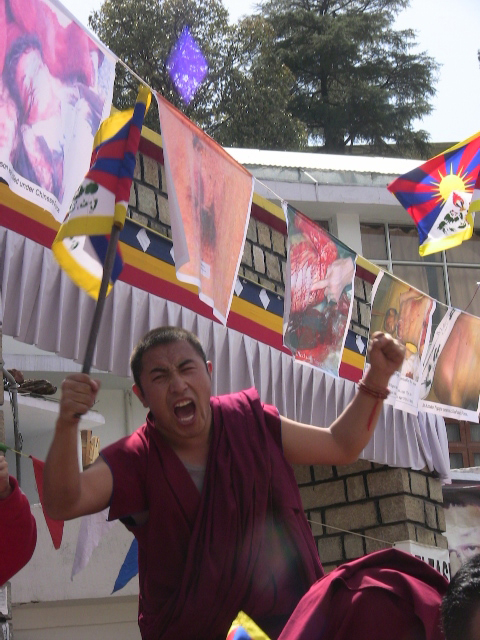
A Tibetan monk screams in protest during a demonstration earlier this month in Dharamsala, India, where the Dalai Lama is living in exile.
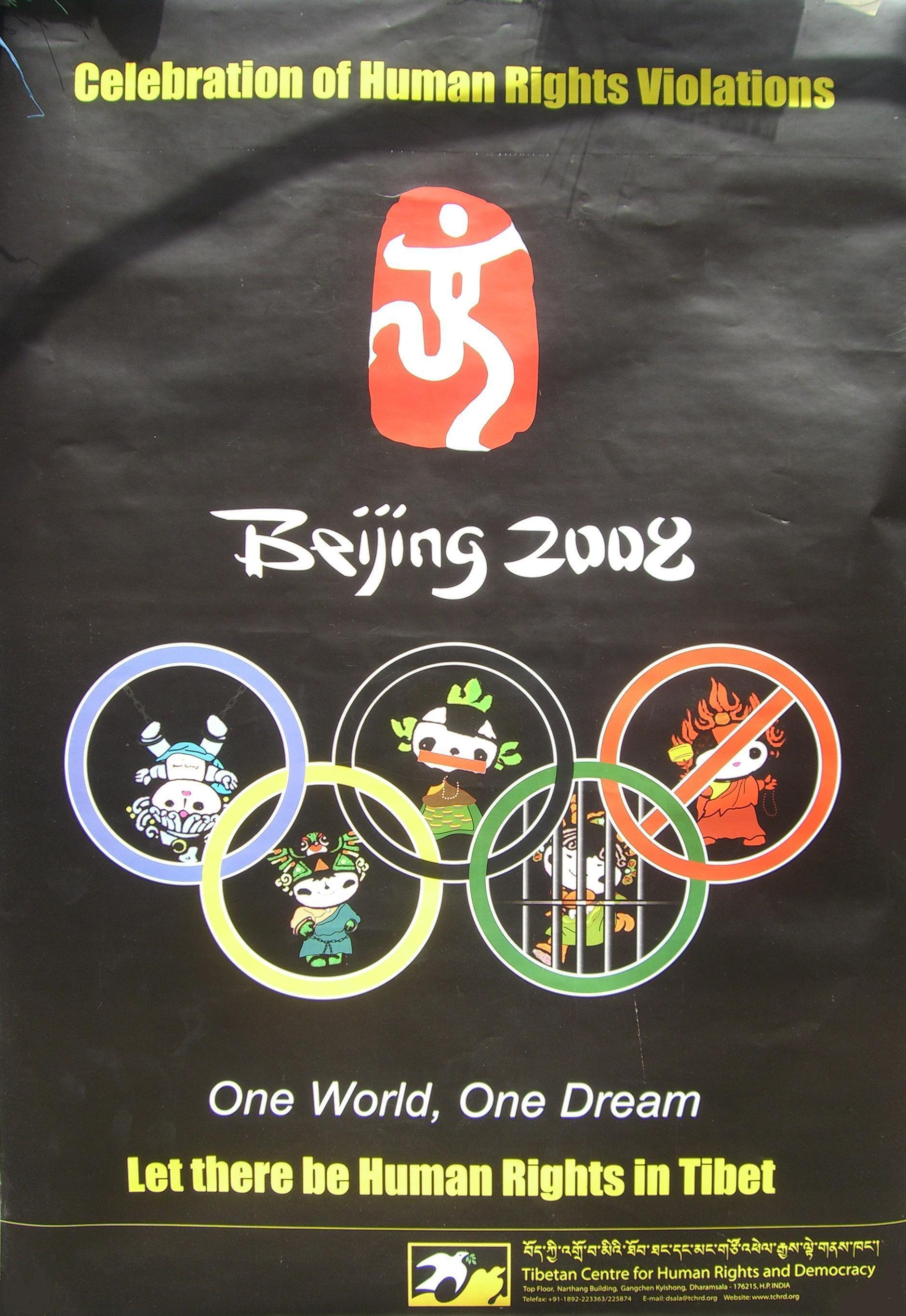
This poster uses Olympic symbolism to decry the state of human rights in Tibet.
Dharamsala, India ? Editor’s note:Ling-Lung Chen, a fellow of the Citizen Journalism Academy, co-sponsored by The World Company and Kansas University’s William Allen White School of Journalism and Mass Communications. She is working with the Tibetan teachers in Dharamsala, India, the home of the exiled Dalai Lama, where she has witnessed demonstrations and candlelight vigils.
Freedom is the common goal for all Tibetans. But a free Tibet may not be, at least not in the short term.
Dalai Lama Tenzin Gyatso, the spiritual leader of the Tibetan people and Nobel laureate, believes that full autonomy, not independence, is the only realistic, peaceful solution for the Tibet issue. Not all Tibetans agree with him. In spite of their unshakable respect and affection for him, they openly express their own views. It is democracy in action.
Whether to boycott the 2008 Beijing Olympic Games is another divisive issue among Tibetans around the globe. This month, as demonstrators continue to pour into the streets or go on hunger strike in Dharamsala, New Delhi, London and elsewhere around the world to protest against Chinese brutality in Tibet, the debate over this issue intensifies.
The Dalai Lama maintains that China should host the Olympic Games. He stands firm on this position even after Wen Jiabao, the premier of the People’s Republic of China, called him a liar and accused him of being the “criminal mastermind of recent unrest in Lhasa.”
Elliot Sperling of Indiana University and some other analysts have concluded that the Dalai Lama is politically naive. Is he, as some have claimed, committing political suicide? Is the Chinese government playing him like a piano?
Why does the Dalai Lama support the Beijing Olympics? Or rather, with the Dalai Lama being the Dalai Lama, we should ask: How could he NOT support the Beijing Olympics?
Tibetans believe that the Dalai Lama is the manifestation of Chenrezig, the Bodhisattva of Great Compassion. It is called “great compassion” because it is not limited to any particular individual or group of people. It applies equally to all living beings, without exception, Mao Zedong included. Mao was probably the greatest enemy of Tibetans and Tibetan culture. It was under Mao that more than 6,000 monasteries in Tibet were destroyed. It was under Mao that thousands of Tibetan monks and nuns were killed. Furthermore, it was also under Mao that as many as 3 million Chinese died in the violence in the Cultural Revolution (1965-1975). Boycotting the 2008 Olympics would be a direct and powerful statement against Chinese brutality and violations of human rights in Tibet and elsewhere.
On March 24, three days after Nancy Pelosi, Speaker of the U.S. House, and her Congressional delegation left McLeod Ganj in Northern India, the Dalai Lama was asked by reporters again in New Delhi about his position on the Beijing Olympics. Despite mounting pressures, he did not alter his position. “There are 1 billion Chinese!” he exclaimed. He holds that he cannot punish 1 billion innocent Chinese for the actions of their government. Moreover, the 2008 Games has become a fervent nationalistic issue for the Chinese people.
The politics of the Tibet issue will go on long after the Olympics have ended. Even if the international community boycotts the Beijing Olympics, as a result, will the Tibet situation really improve or will it become even more confrontational? Will the boycott become another propaganda tool for the PRC government to wage another “People’s War” against Tibetans in the Post-Olympic period of history?
However, activists believe that if they don’t bring the Tibet issue to the world stage of the Beijing Olympic Games, the flame of hope for “Free Tibet” or a “free Tibet” will diminish. It is a life and death battle.
The Dalai Lama cannot give up on humanity. The Olympics dilemma for the Tibetans is, in fact, a dilemma for all humanity. China wants both the Olympics Games and a Tibet under its control. Tibet wants both freedom and compassion.
China remains firm that the Olympic torch will pass through Tibet and up Mount Everest as planned, in spite of disruptions during the lighting ceremony in Greece on March 24. The image of a black flag depicting the five Olympic rings as handcuffs unfurled next to Liu Qi, president of the Beijing Olympic Organizing Committee, was seen, just for a few fleeting seconds, on TV screens across the world. This mere fact suggests that Tibetans and supporters of “Free Tibet” and/or a “free Tibet'” will not give up, at least not easily.
As Beijing begins to countdown on the 2008 Games, so do Tibetan activists around the globe. There are still some 130 more days to go until it opens in Beijing on Aug. 8. The Olympic dilemma will continue to unfold right in front of our eyes. Where do you stand?