

Emergency management leader works in fast-forward mode
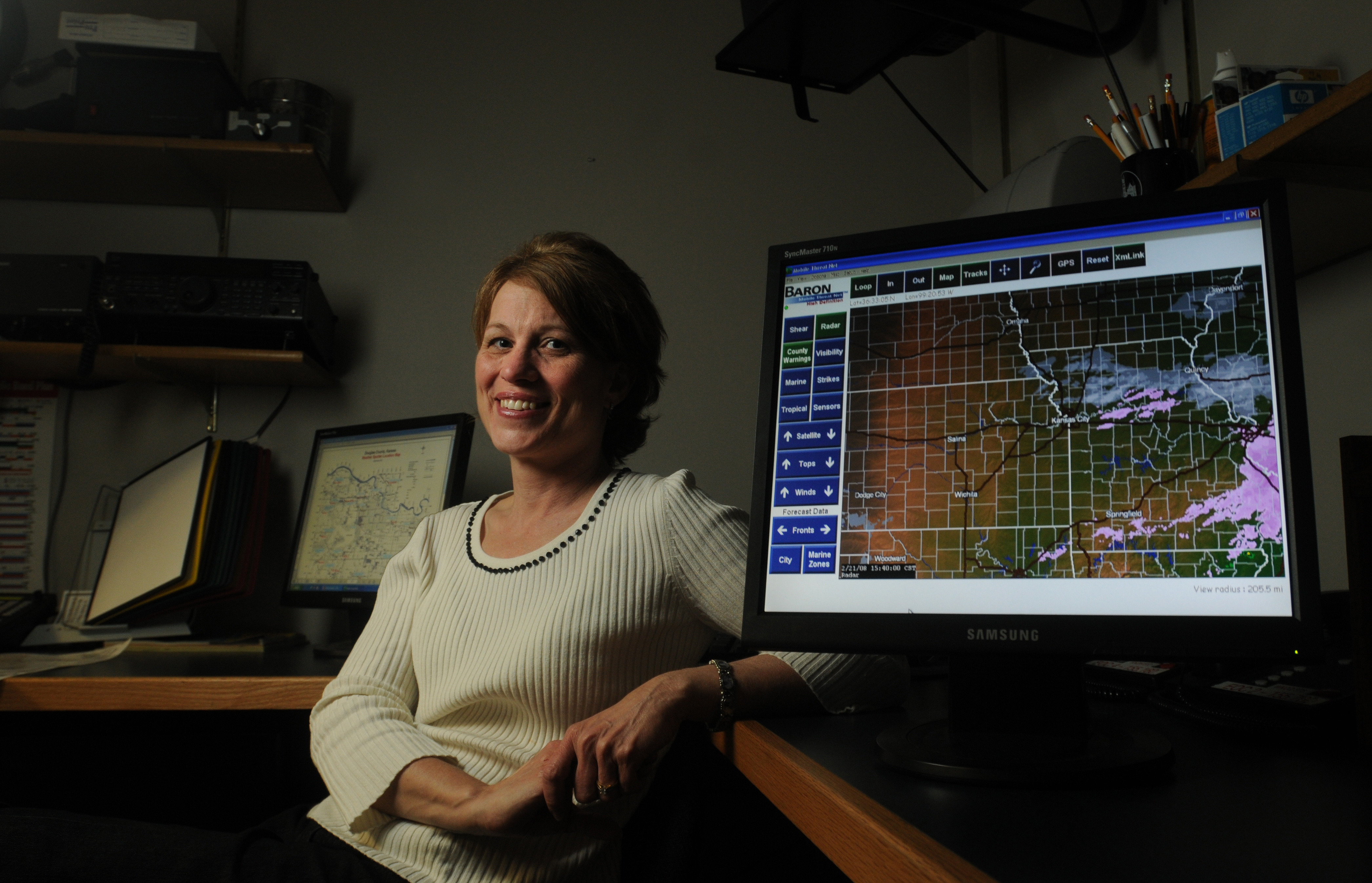
Teri Smith, director of Douglas County Emergency Management, is shown at her department office. She has worked in emergency management since 1995 and became director in August 2007.
Teri Smith doesn’t take the philosophy of “be prepared” lightly.
When Smith, who is director of Douglas County Emergency Management, talks about what being prepared means – about the understanding that at any time, any place, any disaster can take place – she is talking about flooding, tornado, pandemic, fire, hazardous waste or some other unknown.
Smith, a native of Lawrence, has been in her current job since August. She started working in the Emergency Management office in 1995.
“It is the interaction of that, along with my duties, that makes it (my job) a good fit,” Smith said.
Douglas Country Administrator Craig Weinaug said Smith has shown she can work well in a variety of situations.
“She works with a wide variety of local government officials, state officials and volunteers on an ongoing basis,” Weinaug said. “She was one of the first to volunteer for service in the Gulf after Katrina.”
While in Mississippi, Smith attended and helped with presentations about storm recovery. She spent a total of about a month there as part of the Emergency Management Assistance Compact, an interstate partnership.
“People were so thankful, and I feel most of the media missed out on that,” she said.
When Smith isn’t busy overseeing preparedness, mitigation, response and recovery efforts, she said she and her staff help “create and practice exercises in simulated scenarios to help prepare for an event before having to react to a real incident.”
Smith, 46, said that checklists are abundant in her department and are crucial to keep from forgetting an important procedure.
An example: the tornado watch checklist, which includes sending an alert over the weather radio network, sending information to spotters and coordinating with media.
Additionally, the checklists are constantly being updated as events happen within the county or elsewhere “as a way to assure that our responses and resources are always the very best and we serve the citizens to the best of our ability,” she said.
Additionally, when Smith isn’t reviewing and updating plans, teaching residents how to care for themselves and their neighbors, providing informational brochures on preparedness or gearing up for the “tornado of tornadoes,” she attends as many classes, conferences, meetings and instructional seminars as possible.
She said people should be alert to their surroundings wherever they may be.
“Pay attention to where the smoke detectors are when you are on vacation. Note where escape routes are,” she said.
She also advises that people keep frequent contact through communication with family or friends when they are traveling, whether it’s by airplane or car, and added that sticking to a familiar route, mapping out your travel plans in advance and leaving them with someone is always a good idea.
Other ideas when traveling are to have a well-stocked kit in your car and an all-hazards radio, which she said make great gifts. Additionally, Smith would like to see each household begin to stock a three-day supply of emergency supplies, including food, water, first aid, medications and other supplies, and would encourage people to have these items handy for when they are at the workplace as well. Ideally everyone would have several weeks of supplies on hand, but Smith knows that may be unrealistic for a lot of people.
Weinaug added: “It is very easy to forget about the function that Teri and her department provides until the emergency actually happens. Then it is very evident how much preparation, planning and training has been done beforehand.”
The paperweight on Smith’s desk has the slogan: “Never, Never, Never Give Up.” It might be an appropriate message for someone involved in disaster preparedness.
“It is important to know what your potential risks are, and that disaster can impact anyone, anywhere and anytime,” Smith said.