

City’s levee improvements under way
FEMA called for renovations nationwide after Hurricane Katrina disaster
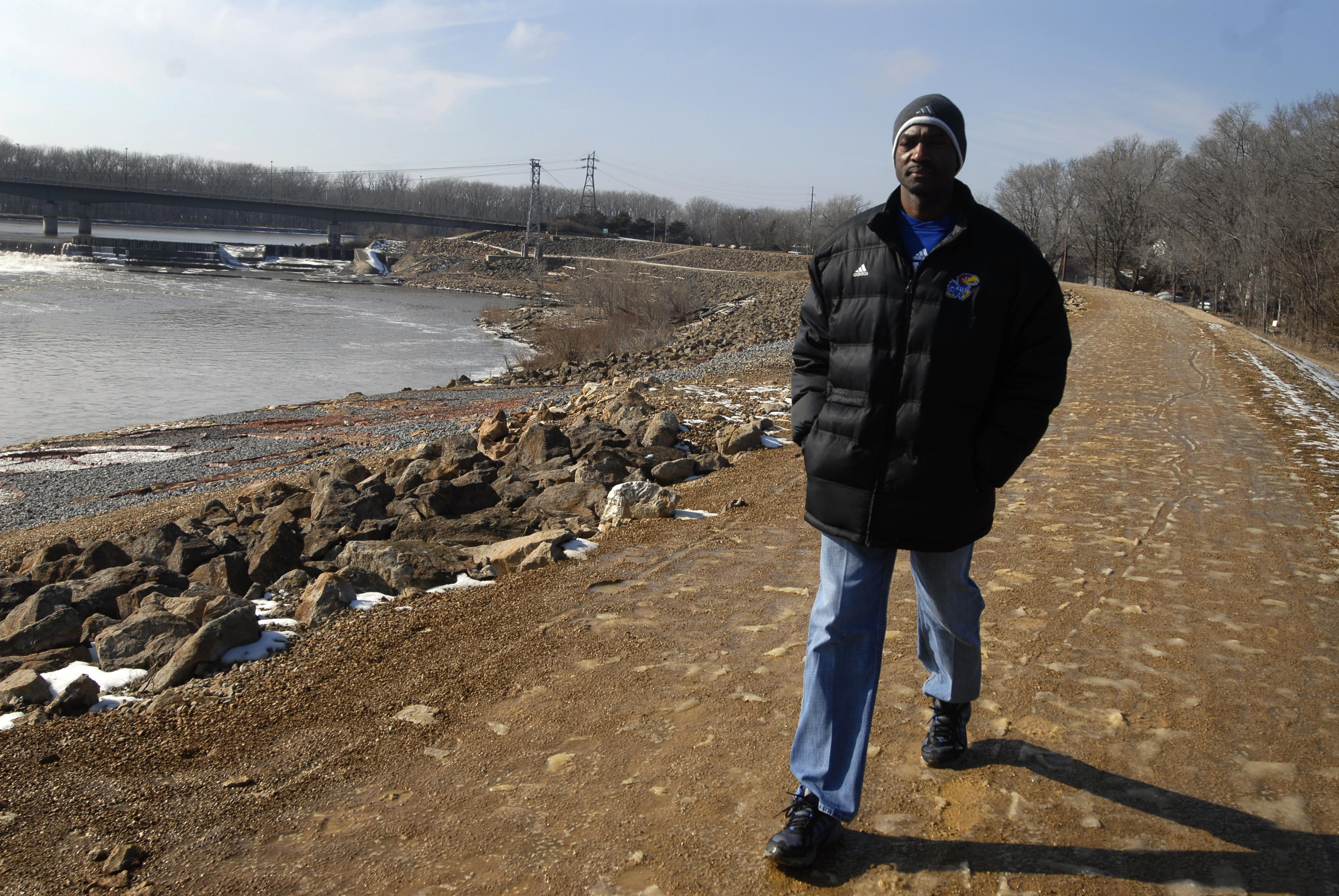
Stanley Redwine, of Lawrence, walks along the levee at the Kansas River. The 13-mile levee protects North Lawrence from flood waters. The city has until 2009 to test the levee's stability following new regulations set after Hurricane Katrina.
It’s 13 miles of dirt and gravel, and a darn good bike path, too.
But at City Hall, the Kansas River levee system is much more. It is an often unsung warrior in Lawrence’s battle with severe weather.
“You look out the windows of City Hall after a rain and see how high the water is in the river, and it is not hard to imagine what would happen if that levee wasn’t there,” said Chuck Soules, director of public works for the city. “It would just spread out all over North Lawrence.”
These days, though, the levee is getting a special look following high-profile breakdowns in the wake of Hurricane Katrina. In early 2007, the city was notified that the levee – like other levees across the country – would need to undergo a thorough rectification process that includes a detailed geological assessment of the 1970s-era structure made primarily of clay and sand.
Soules said city crews and engineers have been able to complete about 70 percent of the work needed for the recertification, but they now likely will have to hire outside crews to complete some of remaining structural analysis. Soules said the city is in the process of determining how much the remaining work may cost. Originally there was concern that the entire recertification could cost $100,000 or more, which led several city leaders to call it an unfunded federal mandate.
City officials have long expressed confidence that the levee is sound, pointing to the high water it contained without problem in the 1993 flood. But officials with Federal Emergency Management Agency have said that it is important to go through a complete review process that provides everyone with confidence.
“I would imagine that people, especially those who live behind the levee, would want to know the levee is actually providing protection,” Melissa Janssen, a spokeswoman for FEMA, told the Journal-World last year.
The city has until the summer of 2009 to complete the recertification. If not completed, it could have major impacts on flood insurance programs in the city.
City crews already spend significant amounts of time on the levee. In addition to routine maintenance like mowing and erosion control, a crew of five workers are frequently on the levee during high-water events.
The crews are responsible for opening and closing a system of 25 tubes and gates that run through the levee. The tubes, when open, allow stormwater to flow out of North Lawrence into the river. But if the gates are left open too long and the river rises too high, the tubes provide a way for Kansas River water to rush into North Lawrence.
The tricky part is that the gates must be manually opened and closed, which means someone has to keep a close eye on the Kansas River. For nearly the last 20 years, that has been Tom Orzulak, the city’s street division manager, who also oversees the levee crew.
“There is nobody who calls you and says that the river is going up,” Orzulak said last summer. “There is a lot of experience involved in knowing when that is going to happen. I watch the weather a lot.”
And that means not just the Lawrence weather. Orzulak said he particularly has to keep a watch on the weather west of Lawrence. A rainfall as far away as Salina can produce a significant rise in the Kaw at Lawrence.
During times when the river is rising, a crew of two people drive a continuous 27-mile loop around the levee. They stop to check each tube and gate to ensure that water is not beginning to flow back into North Lawrence. Each tube must be checked about every two hours.
“It is a real balancing act,” Soules said. “But they do a good job with it.”