

McCain visits Baghdad on low-key fact-finding tour
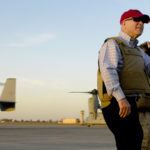
U.S. Sen. John McCain is seen at Baghdad's International Airport upon arrival Sunday. McCain, the likely Republican presidential nominee who has linked his political future to U.S. success in Iraq, was in Baghdad with two other senators for meetings with Iraqi and U.S. diplomatic and military officials, a U.S. government official said.
Baghdad ? Republican presidential candidate John McCain made his eighth trip to Iraq on Sunday, this time holding private talks with U.S. and Iraqi officials about security developments at the end of a week marked by a spike in U.S. troop deaths and a new wave of suicide bombings.
A dozen American soldiers have been killed since March 10, edging the total U.S. death toll closer to 4,000, while suicide bombings and other violence left at least 127 Iraqis dead and nearly 400 wounded throughout the country during the same period, according to Iraqi and U.S. authorities.
The past week’s spasm of violence underscored the fragility of modest gains from the 30,000-troop increase known as “the surge,” which McCain has backed since it began a year ago. The number of attacks in Iraq had dropped by more than half since June, but those figures have begun creeping up since the beginning of the year.
McCain, the senior Republican on the Senate Armed Services Committee, was accompanied by two other committee members: Joe Lieberman of Connecticut, an independent, and Lindsey Graham, R-S.C. Before leaving on the weeklong trip, McCain described it as a fact-finding mission. The other stops are in Israel, Britain and France.
The Baghdad visit was unannounced for security reasons and McCain made no public statements Sunday, avoiding stunts such as the marketplace stroll that earned him ridicule when he was last here in April 2007. On that trip, McCain used his walk through Baghdad’s Shurga market as evidence of “good news” in Iraq but was forced to backpedal when critics pointed out that only heavy U.S. military protection made his tightly choreographed visit possible.
The senators were due to meet with U.S. military commanders and Iraqi leaders, possibly including beleaguered Iraqi Prime Minister Nouri al-Maliki.
Many Kurds from the northern town of Halabja were furious with al-Maliki for failing to show up at memorial services Sunday marking the 20th anniversary of the chemical bombardment that killed an estimated 5,000 Kurds and caused severe ailments that persist for many of the attack’s survivors.
Shops were closed Sunday, police fanned out throughout Halabja and dozens of Kurds gathered in a town square ahead of al-Maliki’s expected arrival. About midday, the mourners realized that Maliki was a no-show and their anticipation turned to outrage.
National
Multiple people shot near a festival in Ohio, authorities say
Multiple people were shot Saturday near a community festival in Toledo, Ohio, and police said a search for the ...

Female Navy officers say they fear a career cap after Hegseth cuts women from promotions list
Pearl Jam bassist Ament highlights skateboarding’s impact in Indigenous communities in Tribeca film
Judge halts White House efforts to impose conditions on SNAP
BOSTON (AP) — A federal judge on Friday sided with 20 Democratic states and halted an effort by the Trump ...
Senate confirms 1st of 3 Kansas nominees to U.S. District Court
Son of girlfriend charged in actor James Handy’s stabbing death
LOS ANGELES (AP) — A man was charged with murder Friday in the stabbing of "Jumanji" and "Top Gun: Maverick" ...