

Tracking produce proves complex
Distribution system seen as biggest hurdle
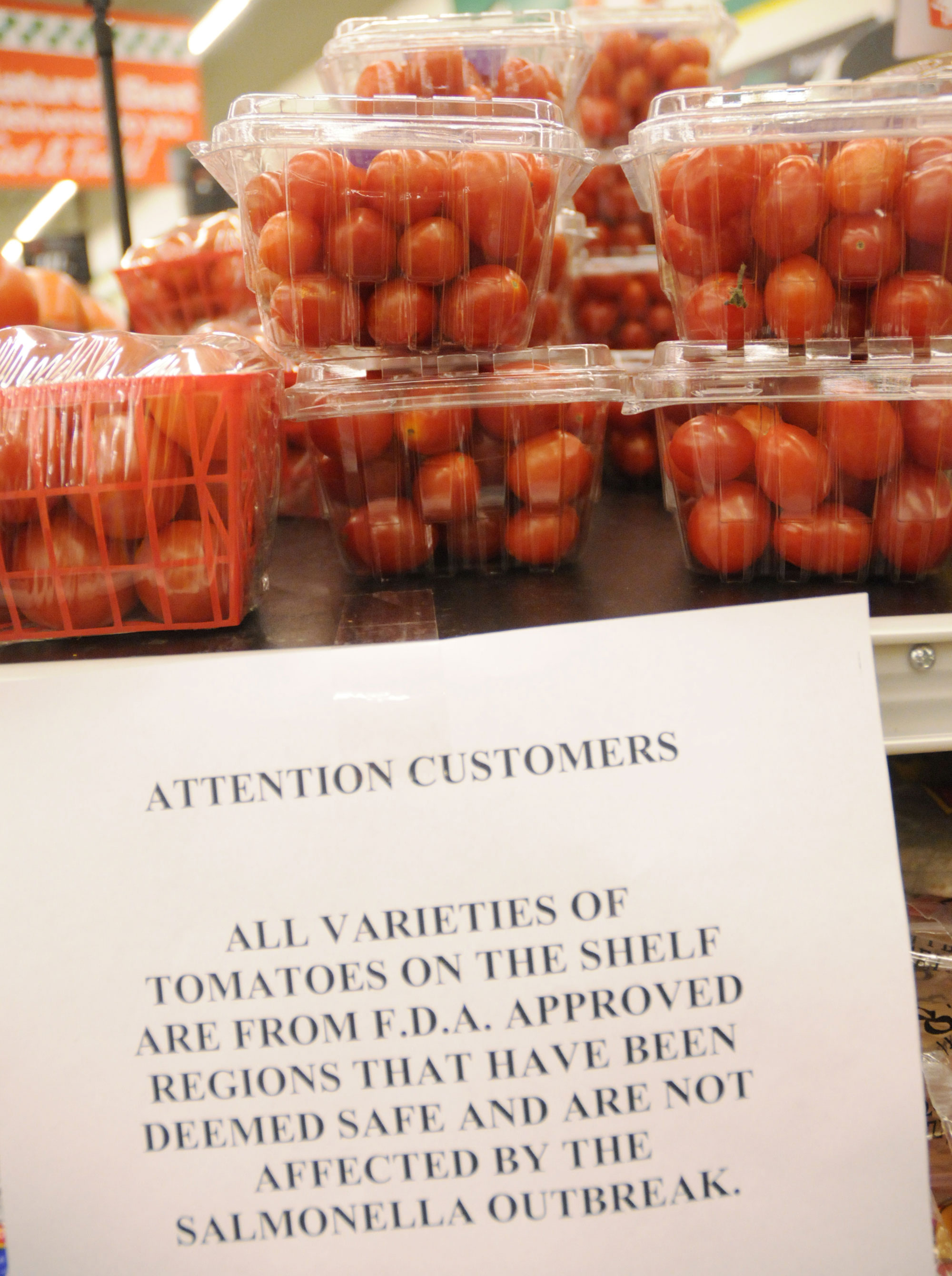
A sign last month at Checkers Foods, 2300 La., informed customers that tomatoes for sale were believed to be safe despite a salmonella outbreak.
How a trace-back works
¢ Outbreak: When an outbreak occurs, health officials start by investigating where a person ate and work backward from there.
¢ Processing: The trail can run cold if the produce has been repacked for size and color, potentially mixing products from different growers.
¢ Source: Investigators search for the outbreak strain all along the produce’s path. The search may bring them back to a farm.
– The Washington Post
The salmonella outbreak of 2008 may go down in history as the case of the missing tomatoes.
More than six weeks ago, the Food and Drug Administration issued a warning about a salmonella outbreak in New Mexico and Texas connected to raw tomatoes. Since then, the agency has expanded the warning nationwide and added jalapeño and serrano peppers. More than 1,100 people have fallen ill since April, but not a single contaminated tomato or pepper has been found.
Investigators said the complexity of the produce distribution system has been their biggest impediment, and some produce industry leaders agree that tracing fruits and vegetables could be easier. Though the technology to do so already exists in the form of bar codes that appear on nearly everything we buy, it could take as long as five years before the entire food industry applies it to food safety.
Produce outbreaks are notoriously hard to trace. In at least half of all produce outbreaks, health officials have never determined what made people sick. The short shelf life of most fresh fruits and vegetables means it’s less likely the items will still be in people’s refrigerators when investigators come looking. Plus, there are the many paths produce can take to reach consumers.
In the salmonella probe, health officials said the practice of repacking made it harder to trace tomatoes to their source. Repacking involves sorting produce for size and color to meet a customer’s specifications.
Many leads
Fresh tomatoes are often repacked, sometimes more than once. For investigators, the practice can open a multitude of new leads. Investigators trying to find the source of contaminated jalapeños have run into “the same spider web,” said David Acheson, a top food safety official at the FDA.
For some produce industry leaders, references to spider webs sound like excuses for mistakes in judgment.
“We are not dealing with failure of traceability. We are dealing with the fact that the trace-back did not support the single-point-of-contamination hypothesis,” said Tom Stenzel, president of United Fresh Produce Association. “We would submit that trace-back worked; we just weren’t listening carefully enough to what it was telling us.”
Other industry leaders agree with regulators that the faster investigators can trace products, the quicker they will be able to prove or disprove theories, thereby limiting an outbreak’s scope and financial losses for businesses.
“When we’ve got illness, we’ve got to get back (to the source) as quickly as we can. We’ve got to do that fast for maximum public health efficiency so we’re not dealing with weeks of delay and … relying on paper and pencil to try to figure this out,” Acheson said.
The technology to track a chili pepper or tomato from packing shed to plate has been around for some time, as anyone who has sent or received a package knows. Both sender and recipient can go online, see the major stops in the package’s journey and, after it arrives, the precise time it reached its destination.
Tracking technology
The nation’s largest food distributors and manufacturers use similar technology to keep tabs on their inventories. But not all businesses can afford such sophisticated systems.
“You have space-age technology operating next to horse and buggies,” said Caroline Smith DeWaal, director of food safety for the Center for Science in the Public Interest, a Washington, D.C., advocacy group. Two weeks ago, the center and the Consumer Federation of America called on the FDA to issue emergency regulations to set up a traceability system.
Among companies that can track their products extensively, such as Wal-Mart or Costco, few use the same system, making the task of tracing a piece of produce slow and labor-intensive.
“There is no consistent use of standards and or technology solutions across the industry,” said Gary Fleming, vice president of industry, technology and standards for the Produce Marketing Association, an industry trade group based in Newark, Del. “What a grower needs to know is different from what a distributor or a wholesaler needs to or a restaurant or retailer does.”
Another hurdle to faster traceability is what happens to information about products collected by the different players along the distribution chain. Too often, they don’t store their data electronically, Fleming said.
Investigators in the salmonella outbreak spent the first few weeks chasing suspect tomatoes from produce aisles and restaurants, through wholesalers and distributors, all the way to farms in Florida and Mexico. To get there, they weeded through hundreds of paper records and invoices, and tested 1,700 samples without finding traces of the outbreak.
The Bioterrorism Act of 2002 required food companies, including manufacturers and wholesalers, to record who sent them a product and the next place they shipped it. The one-step-forward and one-step-back rule has improved traceability, but for some lawmakers, it isn’t a comprehensive solution.
“The course of this whole investigation shows that our food tracking system is pathetic,” said Rep. Diana DeGette, D-Colo., who has introduced legislation to establish a national system for tracing all types of food, not just produce. Sen. Charles E. Schumer, D-N.Y., has introduced similar legislation, but only for meat and poultry products.
National system
Food industry executives representing a broad coalition of growers, distributors, restaurateurs and retailers have been working on a national tracking system since January. Fleming is part of that initiative. They’ve come up with a solution that centers on a global trade item number or GTIN (pronounced “GEE-tin”). Everyone in the distribution chain would be required to use a bar code encoded with a GTIN and three key pieces of information: the grower or shipper who produced it, the production lot it was part of, and the date it was packed or harvested.
Such information proved invaluable in the 2006 E. coli outbreak in bagged spinach. Each bag carried a bar code that identified where and when it was packed, including the shift that did the work.
Using that information, the FDA was able to move in one day from issuing a blanket warning against bagged fresh spinach to announcing recalls of specific brands. Four weeks later, FDA and California state officials traced the outbreak strain to a specific ranch. They later concluded that wild boars running loose in spinach fields were most likely responsible for contaminating the greens.