

At 90, Mandela still revered
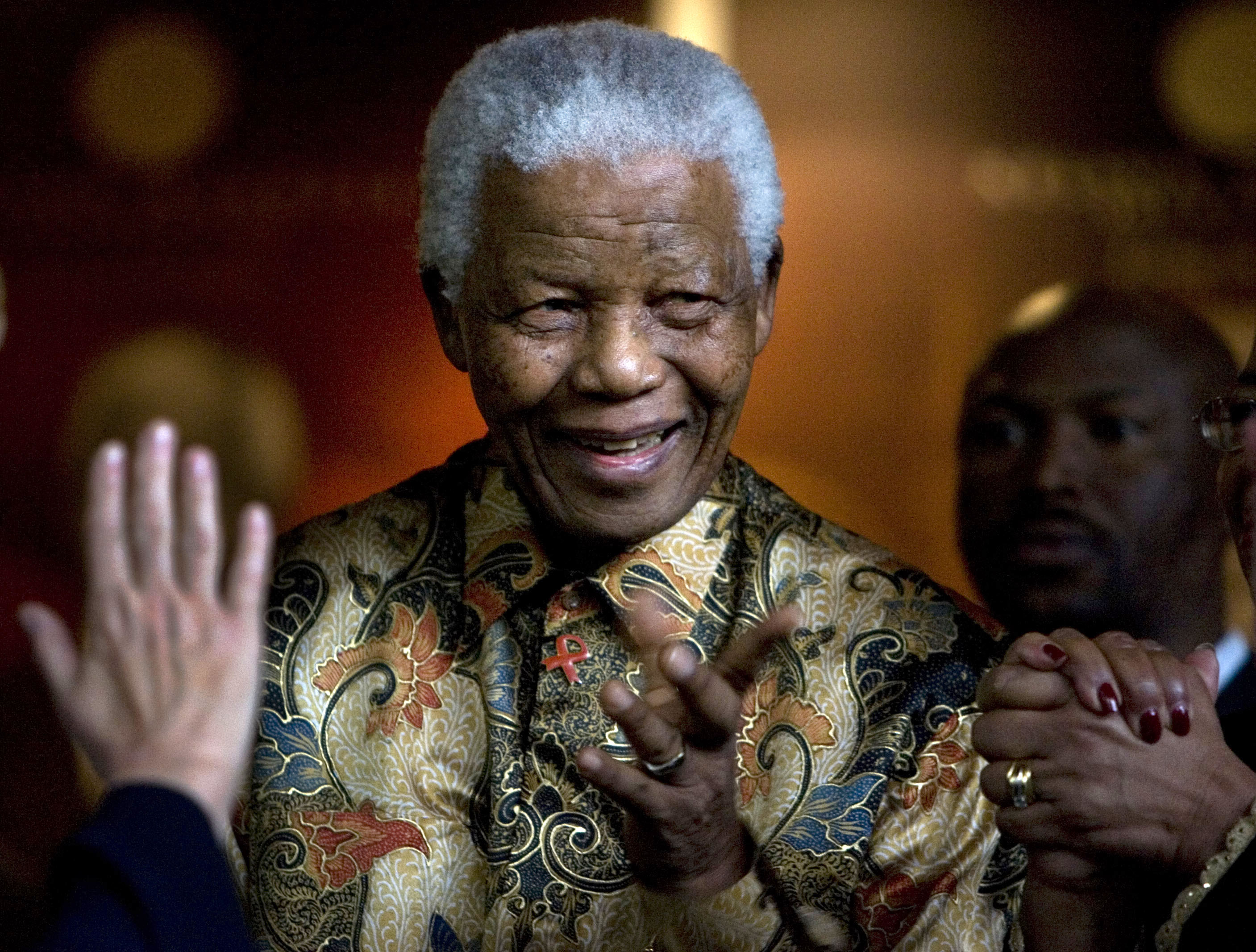
Former South African President Nelson Mandela reacts as German Chancellor Angela Merkel waves farewell after a meeting at the Nelson Mandela Foundation building in Johannesburg, South Africa, in this October 2007 file photo. Mandela turns 90 on Friday.
Johannesburg, South Africa ? He wore a trendy black shirt just like many of the kids in the crowd. But Nelson Mandela moved slowly, leaning on his wife and on a white cane as he crossed the stage to adoring cheers.
Public appearances like the one at the London rock concert in honor of his birthday are rare these days for the anti-apartheid icon. Mandela jokes he has “retired from retirement,” but this time it sounds serious. The majestic figure the world saw walking out of prison to freedom 18 years ago is now gray-haired, frail and for the most part silent as he reaches his 90th birthday Friday.
When he turned 89 on July 18, 2007, Mandela celebrated by announcing the founding of a “council of elders” – fellow Nobel peace laureates, politicians and development gurus pooling their wisdom and influence to tackle global crises. Elders have since jetted to Darfur and the Middle East – but Mandela has stayed at home.
As South Africa’s first black president – he only ran for one term – Mandela ushered in a democratic, multiracial society that is still going peaceful and strong.
There are occasional bumps, some sharp. But overall, the Mandela era has confounded doomsayers at home and abroad who doubted South Africa’s races could live together under black rule.
Still influential
After changing his country so profoundly, then turning his energies during his first “retirement” to tackling problems like AIDS, Mandela has left the stage to younger leaders. But South Africa and the world seem reluctant to let him fade into retirement.
When crises break out – the collapse of neighboring Zimbabwe, a crime wave at home, or violence against African immigrants over jobs and housing – South Africans expect to hear from Mandela.
“I want this great leader to come back,” said Stephen Miller, a composer. “It’s extraordinary nostalgia.”
Mandela has given no interview in years. Increasingly, he leaves the pronouncements on world affairs to officials of the foundation he established upon retiring. Last month, when he spoke up about Zimbabwe’s President Robert Mugabe rampage against democratic change, he did it at a private dinner in London, and his remarks, conveyed by his aides, seemed relatively mild.
He called Zimbabwe’s agony a “tragic failure of leadership” – very different from the harsh language he used against the United States in 2003, when he accused it of committing “unspeakable atrocities in the world.”
Mandela will spend his birthday privately with family in Qunu, his boyhood village 600 miles south of Johannesburg. There, he built a replica of the house he was held in briefly after being moved off Robben Island, the desolate offshore prison where he spent most of his 27 years.
Mandela has been married three times. Winnie, his second wife, has been active in politics since their 1996 divorce. He spends much of the year in Maputo, the relaxed seaside capital of neighboring Mozambique, homeland of this third wife, Graca Machel, in a home filled with her grandchildren and his.
Making progress
However sheltered his life has become, Mandela remains a vivid presence for many South Africans, white and black. Despite 5 percent annual economic growth achieved under his successor, Thabo Mbeki, half the population still lives in poverty, unemployment is 25 percent, crime is rampant, and whenever things look especially bleak, the instinct seems to be that things would be different under Mandela.
The racial gap which Mandela sought by word and example to narrow is still glaring in the richer neighborhoods, where whites own the homes and blacks do the gardening. Their children attend the same classes – one of many post-apartheid reforms – and white parents marvel at how well they get along. But they also see the vast gap between the white children’s toy-filled homes and the one-room servants’ quarters of their black schoolmates.
Still, most South Africans would agree that life is better than before Mandela came to power – less volatile, more fair, less uncertain, more democratic. Only a few cranks try to justify apartheid in public.
In his remarks in London, he concluded with words to the young, saying “It is now in the hands of your generations to help rid the world of such suffering.”