Archive for Friday, February 15, 2008
Amtrak plan would expand service to south
February 15, 2008
Advertisement
City considers Amtrak expansion
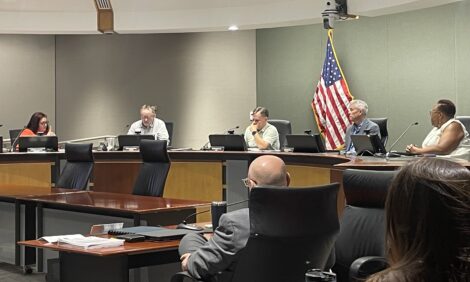
City Commissioners are asked to jump on board a proposal to significantly expand Amtrak passenger train service in the state. Enlarge video
City commissioners Thursday were asked to jump on board a proposal to significantly expand Amtrak passenger train service in the state.
A grassroots organization of Oklahoma and Kansas leaders urged commissioners to pass a resolution encouraging the Kansas Legislature to support plans to establish new, more convenient passenger rail service between Kansas City and the Dallas-Fort Worth area.
"We're not talking about a system that would allow people to just travel through Lawrence," said Mark Corriston, the Kansas City director of the Northern Flyer Alliance. "We're talking about a train that would make it convenient for people to travel from Wichita to Lawrence to attend a sports event, or to come to stay overnight in downtown and do some shopping."
And unlike the current Amtrak train that travels through Lawrence, this new Amtrak service would arrive and depart from Lawrence's Burlington Northern Santa Fe Depot - just a few blocks east of downtown - during daylight hours.
The plan calls for one train to depart Kansas City about 7 a.m. and to arrive in Fort Worth about 10 p.m. Another train would leave Fort Worth at 7 a.m. and arrive in Kansas City about 10 p.m.
Proponents of the plan insist it is not just blue sky.
"It is not possible to do what we want to do today, but by 2010 I think there will be a lot of elements in place," Corriston said, referring to rising gasoline prices and a political environment more open to alternative forms of transportation. "I think the environment will be the best we've had in 30 or 40 years to do this."
City commissioners expressed interest in going along for the ride, as long as the project doesn't require commitment of city funds.
"I think rail travel does have a big future," City Commissioner Boog Highberger said.
The key to its future in Kansas, though, is to get the state to become a funding source. Proponents estimate it will take about $5 million worth of track improvements between Newton and Oklahoma City. The rest of the track is in place and meets passenger rail standards, said Evan Stair, the Oklahoma director of the Northern Flyer Alliance.
Much of that cost could be funded through a federal railway grants program that has been approved by the U.S. Senate but is awaiting approval in the House.
However, state leaders in Oklahoma and Kansas would need to figure out how to fund approximately $6 million in annual operating costs for the train. Amtrak would run the system but would charge the states to do so.
Members of the Northern Flyer Alliance - made up mainly of community and business leaders along the proposed route - have been seeking letters of support from cities throughout eastern and southern Kansas. Thus far, Newton, Strong City, Emporia, Arkansas City and Mulvane all have approved resolutions supporting the project, proponents said.
Mayor Sue Hack said she would plan to put a resolution of support on a future city commission agenda. But commissioners said they did want to learn a little bit more about how a new system would work, particularly about what assurances there would be that the trains would be convenient.
"When it is reliable, there is nothing like a train," City Commissioner Mike Dever said. "The problem is, people have gotten used to reliability. When it is not reliable, it gets overlooked very easily."
Stair said the biggest problem facing passenger trains was that they were often made to wait behind freight trains. But he said if state governments started investing in improvements to railroad tracks - which would still be owned by the rail companies - the states would be in a position to pressure the railroads to give more preference to passenger trains.
The system has worked well in parts of Oklahoma, Stair said. In the late 1990s, a new Amtrak route was established between Oklahoma City and Fort Worth. Original projections called for about 25,000 passengers a year. Instead, the service attracts about 70,000 riders. Fares for a round trip between Oklahoma City and Fort Worth are $50. The trip takes about four hours.
Stair said he thought Lawrence was the type of town that could particularly benefit from rail service because the city's Burlington Northern Santa Fe Depot is within walking distance of hotels, shopping and other amenities that would attract weekend visitors.
"What we're really talking about here is economic development," Stair said.


15 February 2008
at 7:48 a.m.
Suggest removal
Permalink
LogicMan (Anonymous) says…
Interesting, but don't plan on getting any state or local funds …
15 February 2008
at 8:50 a.m.
Suggest removal
Permalink
notajayhawk (Anonymous) says…
“”I think rail travel does have a big future,” City Commissioner Boog Highberger said.”
Let's see:
I can fly from Kansas City to New York for $204 and be there in a few hours. Or I can take the train for $242 and be there in 36 hours.
What to do, what to do…
15 February 2008
at 8:58 a.m.
Suggest removal
Permalink
JackRipper (Anonymous) says…
its_getting_warmer (Anonymous) says:
“state leaders in Oklahoma and Kansas would need to figure out how to fund approximately $6 million in annual operating costs for the train”
good luck with that.
Yeah, wouldn't want to take away any money from an other road project. I guess there was a lot of opposition by the horse and buggy crowd when the automobile came out also so it is reasonable to expect in this country a fear of change. Oh well the rest of the world moves ahead.
http://www.enn.com/business/article/3…
15 February 2008
at 9:04 a.m.
Suggest removal
Permalink
JackRipper (Anonymous) says…
notajayhawk you might want to note that the rest of the world is developing trains that will get you around a lot faster than the trains we are using for freight but nothing will happen until we start working to make it possible. A lot of people complain about the Amtrak subsidizes but you might want to look at how much the tax payer is picking up on your “cheap” flight. But you do get what you pay for, two hours at the airport and assumed a criminal and any type of search possible so you can sit a few hours in a crammed airplane in a dinkie seat plus all the excess fuel it takes in order to get a plane airborne. Let's move boldly into the future by staying with the so called “cheap” flight.
15 February 2008
at 9:05 a.m.
Suggest removal
Permalink
SettingTheRecordStraight (Anonymous) says…
Dumb idea. Stop using Midwestern taxpayers' dollars to transport East and West Coast users of Amtrak.
It's time to de-fund Amtrak.
15 February 2008
at 9:07 a.m.
Suggest removal
Permalink
JackRipper (Anonymous) says…
Ok and lets do the same with the airlines. No more free ground control, subsidized airports, subsidized airline companies, no more subsidized security, get on with your bad self!
15 February 2008
at 9:12 a.m.
Suggest removal
Permalink
JackRipper (Anonymous) says…
Might note that this is opening back up the route that existed in the past so more of the midwest is covered.
15 February 2008
at 9:29 a.m.
Suggest removal
Permalink
hawkperchedatriverfront (Anonymous) says…
I am surprised that local leaders not to mention Kansas city travel promoters have not had tours to the Grand Canyon departing from Lawrence and/or Kansas City. There is potential for tourism and not just Quantrill. Kansas is so far behind the world, and Lawrence lags right behind.
15 February 2008
at 9:44 a.m.
Suggest removal
Permalink
mommaeffortx2 (Anonymous) says…
well not sure i want a train ride but it could be cool not 6 mil. cool but for a person that is not sure all you smart people how much diff. in emmisions would there be in plane vs train vs car? better or worse for env?
15 February 2008
at 9:54 a.m.
Suggest removal
Permalink
JackRipper (Anonymous) says…
Far better. We are such an impatient society though so the idea that we can't go when we want to has unfortunately made us spoiled. $6 million is nothing compared to what is spend on a mile of road work. Highways have cost us a fortune and we never say anything yet they have created endless problems.
15 February 2008
at 10:06 a.m.
Suggest removal
Permalink
madmike (Anonymous) says…
Notajayhawk - I agree with you. When I lived in Germany, I travelled all the time by rail. It was cheap and always on time. I have checked the prices for rail travel in the US, and I can actually fly cheaper than flying. Until this problem if corrected, Amtrak will never have passengers!
15 February 2008
at 10:14 a.m.
Suggest removal
Permalink
mommaeffortx2 (Anonymous) says…
so better for the env. and if you build like germany, bullet train, madmike my dad loved them also, faster now I see the cost to use being a bit high seems like all good ideas end up costing the very people that use the service. but it would be cool to travel across county on a train
15 February 2008
at 10:16 a.m.
Suggest removal
Permalink
Marion (Marion Lynn) says…
The most serious problem facing commuter rail and in paraticular, high-speed rail is that we really no longer have much high-speed track!
Most of our trains run at 70 mph or less and that is all that existing track can handle.
Also, you cannot run high speed passenger trains on track already running failry low speed freight trains.
Expanded passenger traffic is going to rquire building a completely new infrastructure of track, stations, switch yards and will be very expensive.
Transportation to and from the stations is a serious issue.
Expanded passenger service is going to have to be pretty much built from the ground up.
I'm not saying that it can't be done but rather that it needs to be done properly or we will end up with another I-35; always under construction and very slow!
A lot of those “trails” will have to be taken back as well!
That thought should spin out Clark and Merrill!
An interesting and informative discussion group may be found here:
http://mwhsr.blogspot.com/2006/11/usa…
15 February 2008
at 10:34 a.m.
Suggest removal
Permalink
JackRipper (Anonymous) says…
A new system would be ideal because freight has been significantly increasing over the years making bottlenecks the norm and like you said it is a different structure all together but I wonder if the will would ever be there if we just let this system die. Since passenger trains helped subsidize the building of airport systems after WWII maybe a plan for high speed could come from airlines or autos picking up some of the tab but considering how subsidized the airline industry and highway system is maybe we should channel those funds instead.
15 February 2008
at 10:54 a.m.
Suggest removal
Permalink
salad (Anonymous) says…
If we would just hurry up and run out of oil already, then all these transportation problems would get sorted out by the market fairly quickly. I love the train btw.
15 February 2008
at 11:02 a.m.
Suggest removal
Permalink
notajayhawk (Anonymous) says…
JackRipper (Anonymous) says:
“But you do get what you pay for, two hours at the airport and assumed a criminal and any type of search possible so you can sit a few hours in a crammed airplane in a dinkie seat plus all the excess fuel it takes in order to get a plane airborne.”
That two hours at the airport (it has never taken us near that long, incidentally, even post-9/11) still gets me to New York more than a full day ahead of the train. And even as train speeds approach airplane speeds, they will never - *never* - compare to air travel. Airplanes don't have to slow down in populated areas. Or at the thousands of crossings between here and there. They also don't stop in every city along the way. Or have to wait for a slower plane travelling the same route.
I also don't have to stuff all our luggage into overheads and carry it with me when I switch from one plane to another, as I do on the train. Yes, the seats are a little smaller, and there's less room to get up and walk around. But then, I can usually sit still for a couple of hours - a day and a half, not so much. (I'm guessing you don't travel with small children.) Since I'm paying more for the train to get there a day later with less convenience, I am most certainly *not* getting what I pay for.
Going *back* to train travel is moving boldly into the future? Let's be even more bold and go back to stagecoaches. Even less oil fuel used (talk about using bio-fuel!) and both the energy source *and* the “engine” are renewable resources.
15 February 2008
at 11:05 a.m.
Suggest removal
Permalink
JackRipper (Anonymous) says…
http://www.trainweb.org/moksrail/advo…
15 February 2008
at 11:08 a.m.
Suggest removal
Permalink
JackRipper (Anonymous) says…
Not talking about the trains of today, talking about moving to the trains the rest of the world is moving boldly toward. The technology that is being developed is state of the art.
15 February 2008
at 11:23 a.m.
Suggest removal
Permalink
notajayhawk (Anonymous) says…
JackRipper (Anonymous) says:
“Not talking about the trains of today, talking about moving to the trains the rest of the world is moving boldly toward. The technology that is being developed is state of the art.”
Whereas the technology in air travel is not? No matter how fast you can get a train to go, will it be competitive in a future where you will be able to travel from New York to LA on a sub-orbital flight?
High-speed, affordable train travel in the United States will never be as feasible as it is in other countries. Maybe travelling across Kansas, where there's a whole lot of nothing, but in the more heavily populated areas of the country? There is no way - *NO* way - you will ever have trains travelling 500 mph from Boston to DC, unless you're planning on digging a tunnel the whole way. And unless you can go where the population centers are, you'll never be economically viable.
15 February 2008
at 11:44 a.m.
Suggest removal
Permalink
JackRipper (Anonymous) says…
Air travel is subsidized and inefficient and how often to you go to NY and then fly to LA? We don't, we generally travel within this area, Chicago, Dallas, Denver,etc. Air has its place but it is time to start pulling their handouts so we can see what the real cost is. The economic issue is tiresome because we are not looking at the picture on a level playing field.
15 February 2008
at 11:57 a.m.
Suggest removal
Permalink
notajayhawk (Anonymous) says…
JackRipper (Anonymous) says:
“Air travel is subsidized and inefficient and how often to you go to NY and then fly to LA? We don't, we generally travel within this area, Chicago, Dallas, Denver,etc.”
And as I said, it will not be economically viable unless you can make a workable nationwide system. Most of the country's population doesn't live here, and travels to more places than Dallas and Denver. And you will never be able to operate super high speed trains in heavily populated areas such as the Northeast corridor from Boston to DC.
“Air has its place but it is time to start pulling their handouts so we can see what the real cost is. The economic issue is tiresome because we are not looking at the picture on a level playing field.”
Fine. Stop subsidizing air travel and level the playing field.
As soon as I can take a train to Europe or Australia.
15 February 2008
at noon
Suggest removal
Permalink
akuna (Anonymous) says…
We live in a big country and need multiple modes of transportation. I should not have to get on a plane to travel to Chicago or Denver or Houston or Memphis. These cities are close and should be connected with fast passenger trains. NY and LA are much further. It makes sense to travel via plane to those places.
Unfortunately, our leaders gave up on trains long ago and now we are in a position that will require too much money to create the infrastructure needed to build a railway that is competitive or better than airways for reasonably close travels.
BTW - I love traveling by trains. When I was in Europe I could travel at night and sleep. I would wake up when the train arrived at my destination, find a hostel, shower, and hit the city. Good stuff. Impossible to do here.
Viva la train. (Too bad it is already dead in the US.)
15 February 2008
at 12:08 p.m.
Suggest removal
Permalink
JackRipper (Anonymous) says…
Like I said air has it place. I'm not saying it would be only local I'm just saying that the argument of a trip from NY to LA is pulled out like that is what most trips are, traveling across the entire country when it isn't at all so rather irrelevant when discussing transportation needs of most people.
They already have a fairly high speed train in the NE used daily by quite a few people actually. The rail and highway systems would have to be used for the lines since they already exist and for those of us out here in wide open spaces we should start factoring routes now before expanding outward. If Lawrence is really suppose to grow to 150,000 in a few decades wouldn't it be prudient to include provisions for a rail system now?
So air travel should be subsidized because you benefit from it personally? Why not let it be an expense included the price of your ticket instead of subsidized so you aren't under the delusion that it is cheap to fly?
15 February 2008
at 12:21 p.m.
Suggest removal
Permalink
average (Anonymous) says…
“There is no way - *NO* way - you will ever have trains travelling 500 mph from Boston to DC, unless you're planning on digging a tunnel the whole way.”
I'm doubting 500mph, but close to 200, yes. The mainline Northeast Corridor has no at-grade intersections, at least between DC and New York, and only a couple between NY and Boston. Upgrading it further will be a pain, but it is possible. No denser population than, say, the Rhine Valley. But, regional groups like Dallas-Houston-San Antonio or Vegas-LA… seems like a natural.
Amtrak fails in quite a few respects, though. They can't seem to take advantage of their #1 asset… low marginal cost. That is, adding the 101st person to a train is relatively easy. Add another coach, eventually. Adding the 101st person to a 100 seat airliner is a major problem.
Also, food service has gone from overpriced and mediocre to unimaginably bad. I'd give up on it and leverage technology. Alert passengers when they are an hour from a certain city. Local restaurants would pay to have their menus onboard. People would call ahead, and expect food delivered trackside at a five-minute stop. Onboard, nothing but an automat.
15 February 2008
at 12:21 p.m.
Suggest removal
Permalink
JackRipper (Anonymous) says…
akuna is it really that expensive? See the problem is we don't know comparing them side by side how much each mode of transportation really cost because of government involvement. Even with so much government involvement they airlines were still going out of business. And isn't it time we start looking at the convenience factor not being the top priority all the time considering the demands we are putting on oil now and will certainly be greater in the future? The new trains are state of the art and since they run on electricity the fuel options (or green options) are greater since there are more options for fuel used to create electricity. And shoot everything is possible if it makes sense to ship coal to SW Kansas for a power plant when it sits on top of one of the largest natural gas fields in this country!
15 February 2008
at 12:25 p.m.
Suggest removal
Permalink
kansanjayhawk (Anonymous) says…
The Heartland Flyer in Oklahoma is a demonstration that states can work together for funding as Oklahoma and Texas did. This is a great proposal and should be strongly considered, it will benefit all of the communities involved as well as Kansas as a whole. Maybe some of that elusive gambling revenue could be obtained????
15 February 2008
at 12:51 p.m.
Suggest removal
Permalink
bugmenot (Anonymous) says…
No one's mentioned the fact that petroleum-based fuel prices are going up and not going to come back down. Air travel is cheap now, but for how much longer? When it, too, becomes expensive, wouldn't it be nice to have some kind of a travel alternative?
15 February 2008
at 1:39 p.m.
Suggest removal
Permalink
mommaeffortx2 (Anonymous) says…
ok you two both have things people one gets you there faster but one lets you see where you are going stop fighting over facts and when and if we get germany and china style trains then people will have two choices. I think a family vaction on a train would be cool and iff I wanted to fly to maui I still could this is a win win.
15 February 2008
at 2 p.m.
Suggest removal
Permalink
notajayhawk (Anonymous) says…
JackRipper (Anonymous) says:
“Like I said air has it place. I'm not saying it would be only local I'm just saying that the argument of a trip from NY to LA is pulled out like that is what most trips are, traveling across the entire country when it isn't at all so rather irrelevant when discussing transportation needs of most people.”
You're right. The “transportation needs of most people” do not include travel to Chicago, Dallas, or Denver. And most people drive when they do.
“So air travel should be subsidized because you benefit from it personally? Why not let it be an expense included the price of your ticket instead of subsidized so you aren't under the delusion that it is cheap to fly?”
And the subsidy for train travel?
The cost of Amtrak travel between Kansas City and St. Louis is more than half paid for by subsidy. And altogether the cost is about four times what it costs to drive. And Amtrak in Missouri is late almost half the time. But hey, we should pay more than half the cost because someone chooses to relax on the train?
“They already have a fairly high speed train in the NE used daily by quite a few people actually.”
The express train from Boston to DC takes 6-1/2 hours. Not many business travelers are going to spend the entire working day on the train, when they can choose one of 30 flights to fit their schedule, take an hour-and-forty-minute flight, conduct their business, and get home for dinner.
~~~~~~~~~~~~~~~~~~~
bugmenot (Anonymous) says:
“No one's mentioned the fact that petroleum-based fuel prices are going up and not going to come back down. Air travel is cheap now, but for how much longer? When it, too, becomes expensive, wouldn't it be nice to have some kind of a travel alternative?”
Like a diesel train????
15 February 2008
at 2:15 p.m.
Suggest removal
Permalink
livingstone (Anonymous) says…
notajayhawk (Anonymous) says:
“Let's see:
I can fly from Kansas City to New York for $204 and be there in a few hours. Or I can take the train for $242 and be there in 36 hours.”
First, you got to drive 1 hour to KCI from Lawrence, then partk your car at the $5.50 parking lot. Your gas should be going around $25.00 to get there and back. Then, you will need to grab a cab from La Guardia to Manhattan which costs around $38.00 one way.
Also, I don't think you can get $204 anymore. Let's say it's $276 (AA only). Your gas $25.00, and let's say you'll be in NYC for 3 weeks, that will give you around $100 bill for your parking, so that will be a total of nearly $400.00 for your air-ticket.
For the train ride, it will get you straight to the Union Station in Downtown Manhattan, and you will be able to park here in Lawrence for free. Latest check: $300.00.
You will have unlimited baggages for your Amtrak, and more spaces. If you're going for a vacation, train ride makes sense. But if you're going for a business trip, plane ride makes more sense. Or have I talked about possible flight cancelation during winter, and that you will sleep at the airport?
15 February 2008
at 2:21 p.m.
Suggest removal
Permalink
average (Anonymous) says…
Actually, livingstone, not only are there baggage limits (though more generous than most airlines), you can't check luggage at all in Lawrence, and can't get checked luggage to Lawrence, either. This is a knock on using Amtrak for much travel, despite enjoying the trips I've taken on it.
15 February 2008
at 2:32 p.m.
Suggest removal
Permalink
JackRipper (Anonymous) says…
The interstate you drive on to St. Louis, is it paid for by the tooth fairy? All those cars on the road, are they won in the lottery? Probably in the same way trolleys disappeared because of the automakers playing politics I'd assume the same is true today and there are other agendas involved in this.
Continuing to compare locomotives of today with the modern trains we could start considering that other countries are using is like saying the airlines are flying DC-3s today.
You might want to check the usage of the train out east, you may be surprised. Also the trip between here and St Louis is horrible that's why we should be even bolder and propose trains that are independent of freight.
15 February 2008
at 2:56 p.m.
Suggest removal
Permalink
bugmenot (Anonymous) says…
No, not like a diesel train. I'm interesting in replicating the system they have in Europe. We all totally get that you don't like trains. Find something better to do than cut-and-pasting things from the internet to this board.
I guarantee you air travel will price a good segment of society out of travelling within a few years. So will travelling by car.
15 February 2008
at 3:51 p.m.
Suggest removal
Permalink
Lisia (Anonymous) says…
A stop in Ardmore, OK! That's where my sister lives! It would be so cool to get on a train here and visit my sister. My current car isn't up to handling that long of a drive, and I love riding the train, and haven't seen my sister or nephews in ages- other than via Skype.
I took the train out to Los Angeles about a year and a half ago. A long trip, definitely, but I took a day out of it to visit a friend in Albuquerque, NM, which divided the trip in half. I liked it much better than flying- nicer chairs and you can get up and walk around and go to different cars.
15 February 2008
at 3:53 p.m.
Suggest removal
Permalink
mommaeffortx2 (Anonymous) says…
plane, train, or automobile get there anyway you can and want.
15 February 2008
at 4:08 p.m.
Suggest removal
Permalink
notajayhawk (Anonymous) says…
bugmenot (Anonymous) says:
“No, not like a diesel train. I'm interesting in replicating the system they have in Europe.”
Or maybe in Asia. After all, it only took 74 years to electrify the Trans-Siberian. And just out of curiosity, where are we going to get all the electricity from, when we can't meet our current power needs?
In any event, you can not compare what was accomplished in other countries to the United States. When we were signing the Declaration of Independence, there were already horse-drawn trams being pulled over iron rails in Europe. The United States has the highest per capita car ownership in the world - 50% higher than Europe's. We put over 500 times as many miles on passenger cars as we travel by passenger rail. Gasoline is and has been more expensive in Europe, making mass transit more attractive. In the United States, people use their personal vehicles for 95% of trips up to 500 miles and over 60% of trips up to 750 miles - one way. Nine out of ten long distance (over 50 miles one way) trips in the U.S. are made in personal vehicles; less than 1% are made by train.
Maybe it's because the people of this country want convenience. Train travel will never compare with either passenger cars (for mobility) or air travel (for speed) in that regard. And it doesn't even have the benefit of being more cost effective.
“We all totally get that you don't like trains. Find something better to do than cut-and-pasting things from the internet to this board.”
Apparently you don't get anything at all. I never said, or even implied, that I don't like trains. When I lived on the East Coast I used them all the time, for the commute between NYC and the suburbs, even for longer distances on occasion (like from NY to Newport News). It appears it's you that has personalized this. My like or dislike for trains has nothing to do with any of the facts I have presented (none of which, oddly enough, were cut and pasted). Or is it that you just object to facts that don't agree with your own preferences?
15 February 2008
at 4:09 p.m.
Suggest removal
Permalink
Marion (Marion Lynn) says…
Ya know, steamers can run on natural gas, pellets, scrap wood, waste oil; the stacks can be fitted with particulate filters but oh, gosh, not much that could be done about CO2!
Revive some of these guys, put them in front of passenger cars and watch ridership grow!
http://www.youtube.com/watch?v=uSASZl…
15 February 2008
at 4:09 p.m.
Suggest removal
Permalink
notajayhawk (Anonymous) says…
JackRipper (Anonymous) says:
“Continuing to compare locomotives of today with the modern trains we could start considering that other countries are using is like saying the airlines are flying DC-3s today.”
Try considering the trains in use today to the planes in use today, not the trains “we could start considering” to planes in use today.
“You might want to check the usage of the train out east, you may be surprised.”
As I spent almost 35 years of my life living in almost the center of the Boston-to-DC corridor, I somehow doubt that I'd be surprised.
“Probably in the same way trolleys disappeared because of the automakers playing politics I'd assume the same is true today and there are other agendas involved in this.”
Or maybe people prefered driving cars. Let's see … I can take a train to St. Louis and either 1) rent a car or 2) take cabs everywhere, or I can drive there and have my own car with me. Again, what to do, what to do…
15 February 2008
at 4:27 p.m.
Suggest removal
Permalink
JackRipper (Anonymous) says…
So the tooth fairy did provide all the roads. Good deal.
15 February 2008
at 4:31 p.m.
Suggest removal
Permalink
notajayhawk (Anonymous) says…
livingstone (Anonymous) says:
“For the train ride, it will get you straight to the Union Station in Downtown Manhattan”
That would be a good trick, as there is no Union Station in NYC. Amtrak goes to Penn, the other one is Grand Central.
“First, you got to drive 1 hour to KCI from Lawrence, then partk your car at the $5.50 parking lot. Your gas should be going around $25.00 to get there and back. Then, you will need to grab a cab from La Guardia to Manhattan which costs around $38.00 one way.”
First, who said I was starting in Lawrence? I compared the same trip between the same two cities. Believe it or not, not everyone lives in Lawrence. And let's see … I also believe there are other options than parking your own vehicle at the airport … even if - especially if - I was going to stay the magical three weeks you came up with. There are also other options than taking a cab into Manhattan … assuming that was the final destination I had in mind. If I were going to Long Island, for instance, it would cost me that much to travel from Penn Station out there.
“Also, I don't think you can get $204 anymore.”
According to the daily price alerts on my computer, yes you can. Look harder.
“Or have I talked about possible flight cancelation during winter, and that you will sleep at the airport?”
Well, let's see … if I choose Amtrak, I have to spend the night sleeping on a train, since it takes 36 hours. Weighed against the *chance* of having to sleep in an airport (which has never happened to me). Yet again, what to do, what to do…
15 February 2008
at 4:40 p.m.
Suggest removal
Permalink
notajayhawk (Anonymous) says…
JackRipper (Anonymous) says:
“So the tooth fairy did provide all the roads. Good deal.”
The same tooth fairy who's going to provide your new rail lines between KC and St Louis … you know, the ones without freight traffic that can handle high speed trains (not to mention the generous contribution from the tooth fairy of the high speed trains themselves and the electrification).
Or did you have some kind of cost estimate showing that an entirely new rail line would cost less than the expansion of I-70? What? No?
15 February 2008
at 4:50 p.m.
Suggest removal
Permalink
frwent (Anonymous) says…
Note to Marion Lynn: Steam engines went out back in the 1940's. As a life long railroad fan and enthusiast, I can tell you that they were replaced very quickly once the bottom line was presented to railroad management. They required many, many workers to maintain, service, repair, and the very physics of the internal combustion powered diesel-electric locomotive versus the steam powered locomotive doomed the old steam engines very fast. Railroads were required to maintain huge maintenance facilities, fuel facilities, mechanical departments to keep the old pots going. Boiling water into steam and then containing 300 pounds per square inch steam in a steel containment vessel (the boiler) required much work, maintenance, and many safety checks, boiler explosions could cause havoc both to the railroad, it's passengers, and the local communities that just might be adjacent to the railroad's dtracks. Sorry, we all love the old steam locomotives, but they will never return to regular service, there are just too many reasons of safety, economics, and labor-ontensiveness to make this happen. But the day is coming when fuel prices will cause many rail companies to again look seriously at electric locomotives, electricity can be generated from many sources that would be able to move electric powered trains. But they will have to fight with the loons who would not want to look at the overhear catenary wiring system,(ooh, it Looks So Awful and does not fit into the flavor of our community). There are always loons when something new and better is proposed.
15 February 2008
at 6:11 p.m.
Suggest removal
Permalink
simplykristib (Anonymous) says…
Traveling by rail is still a viable option. It's too bad that more people don't take the opportunity to travel by rail.
I have taken the train from Omaha to Hastings NE to visit some people. I had to take the bus aka shuttle from the Amtrak station here in KC to Omaha and back.
I have taken the train from the KC area to Jefferson City a couple of times and once to Hermann, MO and back.
I have taken the train from NYC to Spartanburg, SC and back to NYC.
I have flown numerous times. The farthest I have flown is to Hawaii and back. I flew to NYC once. On the flight home, I got to fly first class. :)
I rather take the train than fly. You can see more by rail. You have the freedom to move around on the train. And the seats are much more comfortable on a train than a plane.
I am glad to see that KS and OK are looking at the opportunity to expand service. :)
15 February 2008
at 6:25 p.m.
Suggest removal
Permalink
Marion (Marion Lynn) says…
Note to frwent:
The last steam engine in the USA went out of regular service in 1960 or so.
It should be noted that Red China dropped most of its fires in 2005 but still runs a number of steamers:
http://www.railography.co.uk/info/cn_…
“China continued to build mainline steam locomotives until late in the century, even building a few examples for American tourist operations. Since China was the last main-line user of steam locomotives, ending officially at the beginning of 2006, it is plausible that many still exist in industrial operations or in more remote parts of China. Many coal mines and smaller cities, such as Pingdingshan and Hegang, maintain an active roster of JS, SY, or QJ steam locomotives bought second hand from China Rail. The last steam locomotives built in China were of the SY 2-8-2 class, built until 1999. The last steam locomotive built in China was SY 1772, finished in 1999. As of date, at least 4 Chinese steam locomotives exist in the United States - 2 QJ's bought by RDC, a JS bought by the Boone Scenic Railway, and an SY bought by the NYSW for tourist operations, then was re-painted and modified to represent a 1920s era US locomotive.”
Ireland still runs this baby in mainline service:
http://www.dailymotion.com/video/x2f8…
Should the dire predictions of the “Peak Oil” crowd come true we may re-consider!
Oh.
Steam pressure in locomotives was normally around 130-150 lbs and boiler explosions in the 20th Century were very, very rare.
New Zealand is still running steamers on several main lines.
Oddly enough, Wikipedia has a very good article on steam locomotives and I quote from the source:
“Chapelon's final rebuilds in 1935 had unbelievable power-to-weight ratios of around 42 draw bar horse power per ton. To give a salient example, if a New York Central Niagara 4-8-4 had had a similar power-to-weight ratio to that of Andre Chapelon's last set of rebuilds, the New York Central's locomotives would have been capable of producing over 17,000 rail horse power.
Even today, Andre Chapelon's lesson has not been well learnt, if at all. It should be noted that the best a modern-day diesel locomotive can achieve (and at 214% the initial purchase price of a steam locomotive) is a power to weight ratio of 22.84 draw-bar horse power per ton.”
http://en.wikipedia.org/wiki/Steam_lo…
15 February 2008
at 6:57 p.m.
Suggest removal
Permalink
merrill (Anonymous) says…
Trains,planes and automobiles are all subsidized modes of travel. My guess cars and trucks are by far the most demanding of tax dollars.
Locally some cars and trucks are demanding that $200,000,000 be spent to get them around a very few minutes quicker. Then comes the ongoing maintenance costs known as wear and tear not to mention the millions that cars and trucks will demand to keep the $200,000,000 roadway free of ice and snow.
Recently we returned on train from Philadelphia to KCMO by way of Chicago. The club car was fun,food was good and traveling through towns and cites was interesting. Yep that 5 hour layover in Chicago was fun considering the station was downtown….airports are stuck out in the middle of nowhere.
If rush is the objective sometimes planes are better.
15 February 2008
at 7:13 p.m.
Suggest removal
Permalink
notajayhawk (Anonymous) says…
“Instead, the service attracts about 70,000 riders. Fares for a round trip between Oklahoma City and Fort Worth are $50.”
That was the first year ('99). Since then ridership has dropped, averaging - depending on who you listen to - 58-65,000 “riders” per year - or as little as 30,000 round trips (about 82 per day). The price *ranges* from $50 to $98, just like the airlines based on advanced booking and other factors. And not everyone rides the entire distance - some “rides” may be from Norman to Purcell or from Gainesville to Fort Worth; those fares would bring in less money. The states of Oklahoma and Texas give them $2 million/year - each. Without knowing how many people ride the entire distance or how many pay full or reduced fares, there's no way of knowing the per-ticket subsidy percentage; but it's over $66 per ride ($132 per round trip - like almost all Amtrak trips, subsidies pay more than a passenger does). Four million dollars may not sound like much compared to the cost of road building. But why should the state pay $4,000,000 every year so a little over 80 people per day can make a round trip on the train?
As for convenience, there's one round trip per day - leaving OK City in the morning and returning from Fort Worth at dinner time (arriving back in OK City 13 hours after leaving). Only one of the 7 stations is staffed - Fort Worth. If your trip originates there, you obviously have to stay overnight to return - assuming the purpose of the visit could be accomplished between 9:30 at night and 8:30 the next morning, otherwise it's two nights. Apparently a lot of OU fans like to take the train down for the Texas game, which I guess you could do in a day. Be a little problematic for Texas fans to do the same, though.
By contrast, round trip airfare can be as low as $103 with a two week advance purchase. Figure most of the time under most circumstances it'll run the *passenger* about twice what the train does. (On the other hand, the cost to taxpayers for each train rider is more than it would have cost to put them on a plane.) But there are several flights per day and they take less than an hour (compared to the 4 hour train). Without making 5 stops in between and with your luggage checked. If you needed luggage - you could fly to a business meeting and be home for lunch.
15 February 2008
at 7:48 p.m.
Suggest removal
Permalink
merrill (Anonymous) says…
the trains we rode from philadelphia to chicago to kcmo had plenty of riders and train stations were plenty busy. if not in a rush i find the train quite enjoyable and sociable.
15 February 2008
at 8:11 p.m.
Suggest removal
Permalink
braden_quinn (Anonymous) says…
This would be Great! I'd love to be able to take the train to Wichita and even farther south.
15 February 2008
at 8:48 p.m.
Suggest removal
Permalink
none2 (Anonymous) says…
It is just too bad that Amtrak doesn't have some train competition. While I love train travel, I despise Amtrak. If airline stewards/stewardesses treated customers like the train workers do, people would do less flying. For some reason the east bound train is filled with some of the rudest workers. On the other hand, the west bound train rarely has rude workers. I've have ridden both trains several times over the last 20 years. So how one direction can be so different than the other, I don't know.
Train travel is a good way to get cars off the road, and people socializing while traveling. It is also more comfortable then the bus. Though people ride the train for various reasons, very few ride to prepare themselves for boot camp which is the way some of the employees treat passengers.
15 February 2008
at 10:18 p.m.
Suggest removal
Permalink
JackRipper (Anonymous) says…
I wonder where car transportation would be today if during the early days of cars when the roads were bad and muddy if people would have said, dang those cars, they are slow, problem prone contraptions and the roads are so bad you can't get very far in them, let's not spend any money on that. But the government stepped in and built them anyway. So should we continue in the horse and buggy mode?
15 February 2008
at 10:47 p.m.
Suggest removal
Permalink
JackRipper (Anonymous) says…
Not meant to be cute. Too close to home? Sounds exactly like what I've read on here today, that the way it is today is some how going to be the way it is into the future. Kind of lame and not very open minded at a time it might be prudent to be open minded for new ideas.
15 February 2008
at 11 p.m.
Suggest removal
Permalink
Marion (Marion Lynn) says…
IGW:
Thank you for your acknowledgement of my point.
If we are to do a “railroad” thing, we are essentialy startong over; from ground zero and dong so will be veryl very expensive.
15 February 2008
at 11:33 p.m.
Suggest removal
Permalink
Marion (Marion Lynn) says…
hmmmmmmmmmm…………
typos abound!
15 February 2008
at 11:46 p.m.
Suggest removal
Permalink
notajayhawk (Anonymous) says…
JackRipper (Anonymous) says:
“I wonder where car transportation would be today if during the early days of cars when the roads were bad and muddy if people would have said, dang those cars, they are slow, problem prone contraptions and the roads are so bad you can't get very far in them, let's not spend any money on that. But the government stepped in and built them anyway. So should we continue in the horse and buggy mode?”
Funny you should chastise others for continuing “in the horse and buggy mode” while advocating returning to a mode of travel that's been around since the beginning of the 19th century.
Yes, I am aware that the technology has advanced. It's still train travel. It still has the major limitations of limited access and scheduling. I can fly to almost any city in this country (or very near it) and drive to all of them. Can you say that about trains? If I travel to the NYC metro area, I have my choice of at least four airports, each of which has advantages depending on what part of the metro my final destination is in. With a train I get one choice, which is great if I'm going to midtown, otherwise not so much. With a plane I can get to almost any part of this country in a matter of a few hours, with a train it's more like a day and a half for long trips. For shorter trips I can drive, and have my own transportation with me when I get there, instead of needing the cabs, buses, or whatever else I have to use to get around once I get off a train.
In other parts of the world they're going great guns with trains. They need them, and for the same reason the Acela is doing okay in Boston: because they're needed *in* *addition* *to* planes, the air routes are saturated. Even at that, train travel is hardly the dominant mode of transportaion in Europe, is it? What is it, like 7%, and dropping further as individual car ownership continues to increase?
Train travel will always have a niche, for those who want to relax and see the sights. It will always be a useful alternative in areas of high density where reliable short-to-mid range point-to-point transportaion is feasible. It will always be an adjunct in areas where air traffic systems are overloaded. But it will never replace travel by personal car or airplane. Those two will continue to be the primary means of travel in this country, and to think otherwise is naive. And as government coffers continue to be in higher and higher demand, if you can't fund everything, it makes absolutely no sense to fund a niche or adjunctive mode of transportation at the expense of the primary modes.
16 February 2008
at 1:36 a.m.
Suggest removal
Permalink
notajayhawk (Anonymous) says…
average (Anonymous) says:
“I'm doubting 500mph, but close to 200, yes. The mainline Northeast Corridor has no at-grade intersections, at least between DC and New York, and only a couple between NY and Boston.”
From Boston to New York there are less than 20 miles where the Acela can reach it's 150 mph speed. It still takes 3-1/2 hours for the trip, barely half an hour less than a conventional train, and more than 2 hours longer than the air shuttle. Saving that half an hour costs about another hundred dollars over the price of a standard train ($212 vs. $114, although the cost of the standard train is even less off-peak, as low as $59), which is also hundred dollars more than the air shuttle ($114.50 on Delta).
16 February 2008
at 9:02 a.m.
Suggest removal
Permalink
mommaeffortx2 (Anonymous) says…
how about a slow boat? come on people lighten up to much to worry about in the world to make this such an issue. Andd marion I am known for my typos so I know you have to be talking about someone else:)
16 February 2008
at 9:34 a.m.
Suggest removal
Permalink
JackRipper (Anonymous) says…
Oh geez, so again we will only look at conditions in America as they are now and close our eyes to the fact that first off, we are eventually talking about an entirely different type of train entirely that has no relationship to the trains we use today. And you hit on an other point, private car ownership as some how being cheaper because when discussing the cost of car transportation we can slide the personal expenditures for the cars, insurance, maintenance off into an other column and only talk about the cost of highways. I don't think that is fair personally. And what about all the other hidden costs like the 40-50000 people killed every year in this county alone and Lord knows how much in costs for injuries and long term care. And yes we have a major road system but we don't appear content with that as our roads are widened and rebuilt at great expense. Look at highway 59, not only is it being rebuilt but we are also moving the darn thing! I think the conversation about transportation seriously lacks in a comprehensive look at all the expenses for either system and is that way because we want to be able do go whenever we want. That is all fine and dandy but it also demands that everybody has to pitch in to a one sided view of how they get somewhere and keep those car companies in business. And again, with the demand on oil what options do you have with the internal combustion engine and jets? Burning food? Brilliant!
16 February 2008
at 10:29 a.m.
Suggest removal
Permalink
JackRipper (Anonymous) says…
Also might want to remember this—
” [Many of America's] cities once had electric railways. They lost them not to the free market, but to massive government intervention in favor of highways and cars. As early as 1921, government was pouring $1.4 billion into highways. In contrast, the vast majority of electric railways were privately owned, received no government assistance and had to pay taxes. Further, their fares were often controlled by local governments, which did not allow them to rise despite inflation. As a result, by 1919, one-third of the country's streetcar companies were bankrupt. After World War II, many local governments completed the destruction of their community's electric railways by pressuring transit companies to convert to buses. Bus conversion in turn led many former transit riders to drive instead.”
http://www.nationalcorridors.org/df2/…
So again why was it ok for the government to spend billions of dollars to support the auto and air industries but $6 million dollars for a train improvement that will once again tie the south to the Southwest Chief line such a crises for budgets? I mean how much is it costing to move 59 and make it bigger for all the future truck traffic that suddenly is coming into play? The fact is government involvement helped to ruin rail and the interurban. If cars and planes were so superior why did the government do so much to sabotage trains?
16 February 2008
at 10:37 a.m.
Suggest removal
Permalink
Axe2Grind (Anonymous) says…
Several factors are driving passenger rail expansion. First increasing world fossil fuel demand. Second, the need to reconnect the rural USA. Third, economic development possibilities. Fourth, reducing transportation costs. Ex: A mile of suburban interstate widening can cost taxpayers up to $18 million; Urban interstate can cost $100 million/ mile.
The gasoline break point versus an Amtrak ticket is $2.40. When was the last time you purchased gasoline at this price? Do you ever expect to pay that price again? Amtrak serves a niche market, not just “BigCity A” to “BigCity B.” Communities such as Lawrence, Topeka, and Arkansas City can be a part of this national transportation system; no need to lug along your car. Amtrak returns to communities, in beyond the fare-box revenue 4:1 public investment. No one would argue about highways and the economic development they afford. Why hold Amtrak to a different standard?
Most importantly, US railroads have deteriorated dramatically since the 1930's. Rail is the most efficient ground transportation form. Make no mistake. The interstate trucking industry have had a free ride for the past 50 years paying substantially less in taxes for the road damage they do. A fully loaded semi-truck can do 9,600 times the damage to a road of a common automobile.
Amtrak is also an investment in general rail transportation. Amtrak operates over private freight railroads such as the BNSF. Amtrak's fee keeps the rails in a condition that encourages freight movement.
It is interesting to see some of the messages on this board that talk sarcastically about the resistance to upgrading horse and buggy technology. It is sad to think that people actually consider Amtrak the equivalent of choo choo trains from the 1800's. Trains today are clean, comfortable: and you don't have to stop at rest stops or gasoline stations.
Also, the belief that highway and personal transportation are sustainable is a myth. What will you do when gasoline is $6.00 a gallon if you can find it? What will you do when a plane ticket, if you can find one, reflects the cost of actual operation?
The Heartland Flyer is not a demo train. It is fully funded by Oklahoma and Texas. They have recognized the importance. Oklahoma's investment is perpetual: $2.2 million spent annually on the route between Ft Worth and Oklahoma City. If the ODOT was doing its job the train would already be operating between Kansas City and Ft Worth.
I have a friend that says Amtrak is underfunded because it does not waste enough money. In other words, highway construction money fuels the highway and trucking lobbies. Look at the money that is spent perpetuating our personal transportation addiction. Look at the insurance that you pay each year, the upkeep on the car, and the gasoline. Look at the time you spend on the road. Would you like to have a substantial amount of that time and money back each year? Support the effort.
16 February 2008
at 11:05 a.m.
Suggest removal