

Castro grip on Cuba still firm as revolution turns 50
Despite limits, dissidents find blogging outlet
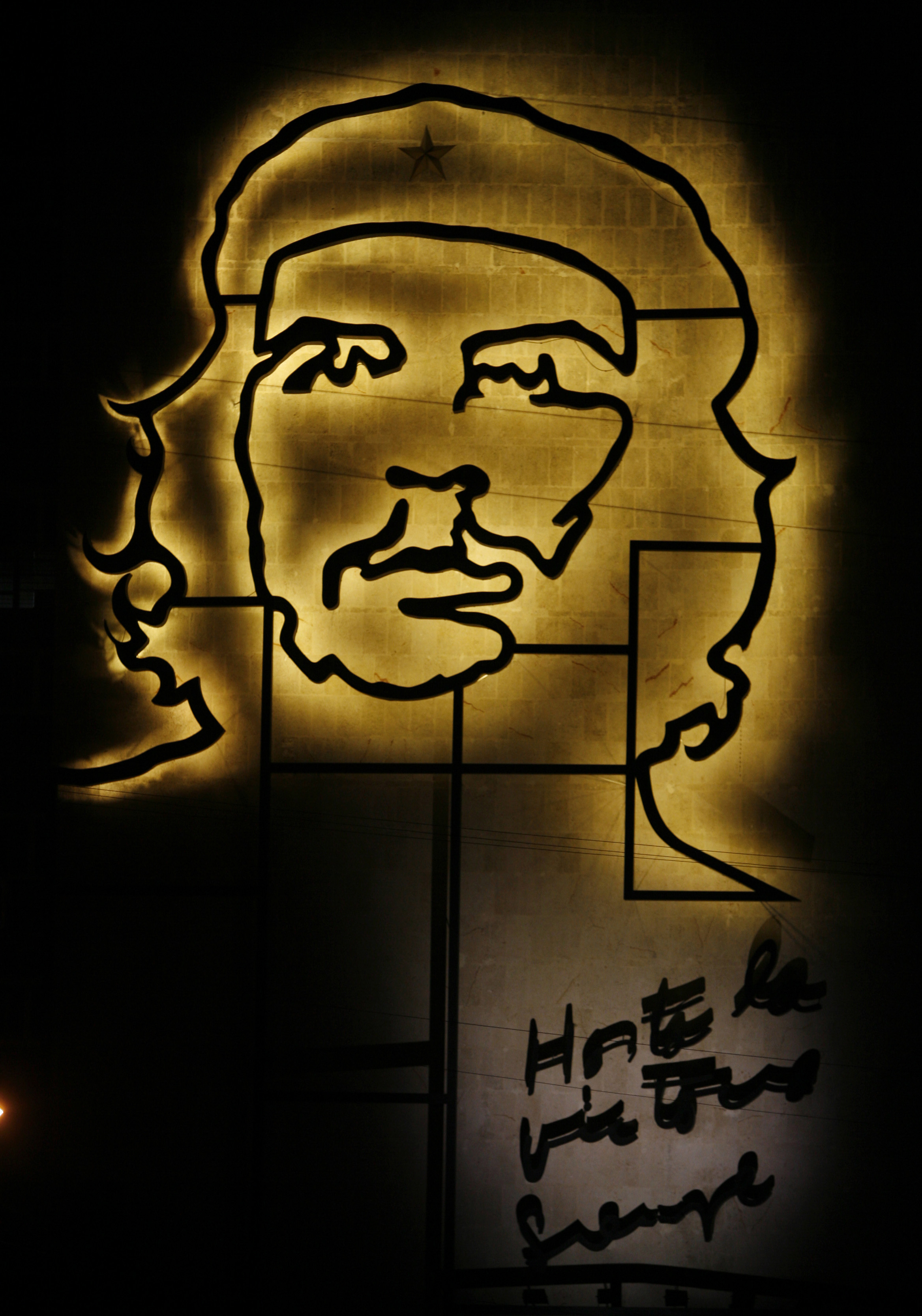
An illuminated image of Cuba’s Argentine-born revolutionary hero Ernesto “Che” Guevara hangs in the Plaza of the Revolution on Dec. 14 in Havana. The Cuban revolution triumphed on Jan. 1, 1959, after dictator Fulgencio Batista fled the country and Fidel Castro and his band of rebels descended from the island’s eastern mountains, where they waged a guerrilla war against government troops. Cuba will celebrate on Jan. 1, the 50th anniversary of the triumph of the revolution.
Havana ? In the palace of a fallen dictator, the grade-school kids in their red Communist Pioneer bandanas are getting their mandatory introduction to the glories of the revolution.
Clattering from one display case to the next, they gaze wide-eyed at an antique gun, a fighter’s bloodied shirt, the engine of a downed U.S. spy plane.
Moving on, they stare at the yacht named Granma that carried Fidel Castro back from exile to launch his guerrilla war, and the combat boots his brother-successor wore as a ponytailed 27-year-old rebel.
The palace of Fulgencio Batista, the ruler whom Castro overthrew, is now the Museum of the Revolution, and these 6- and 7-year-olds are the heirs to a communist government about to turn 50 — a system that may be softening at the edges but appears determined to crush any threat to its grip on power, lest it crumble like its one-time godfather, the Soviet Union.
Since Castro declared victory on New Year’s Day in 1959, the day after Batista fled the country, his rule has prevailed through 10 U.S. presidents, the U.S.-backed Bay of Pigs invasion, a world-shaking missile crisis, the U.S. embargo, the Soviet collapse and the onslaught of globalization. Now 82, he is ailing and out of sight but still the head of the Communist Party of Cuba. Raul Castro, his successor as president, is taking baby steps toward change and vowing to fend off any challenge to his brother’s legacy.
But today, between the extremes of enforced communist dogma and the die-hards of the Cuban diaspora still dreaming of bringing down the Castro regime, other faces of Cuba are emerging from deep underground: rappers, gays, dissident bloggers, installers of pirate satellite dishes, teenagers with tattoos and pierced belly buttons, and the women who call themselves Las Damas de Blanco, or Ladies in White.
Each Sunday, these women deliver a muted counterpart to the official cry of “Viva Fidel! Viva la revolucion!” by marching down Quinta Avenida, a busy Havana thoroughfare, each dressed in white and carrying a gladiola, silently demanding the release of their husbands from political imprisonment.
Dissidents have a new way to reach the outside world — blogging. Yoani Sanchez, 33, gets her message out by dressing like a tourist and slipping into a hotel with Web access for foreigners. She works quickly at a computer terminal and gets out before someone notices her.
In a posting this month, Sanchez noted that the government, which used to send gays to labor camps, now accepts homosexuality. So why not political opposition? she asked. “Why does the adjective ‘counterrevolutionary’ continue to be used for those who think differently?”
But few of Cuba’s 11.2 million people have access to the Internet, and anyway are preoccupied with staying afloat in a sclerotic economy where basics like toilet paper often disappear from store shelves and most people eat meat only a few times each month.
In such conditions, the slightest hint of new thinking at the top can be electrifying.
Cubans felt it after Castro stepped down and his brother Raul, now 77, took over in February, cutting a much lower-key, more pragmatic figure than the bearded, expansive Fidel. He has lifted a ban on cell phone service for ordinary Cubans and allowed them to stay in tourist hotels that hitherto were off-limits. He has let them buy DVD players, computers and coveted kitchen appliances. He has legalized some home ownership, upped payments to farmers, acknowledged that state salaries are too small to live on, and rebuked bureaucrats who don’t properly serve the public.
Now Cubans are excited by the prospect of Barack Obama becoming the U.S. president, offering to talk to the Cuban leadership and promising to immediately lift U.S. restrictions that strictly limit how often Cuban-Americans can visit their relatives and how much money they can send them.
“They say with Obama tourism should improve, that he’ll let family members come whenever they want and maybe all Americans. That would be good for business,” says Roberto Garcia, who paints pictures of old American cars, topless women and bottles of Havana Club rum.