

Countdown over, so let Games begin
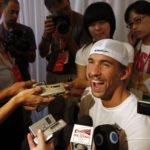
U.S. swimmer Michael Phelps talks to reporters on Thursday during a press event at the Jintai Art Museum in Beijing. The opening of the Beijing 2008 Olympics is today.
Beijing ? While few were noticing – perhaps because it is impossible to see much through the milky white cloud that passes for air here -some people were engaged in the activity that is the presumed essence of the Olympic Games.
Sports competition.
As has been the case in recent Olympics, the soccer tournament kicked off in outposts far from the host city a couple of days before the Opening Ceremony, which will be a technological and cultural extravaganza today involving what may seem like half the inhabitants of the world’s most populous country.
Once China has welcomed the world with the now traditional Opening Ceremony mixture of history lesson and chauvinistic chest-thumping, the 10,000 athletes in 27 sports other than soccer finally will get down to the business of trying to win one of the 931 medals at stake during the next 16 days.
Never has there been an Olympics with a buildup like this, and that doesn’t even include the construction that has transformed Beijing thoroughly or the two main sports facilities that already are grandiloquent architectural landmarks, the “Bird’s Nest” Olympic Stadium and the “Water Cube” aquatics venue.
The thousands of drumbeats that are to herald the start of the Opening Ceremony may sound like faint echoes compared with the antiphonal drumbeat of criticism and defense about pollution, human rights and censorship that has rattled the upcoming Olympics for most of this year.
By Saturday morning, China likely will have won the first of what most expect to be more gold medals than any of the other 204 national teams in Beijing.
By Sunday morning, U.S. swimmer Michael Phelps will have completed his first race, the 400-meter individual medley, in an effort to win an historic eight gold medals. In that race, countryman Ryan Lochte figures to provide the toughest challenge for Phelps in of any of his five events.
And then it will all seem like a whirlwind, so many events going on simultaneously it becomes impossible to keep track of everything, even for those back in the United States glued to the 1,400 hours of television and 2,000 hours of online coverage NBC is providing on a variety of media platforms.
The medal competition between the United States and China is a major plot line. Chinese athletes won their first Olympic gold medals at the 1984 Los Angeles Summer Games and have gone from 15 then to 32 at Athens in 2004, just four behind the U.S.
China has followed the old East German model of investing money and energy in sports with many medals at stake, like rowing and canoe-kayak. East Germany became an Olympic superpower to rival the Soviet Union and United States with a population of 16 million-80 times smaller than that of China.
“This is not a one-time shot opportunity for the Beijing Games,” U.S. Olympic Committee CEO Jim Scherr said of China’s sports commitment. “With the sports infrastructure, the sports facilities, the coaches who are being developed here and the young people who will be inspired by these Games, we think this will be a formidable system that we will have to contend with for a very, very long time.”
China’s nightmare is not falling short in the medal count but having one of its medalists test positive for a banned substance. That would revive the suspicions caused by the Chinese dominance of women’s swimming and distance running in the mid-1990s, results that soon were followed by a spate of doping violations.
Since that embarrassment, the Chinese have been a non-factor in either sport, as evidenced by the United States having a 62-5 medal advantage in the 2007 world championships for both sports.
It likely won’t be long before the first doping case emerges, given that nearly two dozen athletes, including U.S. swimmer Jessica Hardy, have been banned from the Olympics in the past two weeks for doping violations. Olympic Committee President Jacques Rogge figured that is a good thing.
“It means those cheats won’t be falsifying the competition,” he said.
Rogge said he expected 30-to-40 doping cases, compared with 26 in Athens four years ago, basing that estimate on a 29 percent increase in the number of tests to be carried out in China.
Or that athletes simply have found new ways to avoid detection. That would be just one of the unseen elements at the 2008 Olympics.