

Catholic school
Movement leaders paying visit to Lawrence to teach about lay Catholics' rights
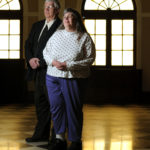
Jamie Schwartz and Susan Tabor, both members of Catholics for Renewal of Northeast Kansas, are pictured Wednesday in the ballroom of the Eldridge Hotel, 701 Mass. On April 26, Catholics for Renewal will play host to a lay synod, an event for lay Catholics to learn about canon law.
The Catholics in southern Illinois had endured enough.
The year was 2002, and the church was embroiled in a sex and abuse scandal involving priests out of Boston.
Disappointed in the church for not learning its lesson before its problems became an international firestorm, the lay Catholics from the Diocese of Belleville, a diocese that had gone through its own sex scandal in the 1990s, decided to do the only thing they could do: hold their own synod, or council, to discuss their church’s problems.
“When the Boston thing broke, people in our diocese just went crazy, because it was obvious they had learned nothing from all the pain we had gone through,” says Lena Woltering, who helped form the event. “And so we decided then to call a lay synod where we would actively come together and talk about what our church needed and work on how we could help bring the changes about.”
Little did Woltering or any of the other laity know that they would start a growing movement across the United States. Lay synods have been held from California to New York, and more groups are interested every day, Woltering says. She is participating in the area’s first lay synod – Saturday at the Eldridge Hotel, 701 Mass. – just days after Pope Benedict XVI’s first trip to the United States.
Canon law
The synod is sponsored by Catholics for Renewal of Northeast Kansas, and organizers are hoping to draw about 100 people.
The event will include Woltering, a member of the national Catholic renewal group Call to Action USA, and Sister Kate Kuenstler to talk about the basics of canon law. Kuenstler, a canon lawyer with the Diocese of Belleville, Ill., plans to let event participants in on the rights of lay Catholics.
“In canon law, that was promulgated by Pope John Paul II in 1983, there was a whole new section of canon law concerning the laity. This section really described for the first time, in law, the rights and obligations of laity in the Catholic Church,” Kuenstler says. “My role in the synods is to just inform the folks of what the church says their rights are and give them the information that most laity in the Catholic Church don’t know.”
For Catholics who want the church to talk about progressive, hot-button issues – such as female priests, the marrying of the clergy and the acceptance of gays – an important tool is using and understanding the lay rights, as laid out by canon law, say members of Catholics for Renewal.
“The thing that appeals to me about the synod is it’s a chance for more levels of dialogue in the church, and I think that … has the potential to be really, really helpful,” says Susan Tabor, a Catholics for Renewal member.
What changes would group members like to see? Tabor, a Lawrence resident who converted to Catholicism in 1994, says she’d like to see more flexibility in church’s exclusive nature.
“I would like to see a church that is more inclusive, and I think that’s probably just really the best way to say it,” Tabor says. “I think large denominations sometimes legislate the heck out of everything, and so there’s not a whole lot of room to grow or to be, oh, imaginative.”
Lack of approval
Catholics for Renewal has met some resistance from church officials. Members learned in mid-March that the Archdiocese of Kansas City in Kansas had sent a message to the editors of parish bulletins asking them not to promote the lay synod. Carroll Macke, the diocese’s director of communications and planning, says the reason for the request is that the event is not sponsored by the diocese and was not approved.
“Normally, events or gatherings of Catholics are sponsored by parishes, diocesan ministries or Catholic groups with formal affiliation with the archdiocese,” Macke says. “Since publication in the parish bulletin or other church media usually means at least implicit approval and/or support, and the archdiocese had received no prior information regarding the event or its sponsorship, it didn’t seem appropriate that we would publicize it through the parishes. This does not question the right of a group to meet to discuss issues of concern.”
Woltering and Kuenstler have heard that before.
“Oh yes, we’re sure a threat,” Woltering says. “It’s such a threat when the people gather without the priests’ or bishops’ permission. It’s just such a threat. And we’re harmless. But, again … the reaction we get from the hierarchy tells us how much power we really have. Yes, that’s common. That’s very common.”
Kuenstler says that despite the disapproval of various dioceses, she’s not teaching anything that she wasn’t taught.
“I teach the authentic interpretation of canon law,” Kuenstler says. “So, I don’t know what the bishops or the dioceses think I do, but teach exactly what I was taught by the professors at the Pontifical University in Rome.”
Jamie Schwartz, a Lawrence member of Catholics for Renewal, says he’s quite interested in what she was taught, especially as someone whose adulthood began with the Vatican II, 1962-1965, when the church laid out four constitutions and also addressed the laity in the church.
“I was a history major in college, so the history of things have always interested me, and I want to get a better feeling for what the grounding of the laity’s participation in the church has been and can be – sort of what was promised by Vatican II,” Schwartz says. “My adult life has been colored by the memory of the changes that happened in the ’60s and where the church has gone from there. And I think we’ve made great progress.”
Tabor, for one, believes the church must change for its survival.
“I think the church is at a really critical time,” Tabor says. “I think that the church’s direction in living out Vatican II sort of got interrupted by some things that happened, one of them being the sex abuse scandal and the other one being just sort of a whole lot of social changes. Either the church is going to get back on track in that direction, or it’s going to retrench. I know what I would like to see, but we have yet to see what’s going to happen.”