

Spain cleanup jolts property owners
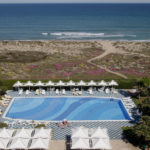
A couple enjoy the sun near the swimming pool of the Sidi Saler Hotel at the El Saler beach near Valencia, Spain. A government drive to clean up Spain's concrete-filled coastline is resulting in many property owners being told that their real estate doesn't really belong to them.
Valencia, Spain ? It’s been the dream of millions – a home by the sea in sunny Spain. People from all over Europe have invested hard-earned savings in coastal villas and apartments.
Now a government drive to clean up Spain’s concrete-filled coastline after decades of abuse may wash away many of those dreams like castles of sand.
Enforcing a much-neglected 1988 law, the Socialist government is getting tough about what constitutes coastal public domain – the strip of land stretching back from the water’s edge – and telling thousands of house and apartment owners their properties do not really belong to them.
“Out of the blue we’ve been told the house we have owned for more than 30 years is no longer ours,” said retired British electronics engineer Clifford Carter, 59, who lives with his Spanish wife in La Casbah, a beach side complex in eastern Spain.
“The house was built legally, but now they say we can only live here until we die but can’t sell the house or leave it to our children,” said Carter.
The fears of losing coastal villas come as Spain’s real estate market is turning sour, a situation tied by some to the international banking crisis and its parent, the U.S. subprime mortgage scandal. While the troubles of Spain’s overgrown coast are not directly tied to the banking crisis, both have involved shady business practices that often wind up in the lap of individual homeowners.
Along the Spanish coast, a protest group formed in January says it already represents 20,000 people. It notes that up to half a million others – apartment and villa owners and restaurant and hotel proprietors – could be affected. Most are Spaniards, but many are foreigners.
“This is the single biggest assault on private property we have seen in the recent history of Spain,” said Jose Ortega, a spokesman for the group and lawyer for many of those affected.
He says that at best, owners are being given 60-year concessions to live on the property or operate their businesses. Others, he says, are threatened with demolition.
The government says the claims are exaggerated but insists the coast has to be saved.
“We’re taking the law seriously,” said the Environment Ministry’s coastal department director, Jose Fernandez. “Previous governments didn’t think it was important, while we have made it a priority.”
The government is finishing the process of drawing the line that designates what is state-owned and cannot contain private property along Spain’s 6,200 miles of coast.
It plans to spend some $8 billion to fix up the coast. Some of the money will go to homeowners who, under the 1988 law, cannot sell to another private party but can sell to the state.
Many people are suddenly finding they’re on the wrong side of the dividing line. Ortega’s group alleges the government is drawing it selectively, targeting individuals but shying away from tourist resorts.
But it’s not just individuals. The five-star Hotel Sidi lies a stone’s throw from retired engineer Carter’s house and the shoreline. Last December its owners were told it had been built on dune land protected by the 1988 law and must go. They are being offered a 60-year operating concession, after which it falls into state hands.