

Victims of eco-disaster still struggle for redress
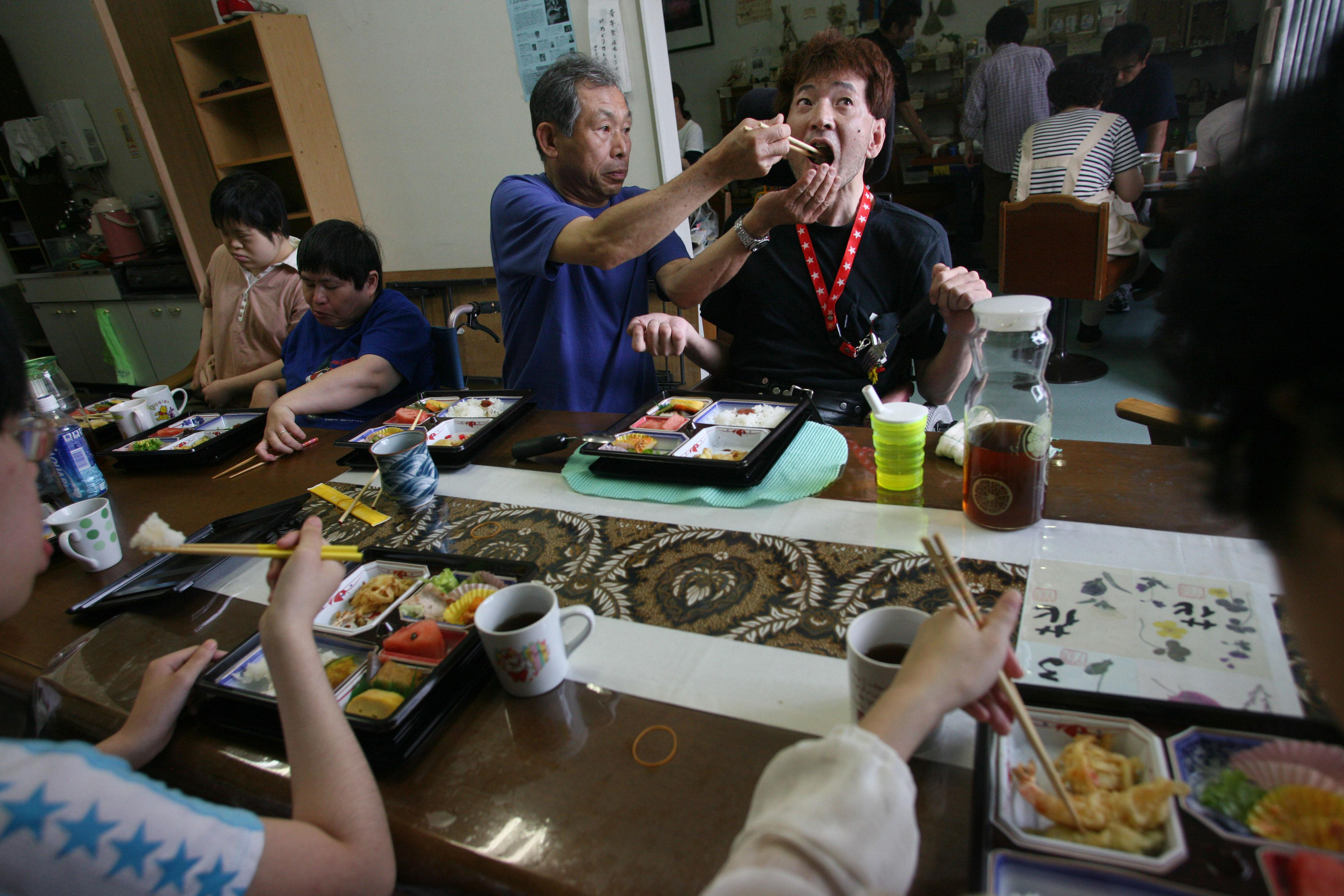
Youji Kaneko, who suffers from fetal mercury poisoning, is fed by a volunteer June 8 at the Hotto Hausu vocational center, in Minamata, Japan, that provides care for disabled people.
Shiranui Sea, Japan ? The dawn is still only a faint glow beyond distant mountains, but fisherman Akinori Mori and his wife, Itsuko, are already hard at work on their boat, reeling in nets of squid, fish and crabs.
Nothing about this placid scene reveals that Japan’s worst environmental disaster unfolded here.
Starting 50 years ago, whole neighborhoods were poisoned by mercury-contaminated fish from these waters. Thousands of people were crippled, and hundreds died agonizing deaths. Babies were born with horrifying deformities.
Today, the tragedy known as Minamata Disease is only a dim memory to the rest of the world, and few outside Japan would recognize Chisso Corp. as the company that polluted Minamata Bay and the Shiranui Sea with deadly methylmercury. But for Akinori, 62, and Itsuko, 58, and many of the people living along these craggy coasts, the disaster never ended.
The Moris’ parents – his father, both her parents – suffered the ravages of the disease: blinding headaches, crippling loss of sensation in their limbs, insomnia and dizzy spells. Both Akinori and Itsuko increasingly feel the disease in their own bones as they age, in painful hand and leg aches and loss of feeling and coordination from eating tainted fish as children.
“Now it’s starting in my hands and fingers,” said Itsuko as she picked strips of seaweed from her fishing nets in the morning sun. “They’re turning white and are all bent.”
Like the Moris, Japan has never fully recovered. Indeed, the disease played a large role in creating the Japan of today. It gave birth to the Japanese environmentalist movement, and like the Chernobyl nuclear meltdown and the Union Carbide chemical disaster in Bhopal, India, it became an international cause celebre.
It forced the country to face up to the price of the industrial miracle it built out of the wreckage of World War II, encouraged other victims of such negligence to sue for redress and forced authorities to be much more attentive to protecting the public from the mistakes of Japan Inc.
But the struggle over Minamata is far from finished. At least 2,000 victims have died. Even now, courts are forcing the government to recognize more victims, which some estimate at as many as 30,000. Many are confined to wheelchairs or bed, complaining that diagnosis and treatment are haphazard and inadequate. Lawsuits for further compensation continue. The government still refuses to conduct an epidemiological study to determine the full scope of the poisoning.
“Minamata disease has been going on for 50 years, but it still hasn’t been resolved,” said Takeko Kato, managing director of Hotto Hausu, a vocational aid center for victims in Minamata. “The country isn’t helping these people enough.”
The disaster in Minamata Bay began in silence.
In the early 1950s, growing numbers of fish were found floating dead in the bay, which feeds into the Shiranui Sea. Then crows fell dead from the sky or crashed into rocks. Cats started gyrating in a bizarre “dance” before dropping dead.
People were next. By the mid-1950s, villagers started suffering dizzy spells and troubles walking and speaking. Growing numbers fell into convulsions, wasted away and died. The name Minamata disease was coined in 1956.
In a landmark decision, the Supreme Court ruled in 2004 that the government was responsible for the spread of the disease. Since then, an additional 12,000 people have become eligible for medical assistance, though not full certification, and the government is working on a plan to expand compensation to more than 5,000 additional people demanding recognition.
The Moris have fixed their hopes on their three children, all of whom have married and show no symptoms of poisoning. They can only hope that the new generation will see the end of the curse of Minamata.
“They’re OK, I think. The poisoning was years before they were born,” said Itsuko Mori as she picked through her nets on a dock not far from her home. “They’re still young though, so you never know.”