

Prairie jewels
Expert treasures what's left of the state's indigenous landscape
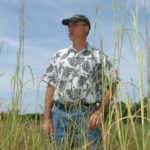
Frank Norman, of Norman Ecological Consulting, looks over one of the few parcels of remaining tallgrass prairie in the area, west of Lawrence. The
Where to see Kansas Prairie
The Nature Conservancy in Kansas has further details and touring information about the locations below; visit The Nature Conservancy, or call (785) 233-4400 or e-mail kansas@ntc.org.
- Smoky Valley Ranch: Located in Logan County, this 16,800-acre ranch is predominately a shortgrass prairie overlooking the Smoky Hill River in western Kansas.
- Konza Prairie: One of the finest examples of tallgrass prairie in the United States. It’s located about seven miles south of Manhattan.
- Flint Hills Tallgrass Prairie Preserve: This 2,188-acre tallgrass preserve is home to hundreds of plant and bird species. It’s located east of Cassoday in eastern Butler County and western Greenwood County.
- Anderson County prairies: The native tallgrass prairie in eastern Kansas provides habitat for part of the world’s largest-known population of globally threatened Mead’s milkweed.
Some people don’t appreciate the glorious rolling hills of the Kansas landscape. They take the scenery for granted – a blip on the radar from the Rockies to the Ozarks.
But for others, the area is one of Mother Nature’s greatest feasts for the eyes, rivaling the towering Tetons or the crashing force of Niagara Falls.
Yet unlike many of nature’s most stunning attractions the country’s native prairies aren’t necessarily protected. There’s no guarantee that our children’s children ever will really know what this awe-inspiring terrain looks like.
As I follow the directions to find one of these not-yet-hayed prairies, I’m weaving down dirt roads lined with rock walls, passing tree farms and cattle, savoring the quintessential Kansas scene before me. Although the heat is rising off the earth in visible vapors, when I step out of the car I’m still stunned by the panorama. A slight, welcome breeze rustles through the tall native grasses as butterflies flit by. Soon this green grassy landscape peppered with canary yellows and cornflower blues will be replaced with reds, rusts and ochre hues as autumn envelope it.
This is how native prairies looked when our pioneering ancestors arrived. It’s what a natural grass prairie evolves into through eons of fire, drought and rainfall.
Unfortunately, these native tall and short grass prairies are becoming more difficult to find. Today less than 4 percent of the original tallgrass prairie remains, concentrated mostly in the Flint Hills.
I’m meeting Frank Norman in a patch west of Lawrence. He has a master’s degree in botany from Kansas University and is president of Norman Ecological Consulting. He’s an expert on native Kansas prairies and explains the allure.
“It is good old growth. Just like the old growth of the redwoods in California, in Kansas it’s the old growth of the prairies,” he says. “As humans have evolved, this is what the environment looked like before our interaction with it. They give you the feeling of wildness, and I think most people recognize that feeling.”
Norman’s career has spanned several decades, and through that time it has been his expertise with plants – why they grow where they do, how they interact with one another and what species of wildlife benefit from certain terrain – that keeps him busy.
“I’ve worked on a number of projects where I fall in love with the area, and then they go in there and develop it. I’d say that is a tough part of the game,” Norman says. “But my mission is to look for creative solutions to please the client and protect the environment.”
As we begin moving through the waist-tall prairie, Norman mentions something about snakes. I rue the fact that I chose flip-flops for this excursion, but he says not to worry because there are no rattlers. This eases my mind … a little.
We begin with the most obvious of prairie flora, the grasses. There are four types in this prairie: big bluestem, little bluestem, switchgrass and Indian grass. It can be challenging for the untrained eye to differentiate between the species, but Norman gives some clues. For instance, switchgrass has hairs at the base of the leaf, big bluestem has “turkey foot” plumes, little bluestem has a stalk with tiny flowers coming up the stem, and Indian grass has a more solid stock with inflorescence.
Norman looks at home out here in grass up to his armpits on a hundred-degree day.
“The prairies are native, and they have been here forever. They identify Kansas for me,” he says. “The prairies tie back to a former time when, as a species, we were more connected with nature. I long for that again.”
As the tour, Norman identifies more plants:
- Lead plant: Part of the legume family and one of the few woody species in a prairie, American Indians used it for making tea and smoking out of a pipe. It is very palatable to livestock and is usually associated with bluestem grasses.
- Whorled milkweed: Produces a milky sap that butterflies love from its delicate, white, clustered blooms. It is poisonous to livestock. Some American Indians used it medicinally to treat snakebites and nose and throat ailments.
- Compass plant: This is a signature plant of the prairie. Its leaves orient themselves in a north-south arrangement, which helped early settlers find their bearings. It has yellow flowers and loped leaves to handle the wind. When wounded, the plant exudes a resinous material that American Indians used as chewing gum.
- Flowering spurge: Has delicate white flowers and is poisonous. The milky sap can cause a skin irritation.
- Pitcher sage: Has sky-blue blooms that attract pollinators and exude a mint/sage smell. Easily identified by its square stem.
- Hemp dogbane: One of the few woody plants in the prairie, with a waxy-looking leaf and clustered white blooms. Americans Indians used the stem fibers to make thread, cord and rope to create garments and fishing nets.
- Side-oats grama: A common grass in the prairie, although not as dominant as the bluestems. The name refers to the small oatlike seeds that hang down uniformly on one side of the seed stem.
- Blazing star: In the liatris family, it’s one of the most beautiful plants on the prairie, with a blue/purple wand as a bloom. American Indians ate the roots as a treat.
- Round-headed bush clover: In the legume family, this plant is a good indicator of a prairie in great condition that has not been disturbed. The plant sports tight clusters of white-with-pink blooms. American Indians boiled the leaves to make tea and used the stem as a counterirritant to treat rheumatism.
- Greyhead prairie coneflower: Beautiful flowers with yellow petals and brown centers, these plants roots were used by American Indians to treat toothaches.
I learned a lot from my time with Frank Norman – things I should know as a native Kansan who appreciates the state’s natural landscape.
Norman worries about the prairie’s future.
“The future of prairies is a little tenuous,” he says. “There is nothing protecting it in Kansas unless there are endangered species living there. It is pretty grim. The state of our prairies is dwindling, and with that goes history.”
Sources: www.lib.ksu.edu/wildflower, www.nature.org
Where to see a native prairie:
The Nature Conservancy in Kansas has further details and touring information about the locations below; visit www.nature.org/wherewework/northamerica/states/kansas/, or call (785) 233-4400 or e-mail kansas@ntc.org.
- Smoky Valley Ranch: Located in Logan County, this 16,800-acre ranch is predominately a shortgrass prairie overlooking the Smoky Hill River in western Kansas.
- Konza Prairie: One of the finest examples of tallgras prairie in the United States. It’s located about seven miles south of Manhattan.
- Flint Hills Tallgrass Prairie Preserve: This 2,188-acre tallgrass preserve is home to hundreds of plant and bird species. It’s located east of Cassoday in eastern Butler County and western Greenwood County
- Anderson County prairies: The native tallgrass prairie in eastern Kansas provides habitat for part of the world’s largest-known population of globally threatened Mead’s milkweed.