

Crimson queens
Japanese maples royalty in autumn's colorful court
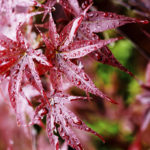
All about the Japanese Maple
Placement
¢ Anchoring a terrace or patio in a large landscape.
¢ As an edge plant to a woodland area or vast lawn.
¢ Highlighting one specimen plant in your garden (beautifully paired with azaleas, ferns, rhododendrons and hostas)
Needs
¢ Partial shade, organic-rich soil, ample amounts of moisture.
Popular varieties for our area
¢ Corallinum, upright variety with moderately divided leaves, 8-10 feet tall, cold hardy with golden leaves.
¢ Dissectum nigrum, an all-season red variety, 7-10 feet tall, hardy with a weeping habit.
¢ Bloodgood, new foliage is brilliant red deepening to dark red with maturity, holds its purplish-red color all year.
¢ Burgundy Lace, slender twigs and deeply lobed and serrated red leaves.
¢ Crimson Queen, weeping habit with dark red leaves turning to crimson in the fall, 8-10 feet tall.
Growth habit
¢ 25 feet tall upright growth to dwarfs that reach 5 feet tall
There’s nothing quite like the colors from mums, berries and trees whose leaves metamorphose from green to ochre, rust and burgundy each autumn in Lawrence. But perhaps the brightest star in this fall extravaganza is the Japanese maple. Sporting intense crimson and orange leaves, the tree scarcely can be surpassed in the season’s onslaught.
With hundreds of cultivars, many of which are quite hardy, Japanese maples placed carefully in a garden are generally unrivaled in their beauty. Fall tree-planting season is prime time to shop for Japanese maples because their true fall colors are on display.
Few trees are as well-behaved as the Japanese maple. Its roots are noninvasive, making it a superior candidate for a large urn or pot. Their fallen leaves break down quickly, making autumn clean-up a cinch. And even the tallest varieties of this gorgeous species is easily trimmed and maintained with a simple stepladder.
In its native land, the tree is called “momiji,” which is said to have two meanings: “baby’s hands” and “becomes crimson leaves.”
The species has long been admired. In fact, more than 200 varieties had been named as early as the 1800s. Today, there are more than 300 with every imaginable leaf shape, leaf color and growth habit.
The trees boast four seasons of interest. Even in the winter, their bare branches – often red, green or variegated – provide structural beauty. Some may appear snake-like, while others zigzag and still others weep like soft, pliable sculptures. The branch pattern can be strong and upright or weeping and dome-shaped. Regardless of which cultivar is in your garden, autumn is a lovely time to admire Japanese maples.
“Japanese maples are such a nice size to fit on the edge of a patio or garden path,” says Charles Barden, K-States Research and Extension forester. “And they look very different from other trees more commonly found grown in our area. The very fine-textured foliage of the cutleaf varieties and the reddish-purple leaves are not found on other woody plants.”
Many of our area’s Japanese maples suffered greatly from that wretched spring frost. We bonsaied them to the point of no return, ruining that wonderful branch habit and architectural feel and turning them into sticks poking out of the ground. But it was for the greater good as most of the trees have made a comeback and, with any luck, those that survived will again be the awe-inspiring specimens that graced our gardens in the past.
As the green chlorophyll breaks down in the leaves this autumn, the bright reds and oranges of the other pigments (carotenoids and anthocyanins) will become more visible.
Mike McLoud, nursery manager at Lawrence Landscape, says frost-damaged trees should have been pruned back.
“I wouldn’t fertilize this year because we don’t want to push any new growth,” he says. “In the spring, when you start to see buds swell, would be a good time to fertilize; then fertilize again at the end of May or first of June.
“If we have what I call an ‘Indian Summer’ in the winter, where the temperatures are in the 40s and 50s and no rain or snow has fallen, then you are going to want to water them.”
When you sow a new Japanese maple, be sure to put it in loamy, acidic soil that’s high in organic matter. This can be achieved by adding a bale of peat moss and tilling it into the bed where the tree will be planted. Adding several inches of plant-based mulch material will help conserve soil moisture.
Barden says Japanese maples are a bit fussy and demanding in their site requirements.
“Leaf scorch (outer edges of leaves turning brown in hot, dry, windy weather) is the most common problem,” he says. “Japanese maples perform best if exposure to afternoon sun and dry south winds is minimal. If it gets too little sunlight, the red foliage colors will be more muted.”
Most trees benefit from regular pruning, particularly when they are young. If the site requirements are met for these beauties, most everything else should fall into place.
Sources:www.arborday.org