

Barrage of cheating weakens sports world
Explanations vary for immoral behavior
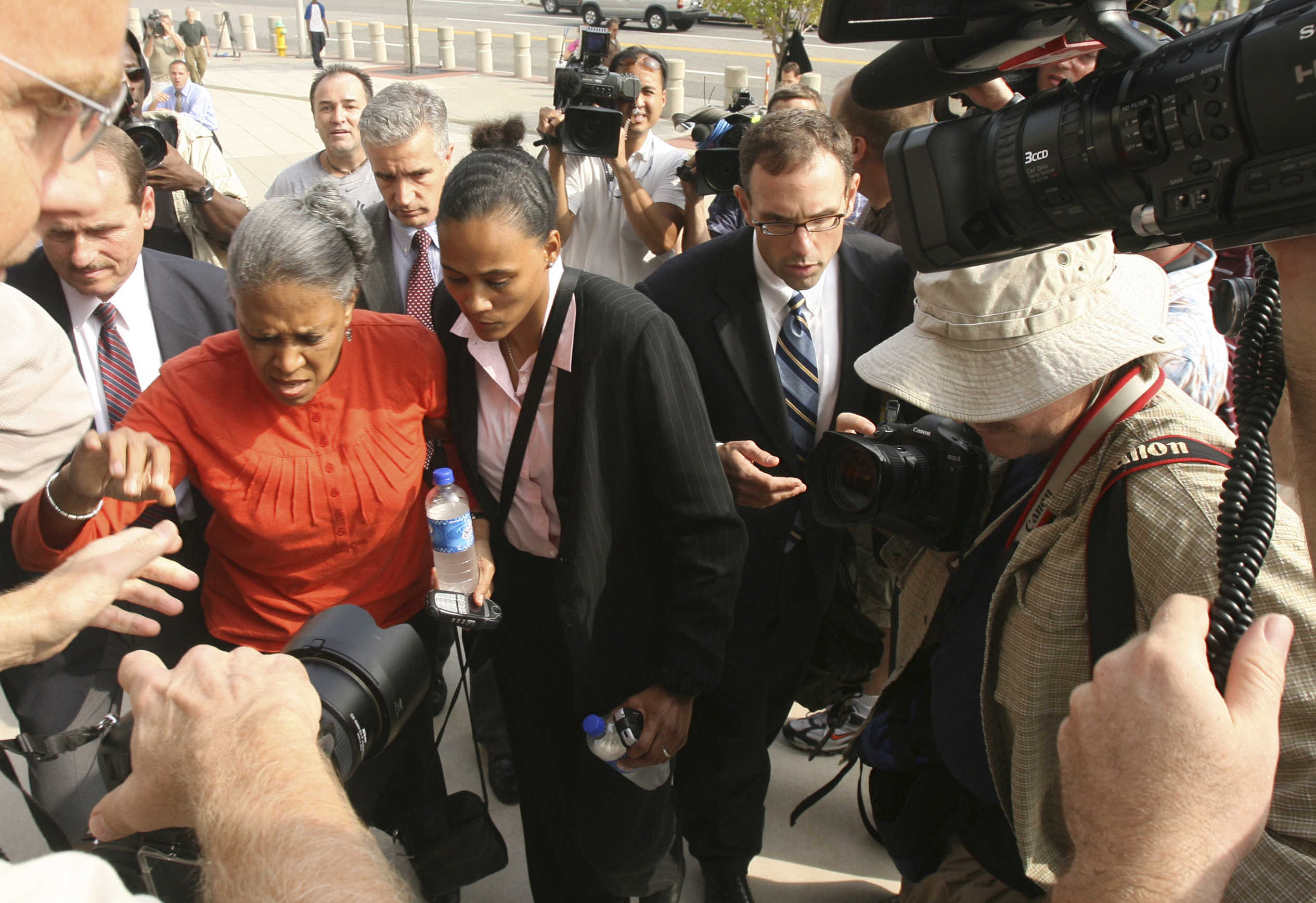
Three-time Olympic gold medalist Marion Jones, center, walks to a federal courthouse with her mother. Jones pleaded guilty to charges in connection with steroid use Friday in White Plains, N.Y., further damaging the image of professional athletes.
Bill Belichick was the Einstein of football until he was caught spying on opponents. Floyd Landis was the heartwarming Tour de France hero until tests revealed that his miracle ride was fueled by steroids. Michael Vick was the dashing quarterback of the future until he was indicted for bankrolling a dogfighting ring that sent losing animals to gruesome deaths.
NBA referee Tim Donaghy conspired with gamblers. Tennis player Nikolay Davydenko is accused of tanking a match. Formula One racing team McLaren snatched Ferrari’s manual. Barry Bonds’ record home run ball – the holy grail of the game if hit by a nobler man – is now a goofball.
The dark side of the sports circus is always just behind the curtain. There has been game fixing, rules breaking, muscle enhancing, cocaine snorting, wife-beating, gun wielding, drunken driving and head butting.
A Hall of Shame for sports would command as much square footage as its many shrines combined. Shoeless Joe Jackson would have an exhibit for his role in the 1919 Black Sox scandal. Pete Rose’s nickname “Charlie Hustle” would describe his base-running and his betting. Mike Tyson, facing more jail time after his latest visit to court, would deserve his bust as a convicted rapist, ear biter and champion who blew it all. Even the fleetest feet – those of Ben Johnson in 1988 – were made of clay.
But throughout this scandalous September and October, the barrage of bad news about unethical and criminal behavior has not stopped. The guilty are facing unprecedented levels of punishment: 25-year jail sentences, career-ending suspensions, a $100 million fine.
Has morality in sports eroded to its lowest level? Has the integrity of competition been forever compromised?
Or does cheating, like destructive hurricane seasons, come in cycles? Do liars provide a periodic but necessary backlash and deterrent? Will the asterisk hanging over so many accomplishments come down like a gavel or pop like a soap bubble? Will fans stop cheering or forgive?
“What goes on in sports is symptomatic of society and the corruption and deception infecting business, government and religion,” said Richard Pound, chairman of the World Anti-Doping Agency. “But sport is supposed to be on a different plane. If you’re involved in sport, you make a deal to engage in fair play and be an honorable example. Too often lately, that deal’s been broken.”
As the stakes, salaries and prize money grow, so do the lengths to which athletes and coaches go in pushing the risk/reward ratio. An athlete such as Landis, the first cyclist to be stripped of the Tour title for doping, might convince himself that only first place counts.
“The obsession with winning – and doing whatever it takes to win – has reshaped values,” said Jomills Braddock, a University of Miami sociology professor. “Michael Phelps only wins six Olympic gold medals instead of eight and so he’s fallen short.”
Reasons for deception
The axiom that sports builds character always has been pocked by contradictions.
“Athletes learn about discipline at the same time they learn it’s OK to cheat if you can get away with it,” he said. “It’s OK for a lineman to hold if he can disguise it. Strategies are taught on how to manipulate the rules and athletes rationalize that ‘everybody is doing it.”
Belichick got caught in a scheme to secretly film the Jets’ defensive signals on their sideline during a game. He was fined $500,000, and the New England Patriots will lose at least one draft pick.
Yet cracking the opponent’s code is a routine part of strategizing in many sports. As a scout for the Rams, Falcons and Redskins, Melvin Bratton watched opponents’ games from the press box and took notes. Instead of a camera, he used binoculars.
“I’d present my report: ‘When you see this, they usually do this, and this is the dummy signal caller and this is the real signal caller,'” said Bratton, a former UM star who is the vice president of football operations for DeBartolo Sports. “Everybody is getting signals.”
The McLaren race car team’s design chief was caught with Ferrari’s 780-page dossier, given to him by a Ferrari mechanic. McLaren was fined $100 million and expelled from the standings – which it led by 23 points over Ferrari.
Former driver Jackie Stewart told CNN that the exchange of engineering data has been “prolific” for years because employees move from one team to another. And in a similar 2002 case, Toyota was not penalized because Toyota was not a threat to Ferrari.
“It’s like, ‘I’ve got dustier underwear than yours – come with me and I’ll let you see it!'” Stewart said of the harsh penalty.
Former NASCAR driver Bobby Allison agrees with Stewart, but said racing had joined other sports in cracking down. No one wants to scare away sponsors.
“In the old days, the lines were not as well-defined,” Allison said. “The engine sizes were often illegally large. There was improper placement of left tires on the right side to make the car faster. Inspectors played favorites, and the ones who weren’t honorable got slipped a few bucks.
“As for weight distribution, one team had a water bottle normally kept behind the driver. But they’d fill it up with lead and move it. The thing must have weighed 200 pounds.”
Baseball’s eminent spitball pitcher Gaylord Perry never got caught in 20 years – at least he never got caught wet-handed. He was ejected only once, and that was on suspicion that he doctored the ball, not on evidence.
Was Perry immoral or clever? A magician or a charlatan?
“I like to think of it as taking advantage of your intelligence rather than taking advantage of the hitter,” Perry said. “The hands are quicker than the eye. That’s not cheating.”
Perry didn’t always use saliva or Vaseline, but he wanted the hitter to think he did.
“I’d shake the opposing team’s hands with my hand all sticky. Or I’d throw a forkball to their first hitter, and he’d go back to the dugout and tell his teammates the ball was loaded. I’d fiddle around on the mound, lick my fingers and touch my cap, my sleeve. Just to make them think,” Perry said. “The psychological edge was huge.”
Cheaters’ impact
In The Cheater’s Guide to Baseball, author Derek Zumsteg details how the ethics of the sport have improved since its early days, when gambling and game-fixing scandals were common. In 1919, the White Sox, horribly underpaid by owner Charles Comiskey (they were nicknamed the Black Sox because he charged them for laundry service and they refused to pay, and their uniforms got dirtier and dirtier), accepted money to lose the World Series to the underdog Cincinnati Reds.
The gambling taint spreads quickly, which is why NBA commissioner David Stern identified referee Tim Donaghy as a “rogue,” acting alone when he shared information and placed bets with gamblers.
Performance-enhancing drugs turn real competition into something phony, like professional wrestling. The penalties in sports that enforce random testing are devastating. Landis, who spent $2 million appealing his ban, is suspended for two years. American sprinter Tim Montgomery’s world record was expunged and his career ruined by a positive test. Grand jury testimony and suspicion that Bonds juiced made his chase of Hank Aaron’s record a sour slog.
But advocates of deregulation of doping ask where to draw the line on physical enhancement. HGH improves strength, but Lasik surgery improves vision. Steroids build muscle but Tommy John surgery rebuilds elbows.
Sports might have sunk to a low point in 2007, but it always rises, as boxer Sugar Ray Leonard did after he admitted to abusing his wife and being addicted to cocaine and alcohol.
Sports fans are as eager to forgive Jason Giambi as the American public is to forgive Paris Hilton. The key is admission and contrition.
“Every one of us is struggling with something, and we like to pull for people who recognize their own struggles,” said Michael Irvin, a former Miami Hurricane and Dallas Cowboy who kicked drugs and a fast-lane lifestyle and was inducted into the Pro Football Hall of Fame this summer. “There’s a much brighter light on athletes, and fans are very possessive. You’ve got to apologize deeply and sincerely.”
Pete Rose never has come completely clean about gambling, and he remains a pariah. Bonds has been evasive, defensive and defiant. Mark McGuire could have used a Congressional hearing as a confessional, but retreated instead. Belichick has said little, except that he “misinterpreted” the rules.
“In Hollywood, you fess up and go to rehab; in sports, you fess up and make a comeback,” said former pitcher Vida Blue, who overcame drug problems and now works as a community liaison for the Giants.
“Our society believes in redemption.”
Bratton sees hope for Vick, despite the heinous nature of the crime. “Nobody ever told him no, which is the trap celebrities fall into,” Bratton said. “But we gave President Clinton a second chance.”
Irvin said Vick’s televised apology was a step forward. Like Magic Johnson, now an advocate for HIV/AIDS research, Vick can earn back respect.
“He should have stood up earlier, as I learned the hard way,” Irvin said. “You’ve got to flip that thing that was on top of you. Who better than Mike someday to speak about the cruelty of dog fighting.”
In the end, fans are quick to forgive and quicker to forget, Pound said.
“Especially at the pro level, because it is entertainment,” he said. “It’s like a video game, and the besotted fan sees athletes not as real people but as actors.”