

Stacked high court approves Musharraf’s re-election
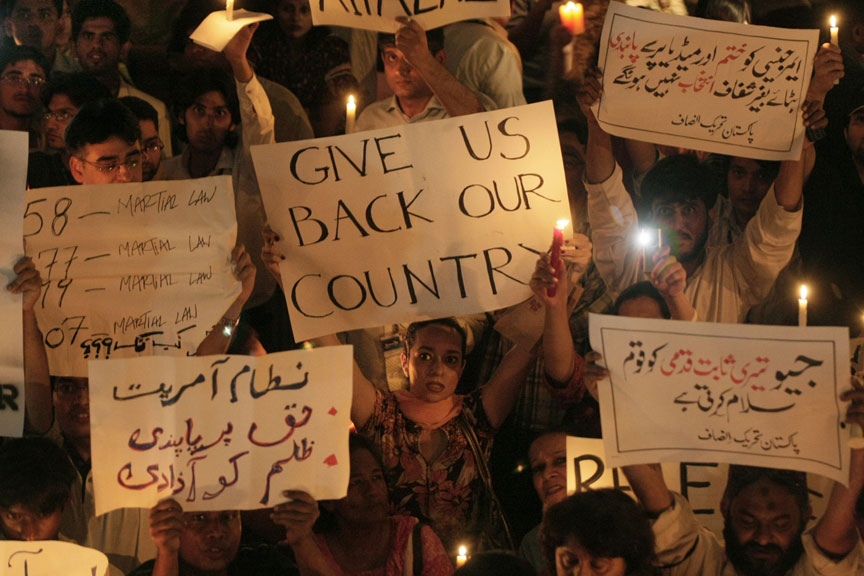
Employees of Pakistan's Geo television network and other protesters hold a candlelight rally in Karachi to protest against President Pervez Musharraf's emergency rule and the crackdown on the media. Musharraf on Monday appointed a new Supreme Court that upheld his election victory. The move should pave the way for him to step down from his military post, but there is no word on when emergency rule might be lifted.
Islamabad, Pakistan ? Judges hand-picked by Gen. Pervez Musharraf took just two hours Monday to quash legal challenges to his disputed re-election as president, paving the way for him to fulfill a promise to quit as army chief, perhaps by the end of the month.
The Supreme Court ruling also might make the U.S.-allied leader more inclined to ease a state of emergency that has bruised relations with opposition leader Benazir Bhutto and Washington.
Still, it further enraged his most bitter opponents, who denounced the purged court’s decision as illegitimate and insisted Musharraf will have to give up power to end the political turmoil that is bedeviling the country just as Islamic militants are gaining ground.
The ruling did not certify Musharraf’s election. That action by the election commission must await a ruling from the judges Thursday on a petition from a man who was blocked from being listed as a candidate on the presidential ballot put before legislators last month.
Sheikh Rashid Ahmad, a Cabinet minister close to Musharraf, said he doubted Musharraf would lift the emergency soon despite the favorable court action Monday.
But opposition parties and analysts said the ruling opened a window for the general to calm rising international and domestic pressure by easing restrictions and making it easier for politicians to campaign for Jan. 8 parliamentary elections.
“The whole country was subject to martial law only to get this decision,” said Ahsan Iqbal, leader of one of Pakistan’s two main opposition parties. “Now he has got his decision at gunpoint” and may soon make concessions, Iqbal said.
Musharraf told The Associated Press last week that he would give up the powerful post of army commander by the end of the month, assuming he was given the go-ahead by the Supreme Court to remain as president.
An official in the president’s office said the ruling Monday kept the general on track to quit the army by Nov. 30. “The president will not waste time in … removing his uniform after a final court ruling,” the official said, insisting on anonymity because he was not authorized to speak to journalists.
The Bush administration has put intense pressure on Musharraf to go further and lift emergency rule as swiftly as possible, fearing heightened discontent among moderates and secular groups will make it easier on militants.
“Of course we remain concerned,” White House press secretary Dana Perino said after Monday’s ruling, but added that there were some positive signs in Pakistan.
She said Deputy Secretary of State John Negroponte briefed President Bush on Monday about his weekend talks with Musharraf. She wouldn’t reveal the president’s reaction, but repeated Negroponte’s sentiment that “you can’t expect instant results” from such face-to-face diplomacy.