

U.S. envoy says emergency rule must be lifted before elections
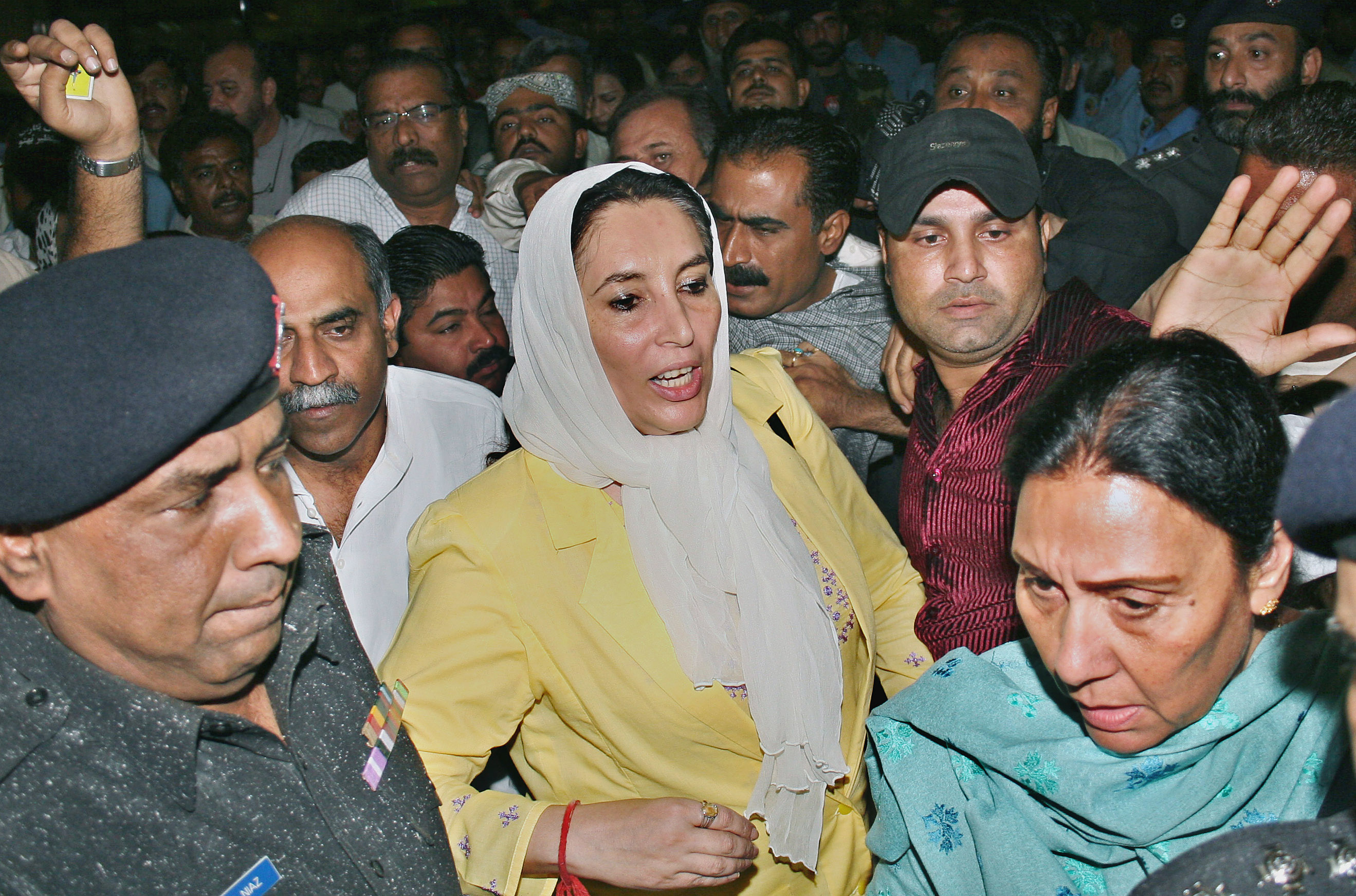
Supporters and security officials make way for Pakistani opposition leader Benazir Bhutto, center, as she arrives at Quaid-e-Azam International airport Saturday in Karachi, Pakistan.
Islamabad, Pakistan ? Washington’s No. 2 diplomat delivered a blunt message to Pakistan’s military ruler, telling him that emergency rule must be lifted and his opponents freed ahead of elections.
Deputy Secretary of State John Negroponte’s visit was seen as a last best chance to avoid political turmoil in Pakistan. He met for more than two hours Saturday with President Gen. Pervez Musharraf and Pakistan’s deputy army commander, Gen. Ashfaq Kayani.
“I urged the government to stop such actions, lift the state of emergency and release all political detainees,” Deputy Secretary of State John Negroponte told a news conference at the U.S. embassy at the end of his trip. “Emergency rule is not compatible with free, fair and credible elections.”
But Negroponte also praised Musharraf’s efforts in the war on terror, and said he was heartened by the announcement of an election date for Jan. 9.
Musharraf has insisted – publicly and in his meeting with Negroponte – that he will not lift the widely criticized emergency powers unless the security situation improves.
Thousands of opponents have been jailed, Supreme Court judges purged and independent TV stations muffled since the state of emergency came into effect Nov. 3. Just ahead of Negroponte’s visit, Musharraf freed opposition leader Benazir Bhutto and a leading human rights activist, and loosened his restrictions on several independent television news outlets.
Negroponte was measured in his comments, but expressed some impatience with Musharraf, saying he hoped to see more steps toward democracy soon. “There remain some other issues that are yet to be considered, or yet to be undertaken,” he said, without going into detail.
An official in the president’s office, who spoke on the condition of anonymity because he was not authorized to talk with the media, said Musharraf told Negroponte the emergency was needed to hold a successful vote.
Going into Saturday’s meeting, senior Bush administration officials were clear on what they wanted: an end to the emergency, a date set for legislative elections in January, the release of opposition leaders and that Musharraf step down as army chief.
Kayani is widely expected to take over the powerful role of military chief when Musharraf sheds his uniform and starts his second term as president in the coming weeks.
Shortly after arriving in Pakistan, Negroponte phoned Bhutto, the highest-level U.S. contact with the Pakistani opposition leader since the emergency rule began.
The conversation came just hours after Bhutto was released from house arrest, one of a number of face-saving measures the government took ahead of the senior American diplomat’s arrival. A prominent human rights activist was also released, and several opposition television news stations were allowed back on the air.
But there were also some ominous signs, with the broadcasts of two major independent television news stations – Geo and ARY, both of which transmit from nearby Dubai – being cut. Both stations said Dubai took action in response to pressure from Musharraf.
Neither Emirati nor Pakistani officials commented on the allegations.
Bhutto and Musharraf had been negotiating a power-sharing arrangement, but talks apparently collapsed as the general moved against the opposition following his decision to suspend the constitution.