

Pakistani police beat protesters; restoration of democracy urged
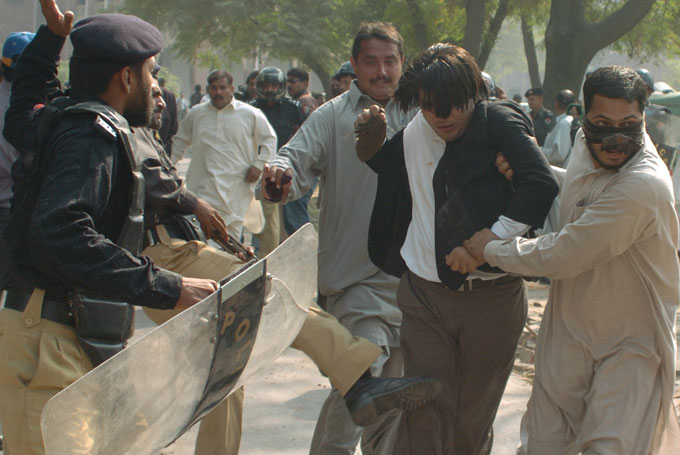
A uniformed police officer kicks a lawyer who has been arrested by plainclothes officers during a protest against Pakistan's President Pervez Musharraf in Lahore, Pakistan. Legions of police firing tear gas and swinging batons clashed with lawyers on Monday.
Islamabad, Pakistan ? Pakistani police and soldiers quashed planned protests against President Pervez Musharraf on Monday, rounding up lawyers, blocking access to the Supreme Court and beating protesters in several cities, as the country’s political crisis deepened and the international community urged Musharraf to lift emergency rule.
The worst clashes erupted in the eastern city of Lahore, where police fired tear gas and clubbed hundreds of protesting lawyers who fought back with stones and tree branches. The number of lawyers, human-rights activists and Musharraf political foes arrested or placed under house arrest rose to nearly 2,000 since the army general suspended the constitution Saturday.
With President Bush and other Western leaders urging a return to democracy as soon as possible, government officials indicated Monday that January parliamentary elections might not be delayed as originally announced. But it was unclear how long Musharraf intends to keep Pakistan under emergency rule, or what it ultimately will mean for the country’s stability and role in the U.S.-led war on terror.
Some analysts said emergency rule will exacerbate Pakistan’s problems, create more hurdles for the anti-terror war, more opposition to the military and possibly an increase in Islamic militancy, especially in the border areas where al-Qaida and Taliban supporters hold sway.
“For people who live there, it will be a choice between the militants and the military,” said retired Gen. Talat Masood, a defense and political analyst, adding that most people are opposed to emergency rule. “For even the moderates it will be a dilemma.”
Other analysts said the role of Musharraf’s fellow generals will be crucial, speculating that the country’s powerful military could decide to step in to end the crisis by asking Musharraf, who seized power in a bloodless 1999 military coup, to step down as army chief.
Musharraf could decide on his own to end emergency rule, give up his controversial second role as army chief and hold elections as planned, some analysts said. But he would have achieved one of his major goals: purging Pakistan’s newly independent judiciary, which has challenged him in recent months and could have blocked his continuing hold on power.
The international community strongly urged the government to reconsider on Monday. The U.S. said Sunday it was “reviewing” its aid to Pakistan but indicated Monday that it probably would continue sending billions of dollars to Pakistan’s military, which the Bush administration considers crucial to battling Islamic radicals.
In his first public remarks on the Pakistani crisis, Bush said in Washington that the U.S. expects Musharraf to remove his uniform, as promised, and to hold elections “as soon as possible.”
“All we can do is continue to work with the president to make it abundantly clear the position of the United States,” Bush told reporters in the Oval Office. “We made it clear to the president that we hoped he wouldn’t declare the emergency that he’s declared, and at the same time we want to continue working with him to fight these terrorists.”