

Payroll rise largest in five months
Jobless rate holds steady at 4.7 percent, exceeding expectations
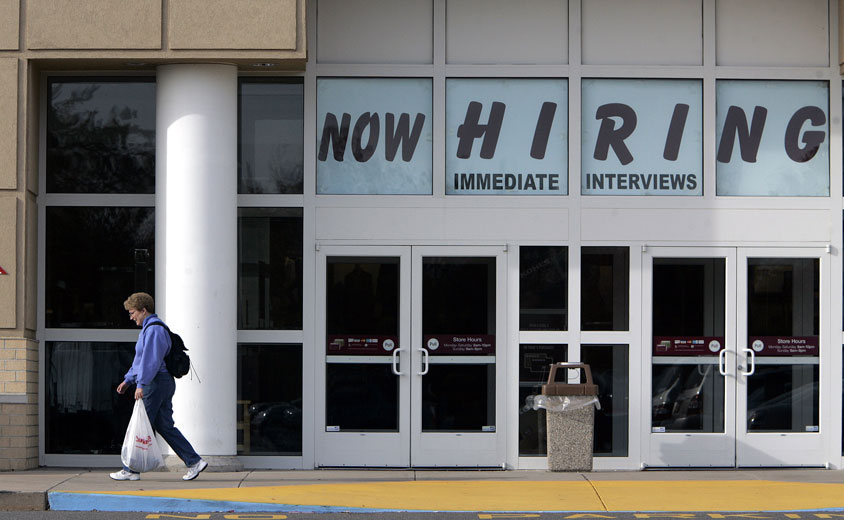
A turbulent economy isn't keeping employers from hiring nationwide. The Labor Department reported Friday that the nation's payrolls grew by a net 166,000, the most in five months. The unemployment rate didn't change at 4.7 percent, a figure considered historically low.
Washington ? A housing collapse and a mortgage meltdown haven’t stopped the nation’s job machine from chugging ahead.
Employers added twice as many new jobs to their ranks as expected in October, an encouraging sign that all the problems facing the economy haven’t short-circuited job creation.
The Labor Department reported Friday that the nation’s payrolls grew by a net 166,000, the most in five months. The unemployment rate didn’t budge at 4.7 percent, a figure considered low by historical standards.
Job gains were logged at schools, hospitals, bars and restaurants, hotels and motels, temporary-help firms, legal services, accounting and bookkeeping companies, the government and other places.
Those hiring increases more than offset jobs losses at factories, construction companies and mortgage businesses – casualties of the troubles in the housing and credit markets. Retailers and trucking companies also shed jobs.
“There is no question that employers are more cautious as they look forward. But I think many of them are not seeing it in their actual operations,” said John Challenger, president of Challenger, Gray & Christmas, a placement firm. “They need workers and they are hiring.”
The latest report on employment conditions nationwide was better than economists anticipated. They had expected payrolls in October to grow by a much smaller 80,000.
“Businesses have not clammed up on the hiring scene as some feared,” said Ken Mayland, president of ClearView Economics. “The wheels aren’t coming off the economy.”
Wage growth, meanwhile, moderated a bit last month.
Average hourly earnings rose to $17.58 in October, a 0.2 percent increase. That was down slightly from a 0.3 percent rise in September. Over the past 12 months, wages were up 3.8 percent.
Still, economists said the wage gains should be sufficient to support consumer spending and keep the economic expansion – which began in late 2001 – intact.
The state of the nation’s employment climate is a crucial factor determining whether the economy will, in fact, weather the financial storm. So far, decent job creation and wage growth have helped to offset some of the negative forces hitting some individuals from the housing slump, weaker home values and harder-to-get credit.
To be sure, problems challenging the economy are hitting some industries and workers hard. Construction employment has fallen by 124,000 since its peak in September 2006. Factories have cut more than 200,000 jobs over the year. Employment at mortgage firms has fallen by 56,000 since peaking in February.
And, the length of the job hunt grew longer.
The average time the 7.2 million unemployed people spent in their jobs searches was 17.1 weeks in October, up from 16.5 weeks in September.
The economy, which grew at a brisk 3.9 percent annual rate in the third quarter, is expected to slow to about half that pace or less in the current October-to-December quarter. The toll of the housing collapse and credit crunch are expected to catch up to consumers and chill their spending.
“The pace of economic expansion will likely slow in the near term, partly reflecting the intensification of the housing correction,” Federal Reserve policymakers said Wednesday as they decided to lower their key interest rate again.