

Military runs on rise
Air Force, Army, Marines trying to boost profile of marathons
DAYTON, OHIO ? The Air Force has enlisted former top marathoners Alberto Salazar and Dick Beardsley to pump up the crowd. The Army is enticing runners with personalized postcards bearing action photos of themselves.
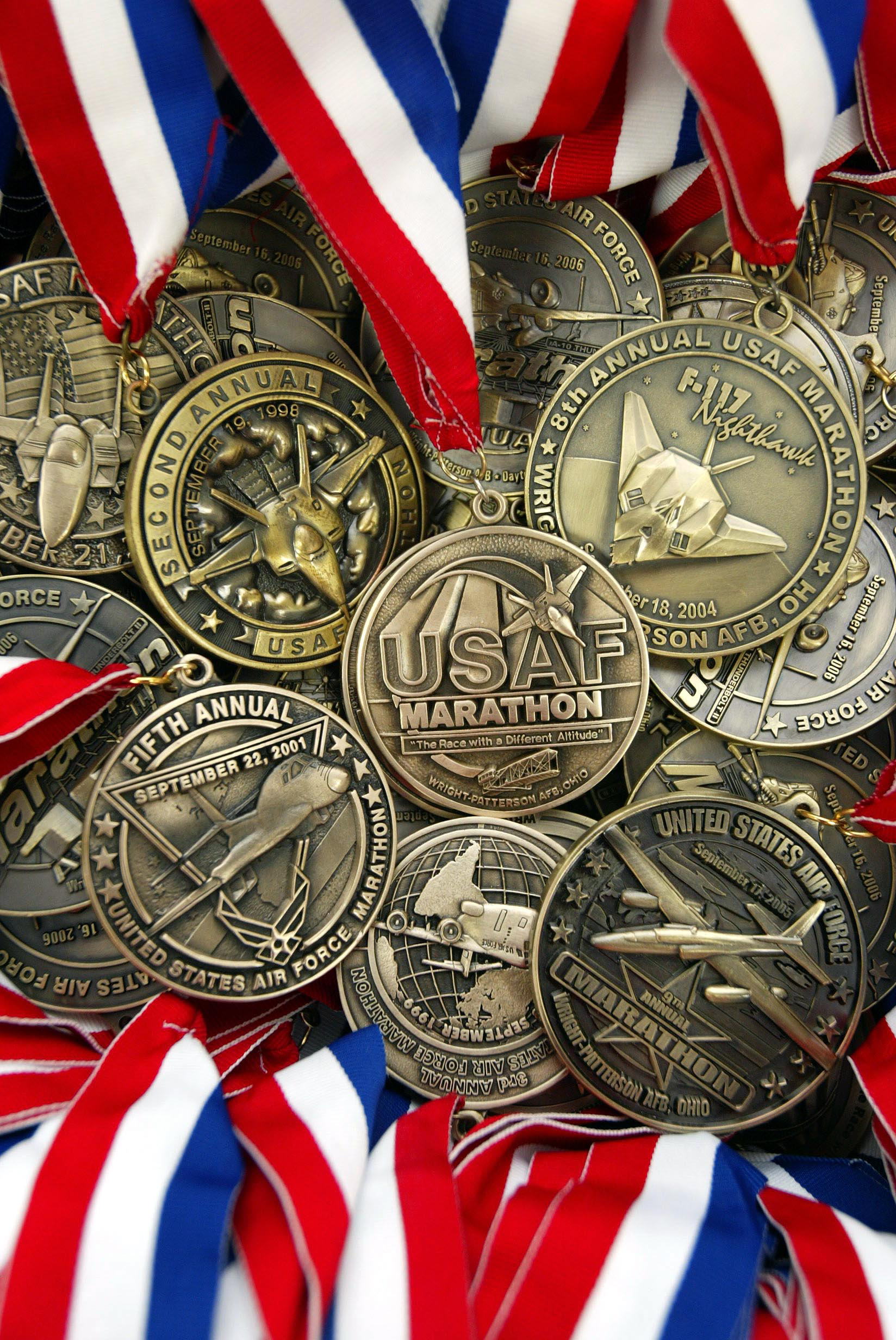
Each runner in September's U.S. Air Force Marathon at Wright Patterson Air Force Base in Fairborn, Ohio, receives a medal like the ones shown above. To increase exposure this year, runners in this year's event won't be constrained to the base and will be allowed to wend their way through the surrounding community.
The military services are trying to expand or raise the profile of their marathons and other races to generate goodwill with the public, boost recruiting and portray soldiers as disciplined, well-conditioned people who are more than just fighters.
“It’s giving people the opportunity to see the military in a different light,” said George Banker, operations manager for the Army Ten-Miler in Washington, D.C.
To increase exposure this year, runners in September’s United States Air Force Marathon will be freed of the confines of Wright-Patterson Air Force Base near Dayton and allowed to wend their way through the surrounding community.
Organizers have increased advertising in running magazines, expanded the race’s sports and fitness expo with more vendors selling equipment and clothing, and invited Salazar and Beardsley to speak before the race. In 1982, Salazar beat Beardsley by two seconds in one of the most exciting finishes at the Boston Marathon.
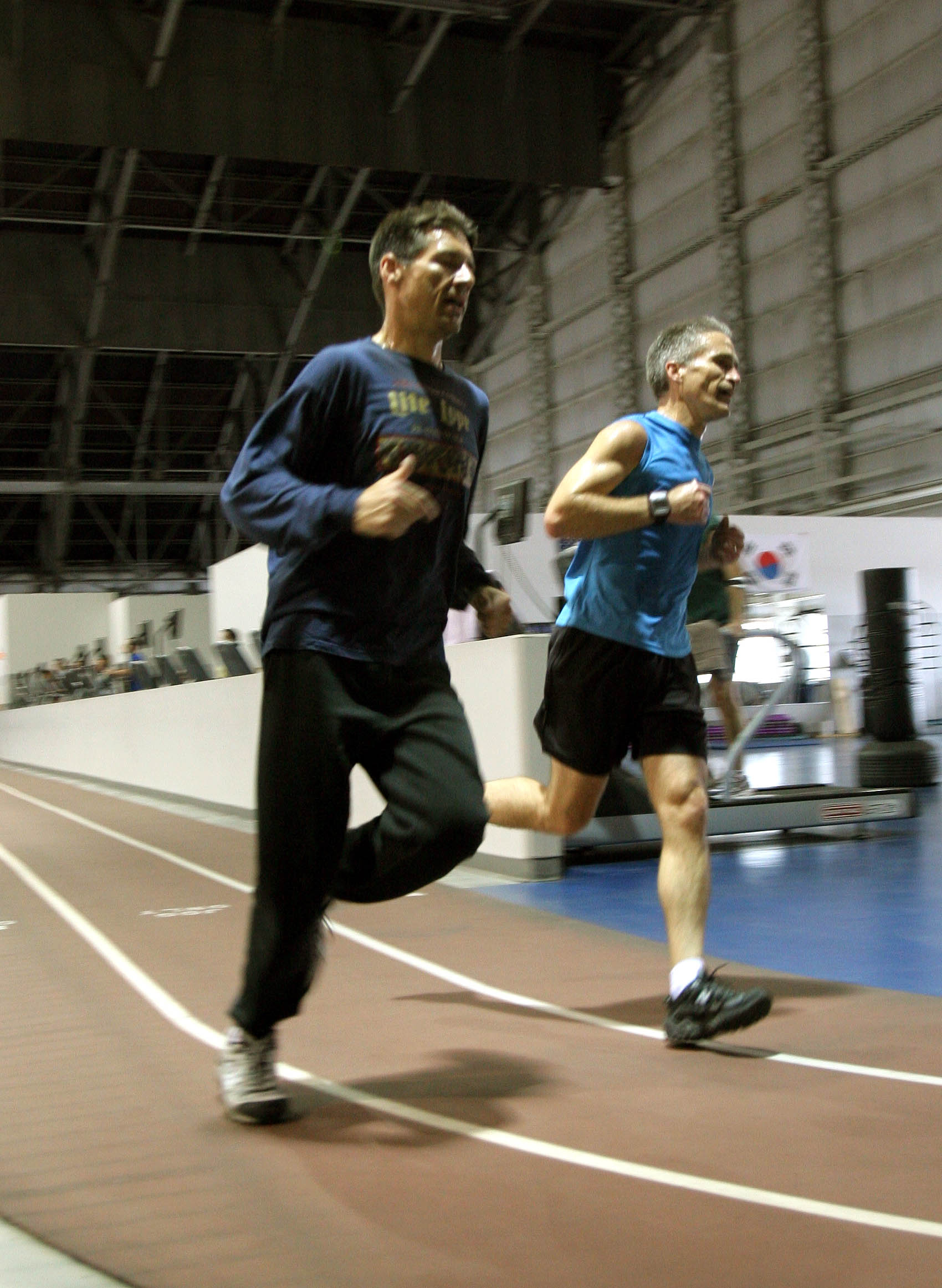
Maj. John Erickson, 42, left, and Terry Chown, 46, train for the upcoming Air Force Marathon. Both men are part of a four-man team that will run the relay portion of the marathon in September. The military is trying to expand or raise the profile of its marathons and other races to generate goodwill with the public.
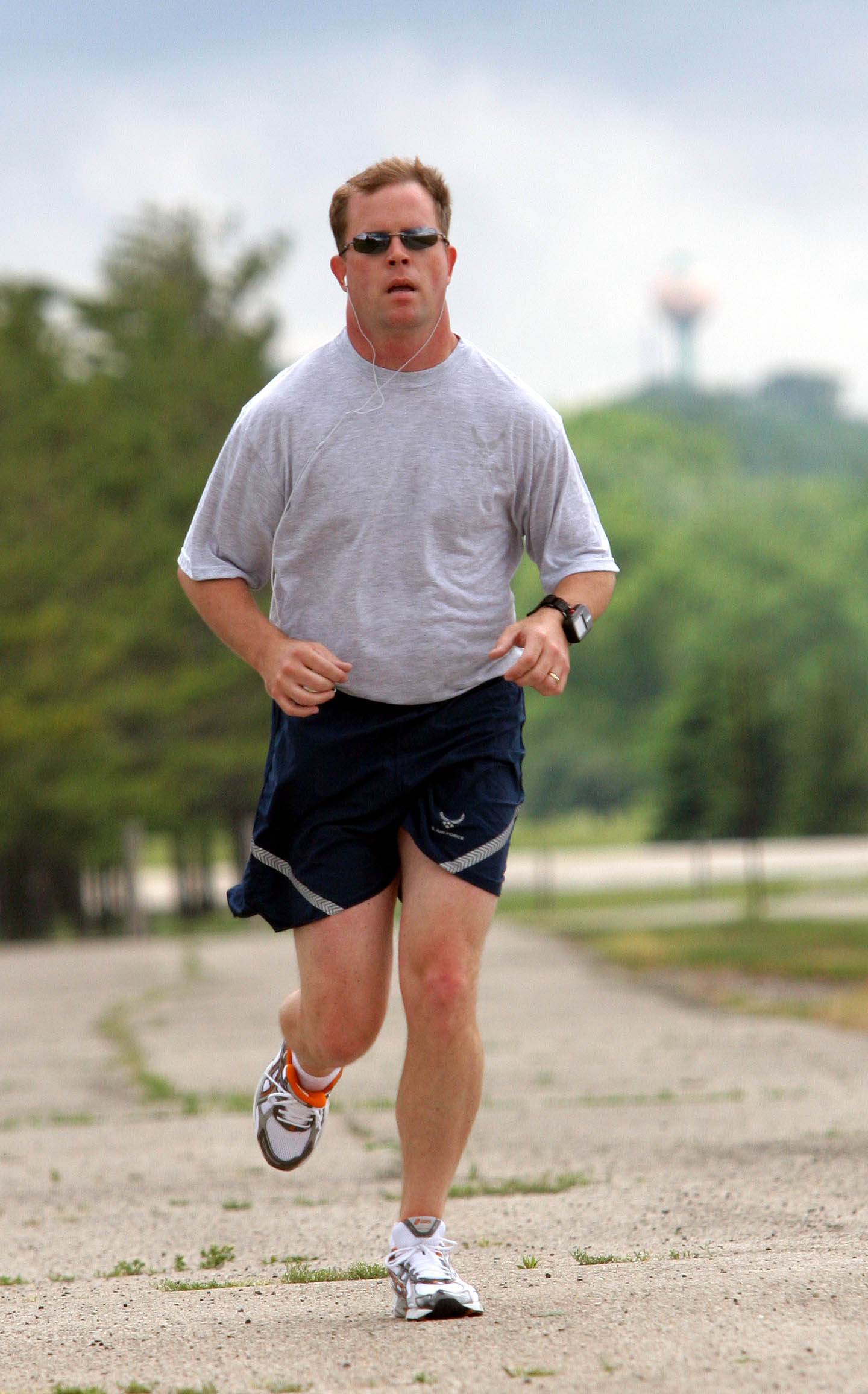
Staff Sgt. Jason Plosch runs on the trail at Wright Patterson Air Force Base in Fairborn, Ohio. The 33-year-old native of Clinton, Iowa, will be running his second Air Force Marathon this fall.
Officials with the Army Ten-Miler hope the postcards will lure back the 25,000 previous runners and get them to spread the word about the race among fellow runners. Monthly e-mails featuring training tips and recipes for runners also are being sent.
Organizers with the Washington-area Marine Corps Marathon have doubled to 12 the number of other races they attend during the year to meet with runners.
All three races had a record number of finishers last year. About 4,700 runners completed the Air Force marathon, 23 percent more than in 2005. A total of 15,645 runners finished the Army race, and 20,908 completed the Marine marathon.
The race budgets have grown as well. The Marines’ marathon budget has grown to $5 million, up from $3 million in 2004; the Air Force budget is $475,000, up from $184,000 in 2003.
Usually only about 20 percent to 25 percent of the runners in military marathons are affiliated with the military. But many runners have indirect ties to the military, and the races are associated with the armed forces in the eyes of the public.
Loren Thompson, a defense analyst with the Lexington Institute, said public image is essential in helping the military recruit and gain funding.
“The military is looking for any images that can counter the negative reporting coming out of Iraq and remind the public of the positive side of military life,” Thompson said. “You don’t win a marathon unless you’re disciplined and you’re organized and you’re goal directed. Those are all qualities that appeal to almost anybody and make the military look good.”
There is evidence the stepped-up publicity is paying off. The number of runners registered for this year’s Army Ten-Miler has increased from 24,000 to 26,000. And many people who have run in the Marine marathon say they now also want to run in the Air Force event, said Molly Louden, director of the Air Force race.
The races also have welcomed an increasing number of veterans who were wounded in Iraq or Afghanistan and compete in wheelchairs, on prosthetic legs or on three-wheel handcycles.
Army Staff Sgt. Daniel Metzdorf, from Altamont Springs, Fla., lost a leg in an attack in Iraq in 2004. He underwent nearly 30 operations and more than seven months of rehab, and now is on active duty and training to be part of the Army’s Golden Knights parachute team.
Metzdorf finished the New York City Marathon and an Army Ten-Miler at Fort Bragg using a handcycle. He wants to do more.
“I saw the example it set for the newer, injured soldiers,” he said. “For some soldiers, it forces them back to living life.”
Relatives of soldiers killed in Iraq and Afghanistan also run in the military races to pay tribute to their loved ones and as an outlet for their grief.
Rose Camero-Gill of Round Rock, Texas, began running in the Marine marathon after her 24-year-old son, Marine Cpl. Steven Gill, died in Iraq in 2005. While she was training for the race that year, Camero-Gill broke her foot. So she ran in a cast, permanently injuring her foot.
“I don’t ever want to let anybody forget my son. And that’s why I do it,” she said.
Major military runs
Here is a breakdown of the major U.S. military marathons and races:¢ MARINE CORPS MARATHON: Established in 1976 as the Marine Corps Reserve Marathon, it became the Marine Corps Marathon in 1978. Starts and finishes in Arlington, Va. Last year, a record 20,908 runners finished the race. Notable runners have included then-Vice President Al Gore and talk show host Oprah Winfrey.¢ UNITED STATES AIR FORCE MARATHON: Began in 1997. Starts and finishes at Wright-Patterson Air Force Base near Dayton, Ohio. About 4,700 runners finished the race last year, a record for the race. There has been a marriage proposal at the finish line, and one year a runner ran the marathon dressed as a Star Wars stormtrooper.¢ ARMY TEN-MILER: Inaugural race in 1985. Begins and ends at the Pentagon. Last year, a record 15,645 runners finished the race.