

Odds stacked against Vegas landing pro sports team
Gambling not the only mark against Sin City
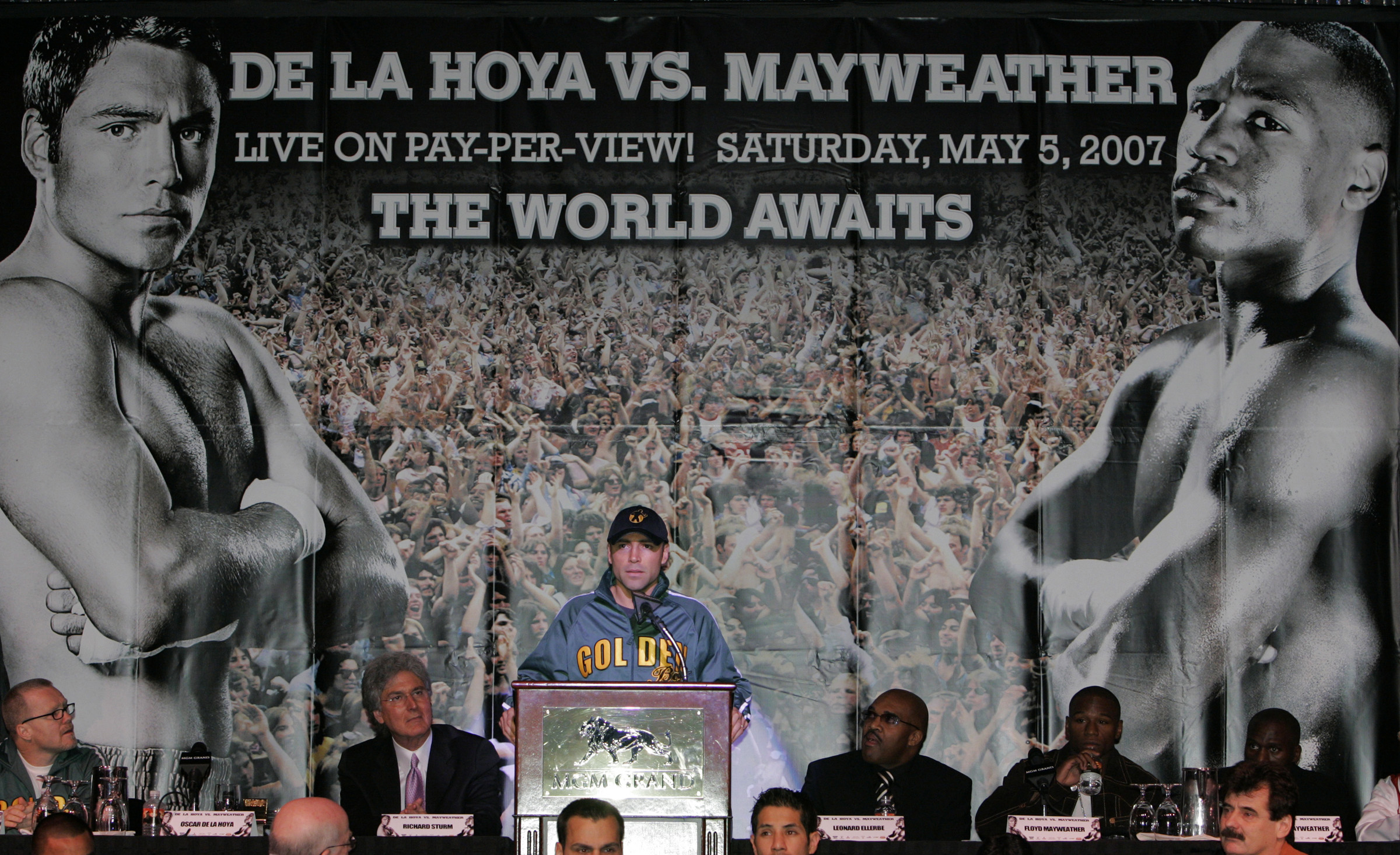
Boxer Oscar De La Hoya, center, speaks during a news conference earlier this week in Las Vegas. Sin City has long been a popular site for boxing matches, such as De La Hoya's upcoming bout against Floyd Mayweather on Saturday, but has been unable to attract a major-league sports franchise to the relatively small television market.
Las Vegas ? This desert entertainment mecca claims a metropolitan area of 1.8 million permanent residents, 133,000 hotel rooms and 135,000 visitors daily, and on NBA All-Star weekend it lavishly reaffirmed that it can host a big-league party.
But can it permanently host a big-league franchise?
Mayor Oscar Goodman, the martini-savoring, showgirl-squiring, easily re-elected mayor who has added savior of downtown Las Vegas to his credentials as a former mob lawyer, is betting it can.
Goodman has submitted a written proposal to the NBA – his town’s pitch for a franchise. He also made inquiries when the NHL’s Pittsburgh Penguins were thought to be amenable to relocation last year. Vegas interests also bid for the Montreal Expos before Major League Baseball moved them to Washington, D.C., and renamed them the Nationals for the 2005 season.
The NBA’s board of governors viewed Goodman’s letter at an April 20 meeting.
“Consider this the opening of parries back and forth,” said Brian McIntyre, the league’s senior vice president of communications. “We now know they want us to bring a team to Las Vegas.”
One potential sticking point is Commissioner David Stern’s insistence that betting on NBA games be disallowed in Vegas sports books. Goodman doesn’t see that happening.
“I believe it would be hypocritical for us to even suggest it,” he said. “We have to be true enough to ourselves.”
In his letter to the NBA board, Goodman cited Las Vegas’ system of regulating gambling as a model of “integrity and operational excellence” that should eliminate any “concern of corruption or interference by unsavory individuals.”
Ironically, the presence of hundreds of “unsavory individuals” engaging in gunplay and other acts of violence was a serious blemish on what the NBA otherwise regarded as a successful All-Star weekend. Las Vegas police reported more than 300 arrests, and since-
suspended Tennessee Titans defensive back Pacman Jones has been questioned about a shooting at a strip club that left two men critically injured.
Stern’s opposition to gambling is well-documented; he got Canada’s sports lotteries to exclude NBA games before awarding expansion franchises to Toronto and Vancouver.
But for Las Vegas, gambling appears to be a secondary issue to getting a suitable arena. The All-Star game was played at UNLV’s Thomas & Mack Center, which McIntyre described as “insufficient.”
“We made it clear that no NBA team would come into it as its home arena,” he said.
Stern and Goodman have indicated flexibility on the gambling issue, Stern because “enough owners have said they have no problem with it,” McIntyre said.
Many local observers believe the gambling question is a red herring. The real issue, they say, is whether Las Vegas, with its other attractions and distractions and a relatively small TV market, can support a major-league team.
Of the betting issue, taxi driver Bill Bachunas said, “You can get a point spread on games in any city in the country, so why single out gambling in Las Vegas?”
Bachunas came to Nevada from Chicago 16 years ago. “I think there would be support for a team, enough to build a venue,” he said. “But I don’t think chances of us getting a pro team are very good.”
The Sacramento Kings, embroiled in an arena dispute in the California capital, are believed to be Las Vegas’ best bet. The Maloof family owns the Kings as well as the lavish Palms Hotel-Casino and other Las Vegas properties, and Kings owners Joe and Gavin Maloof spearheaded Las Vegas’ effort to land the All-Star game.
Goodman views landing an NBA team as a top priority of his final term, but he doesn’t have everyone in town convinced it’s a good fit. They note that while Las Vegas’ population is sufficient, it lags as a TV market. Further, they say, an owner would have to spend more to market a sports team here than in most cities, where there are fewer competing entertainment options.
“Las Vegas is a different model from most American cities,” said Alan Feldman, senior vice president of public affairs for MGM Mirage. “The small TV market will look more like Portland or Indianapolis, but the entertainment competition is more like Chicago or New York.”
Feldman also raised the universal issue of who foots the bill for an NBA-caliber facility.
“It would be terrific to have a professional sports team here, but no public money should be involved in making it happen,” he said. “It should be financed by the tenants, not by taxpayers’ dollars.”
Owner of 10 Las Vegas hotel-casinos, including the MGM Grand, Bellagio, Mandalay Bay and Mirage, MGM Mirage is Nevada’s largest landowner, taxpayer and employer, with 60,000 employees.
Feldman insisted the prospect of a sports team competing for entertainment dollars is no problem. “This is an economy that grows and thrives with competition,” he said. “But don’t look to public funding for money to build a facility that will compete with us.”
Don Logan, president and general manager of Las Vegas’ minor-league baseball team, the 51s, views Goodman’s quest as a pipe dream.
“What the mayor doesn’t get is that just because he wants it doesn’t mean it will make sense for a sports business to come here,” he said.
Noting that the city came up short in its bid to land the Expos, Logan said, “A lot of things in Las Vegas mitigate against it.”
He cited a few:
“Tourists aren’t here for ballgames.
“For a lot of our residents, this is a 24-hour, three-shift town. So one-third of the population is working, one-third is off and one-third is sleeping at any given time.
“It’s hard to get people into 110-degree heat to watch a professional baseball team.”
The 51s are named for Area 51, an infamous Air Force flight test center in remote Nevada whose secretive research into enemy aircraft and weapons has long spawned UFO conspiracy chatter, leading to government efforts to deny access to it or that it even exists.
Logan sometimes feels his Pacific Coast League team, Triple-A affiliate of the Los Angeles Dodgers, is similarly off the map.
“We have a pro sports team here, we just don’t have a major-league team,” he said before a recent 51s game.
Like two other pro teams in town, the Arena Football League’s Gladiators and the ECHL’s Wranglers, the 51s struggle to attract fans, averaging 5,000 per home game at 10,000-seat Cashman Field.
Las Vegas would rank among the smallest TV markets in pro sports and is isolated from other populated areas, Logan said. “Also, it would be hard to imagine a sizable contingent of fans from another NBA city planning a visit to Vegas around a game. You might do better with baseball, where a visiting team would be here for a three- or four-game series.”
If there is one thing this town loves, it’s wagering on sports. And even if the odds are against Mayor Goodman’s bet on winning over a major-league team, so far there is nothing to lose by trying.