

Suicide bomber strikes college, killing at least 40
Baghdad, Iraq ? A suicide bomber triggered a ball bearing-packed charge Sunday, killing at least 41 people at a mostly Shiite college whose main gate was left littered with blood-soaked student notebooks and papers amid the bodies.
Witnesses said a woman carried out the attack at the business school annex to Mustansiriyah University, but Interior Ministry officials said it was investigating the reports. The school’s main campus was hit by a string of bombings last month that killed 70 people.
The attack came as a powerful Shiite militia leader bitterly complained that “car bombs continue to explode” despite an ongoing security crackdown in Baghdad and suggested he was rethinking his cooperation.
The statement issued in the name of the radical cleric Muqtada al-Sadr put increased strains on the U.S.-Iraqi security sweeps – aimed at restoring order in the capital. The cleric said any crackdown that includes American soldiers was doomed to failure.
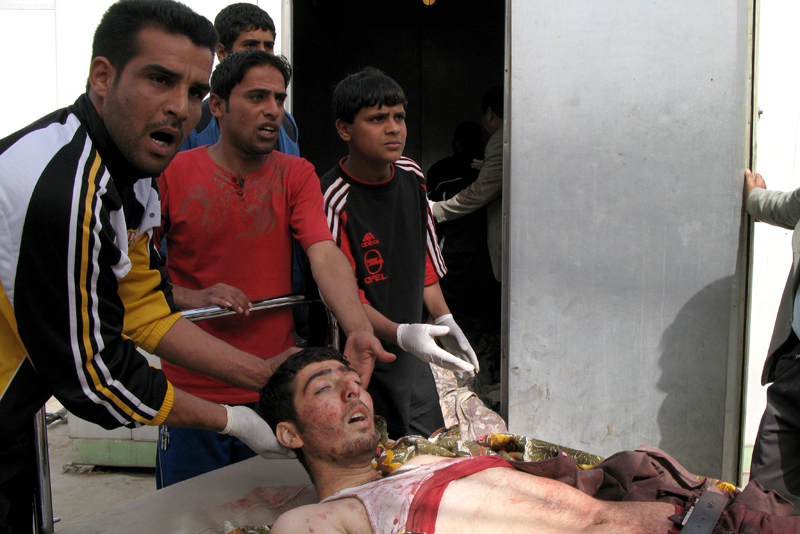
A man injured in a suicide bomber attack is rushed into the Imam Ali hospital in Baghdad's Shiite enclave of Sadr City, Iraq, Sunday. A suicide bomber struck Sunday outside a college campus in Baghdad, killing at least 41 people.
Al-Sadr’s Mahdi Army militia pulled its fighters off the streets under intense government pressure to let the 12-day-old security plan proceed. But a relentless wave of Sunni attacks – six alone in the Baghdad area Sunday – has apparently tested al-Sadr’s patience as well as many ordinary Shiites.
A return to the streets by the Mahdi Army forces could effectively block the security effort and raise the chances of Baghdad falling into sectarian street battles – the apparent aim of Sunni extremists seeking any way to destroy the U.S.-backed government.
“Here we are, watching car bombs continue to explode to harvest thousands of innocent lives from our beloved people in the middle of a security plan controlled by an occupier,” said a statement read by an al-Sadr aide in Baghdad.
Al-Sadr – who has not appeared in public in more than a month – is no friend of Washington and his forces fought fierce battles with U.S. troops in 2004. But he has largely cooperated in the Iraqi political process to avoid strains with Prime Minister Nouri al-Maliki and the Shiite leadership.
The statement, however, was highly critical of the U.S. role in the security plan and urged leaders to “make your own Iraqi (security) plans.” He said “no security plan will work” with direct U.S. involvement.
The statement – read to hundreds of cheering supporters – was the first public word from the al-Sadr since U.S. assertions earlier this month that he fled to neighboring Iran to avoid arrest.
Al-Sadr’s aides and other loyalists insist he never left Iraq.