

Soccer hooligans test tolerance limits
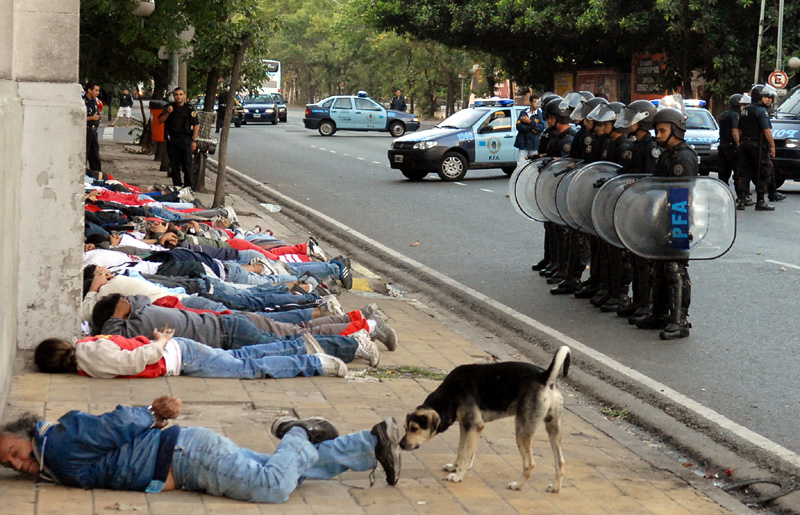
Police officers guard soccer fans of a lower-division team after clashing with police last Sunday in Buenos Aires. Concerns about rising soccer violence in Argentina have become a major public worry for the government, soccer regulators and fans alike, who complain about a lack of safety precautions at stadiums in a country obsessed with the sport.
Buenos Aires, Argentina ? Even by the standards of Argentina, where people like to joke that soccer is less a pastime than a pathology, a recent surge of fan violence has been exceptional.
In the past two weeks, local stadiums have erupted in mass fights – some of them all-out brawls injuring dozens of fans – an average of every other day.
Politicians are vowing reforms, and most fans and league officials are blaming the violence on organized hooligan groups known as “barrabravas,” which are increasingly labeled as out-of-control mafias eroding the integrity of the sport.
On Tuesday afternoon, as police fired rubber bullets into a crowd to separate warring fans in a Buenos Aires suburb, a congressional committee was grilling the president of River Plate, one of South America’s most famous soccer clubs, about the violence that has resulted in the closure of its 65,000-seat stadium for five games.
Among the incidents in question was a gun-and-knife fight among members of a River Plate hooligan gang on Feb. 11 that sent picnicking families fleeing the stadium.
River Plate officials eventually expelled six fans known to be affiliated with the barrabrava.
But the incident sparked a public backlash against such gangs, many of which are rumored to receive money, tickets and jobs from the clubs. Club officials customarily deny links to the barrabravas. Many hooligan leaders, even those widely known to belong to specific gangs, often treat their affiliations as badly kept secrets: They shun media exposure and publicly deny connections to specific acts of violence as well as links to the clubs. But almost everyone else connected to the sport – from security officials down to the most casual of fans – simply assumes that the hooligan gangs and the clubs they cheer for are closely connected.
“The barrabravas are a cancer,” said Hernan Fernandez, 30, a River Plate fan standing outside the stadium one evening last week to protest its closure. “They have been a problem for a long time, but now they are stronger than ever, and the problems are getting worse.”
According to local security officials, the gangs – which began in Argentina in the 1950s – have begun exporting their methods. Javier Alberto Castrilli, an official with Argentina’s Interior Ministry who is in charge of soccer security, said the barrabravas’ influence has spread in the past five years across South America and into Mexico.